Google Fi and T-Mobile operate on the same network, but offer different kinds of benefits for potential customers. T-Mobile is one of the "Big Three" major carriers, boasting the largest 5G network in the country and premium, perk-heavy unlimited plans.
Google Fi is a mobile virtual network operator (MVNO) that runs on T-Mobile’s network, offering the same coverage at a lower price point, and with a special focus on flexibility and international travel.
After completing extensive testing of T-Mobile and Google Fi, our WhistleOut experts named the most important factors that help users choose which carrier is best for them.
- T-Mobile is best for power users (heavy data use) and families who want an "everything but the kitchen sink" plan included with their service, such as streaming subscriptions and massive hotspot allowances.
- Google Fi is the better choice if you’re a frequent international traveler, single-line user, or someone who wants a simpler, no-contract experience without sacrificing data speeds.
Read on as we cover the differences between T-Mobile and Google Fi to help you make the best decision for your next carrier.
Get to the point: Google Fi vs. T-Mobile overview
If you want to know what it’s like to be a customer of one of these carriers, check out our hands-on reviews of Google Fi and T-Mobile. Our mobile experts have years of experience using these carriers and know the best plan options available. That said, here are the quick answers if you want to make a decision right now:
| Google Fi | T-Mobile | |
|---|---|---|
| Plan prices | $20–$65/month | $60–$100/month |
| Mobile hotspot data | From pay-per-GB up to 50GB limits |
From unlimited 3G speeds to 250GB high-speed |
| Top 5G network speed | 400Mbps | 174.86Mbps |
| Family plans available | Yes | Yes |
| WhistleOut Rating | ||
| Shop plans | Shop plans |
The bottom line
Overall, Google Fi is the cheaper option, ranging from $20/month for its flexible plan up to $65/month for the top-tier unlimited plan. T-Mobile’s plans are pricier—topping out at $100/month—but include premium plan perks like Netflix, Apple TV+, and satellite coverage. Both carriers also offer substantial hotspot data, with their top plans featuring large hotspot allotments. Plus, no matter which one you pick, you can rely on having access to T-Mobile’s excellent 5G network coverage.
Google Fi is the best choice for budget-conscious customers and international travelers. Its lower price ceiling and included international data on premium plans make it hard to beat if you leave the country often. T-Mobile is the go-to for power users and families who can take advantage of multi-line discounts to score massive unlimited data allotments of premium, high-speed data.
T-Mobile vs. Google Fi: How they compare
- Shared network: Google Fi and T-Mobile operate on the same network, utilizing T-Mobile's massive 5G footprint and 4G LTE backbone.
- Coverage experience: Users on both carriers can expect fast, robust speeds in urban and metropolitan areas, but both tend to struggle with reliability and signal strength in rural locations.
- Family plans: Both carriers have options for family plans and multi-line discounts.
T-Mobile vs. Google Fi: Key differences
- Pricing: Google Fi’s plans are generally cheaper, topping out at $65/month, while T-Mobile’s most expensive plan is $100/month.
- Perks and extras: T-Mobile’s top plans offer tons of perks, including streaming services like Netflix, Hulu, and Apple TV+, early device upgrades, and in-flight Wi-Fi. Google Fi offers a narrow suite of Google-specific perks, like unlimited international data, Google One cloud storage, and YouTube Premium.
- Plan flexibility: Google Fi offers a unique Flexible Plan where customers pay for each gigabyte of data used. T-Mobile does not offer limited or flexible postpaid plans.
- Family Plan Customization: Google Fi allows families to mix and match different types of plans for different lines on the same account. T-Mobile requires all lines on a family account to use the same plan type, which can force some family members to pay for more data than they need.
Reviews and ratings: How we scored Google Fi and T-Mobile
At WhistleOut, we review all carriers using the same five criteria: price, value, speed, coverage, and customer service. Each is evaluated on a 5-star scale to calculate the carrier's overall rating.

- – Price: 4 out of 5
- – Value: 4 out of 5
- – Data speeds: 3.5 out of 5
- – Coverage and network reliability: 3.5 out of 5
- – Customer service: 4 out of 5

- – Price: 2 out of 5
- – Value: 4 out of 5
- – Data speeds: 4 out of 5
- – Coverage and network reliability: 4 out of 5
- – Customer service: 4 out of 5
Google Fi's rating details
Alissa Bird—WhistleOut’s long-time Google Fi user—found the carrier to be a solid choice, particularly with its price and value. She noted that while Google Fi can be pricey for a single line compared to some other MVNOs, you get better value if you use the international features or have a family plan. You can also expect excellent customer service thanks to a streamlined experience. Alissa connected with a representative in under three minutes via phone or chat.
However, Google Fi’s data speeds and coverage struggled sometimes. While Alissa experienced blazing fast speeds near 5G towers in urban areas, she noted that rural areas proved less reliable. In small towns and woodland areas, she experienced slowdowns to between 1 and 5Mbps, affecting her ability to browse social media and load maps. Despite this, the service was reliable enough for her to recommend it to urban dwellers.
Read Alissa's full Google Fi review for more details on her experience.
T-Mobile's rating details
T-Mobile is one of the most expensive carriers on the market, with plans reaching up to $100/month. However, that doesn’t mean it’s a waste of money. In fact, during our review, WhistleOut experts Adam Roach and Daphne Kelly noted that the plans hold a solid value despite the high pricing because they offer massive data allowances and premium perks like Netflix, Apple TV+, and T-Satellite access.
T-Mobile’s data speeds and coverage were excellent too. Daphne and Adam found speeds to be reliably fast in metropolitan areas, with Daphne seeing consistently fast speeds at her home in downtown Boise, Idaho. However, similar to Google Fi, the experience dipped in remote locations. Adam saw his signal drop significantly during a hike, making the phone unusable despite showing one bar of service.
Read more about Daphne’s and Adam’s testing in our T-Mobile review.
Google Fi vs. T-Mobile plans and pricing
Both T-Mobile and Google Fi offer robust plans, but their options appeal to different types of customers.
Google Fi’s plans are the best value if you travel. For $65/month, the Unlimited Premium plan offers 100GB of domestic premium data and 50GB of international data, which is a rare perk for wireless carriers.
T-Mobile is more expensive, but it offers excellent options if you are a heavy data user or have a family. The Experience More ($85/month) and Experience Beyond ($100/month) plans include unlimited premium data and massive hotspot allowances, plus entertainment perks. However, getting these options as family plans unlocks a steep multi-line discount. With a family of four, you can score Experience More plans for $42.50/line and Experience Beyond for $53.75/line—which means you save almost half off the price of each plan.
Compare Google Fi and T-Mobile plans
Check out the postpaid unlimited plans offered by Google Fi and T-Mobile below:
| Google Fi | T-Mobile | |
|---|---|---|
| Select plan | ||
| Mobile data | ||
| Coverage | ||
| Hotspot | ||
| Speeds | ||
| Price | ||
| Shop plans | Shop plans |
T-Mobile vs. Google Fi unlimited plans
Google Fi offers three unlimited plans:
Google Fi unlimited plans
| Plan | Price | Premium data | Hotspot data | International coverage |
|---|---|---|---|---|
| Unlimited Essentials | $35/month | 30GB | None | None |
| Unlimited Standard | $50/month | 50GB | 25GB | Mexico & Canada |
| Unlimited Premium | $65/month | 100GB | 50GB | 200+ Destinations |
While the Unlimited Essentials plan is the cheapest, Google Fi’s true value as a carrier lies in the Unlimited Premium plan. The Premium plan stands out by including international coverage, YouTube Premium, and 100GB of Google One cloud storage for just $65/month. Google Fi essentially allows you to use your plan while abroad for free. There is no other wireless plan offering that level of international coverage for that low a price.
T-Mobile features three unlimited plans as well:
T-Mobile unlimited plans
| Plan | Price | Premium data | Hotspot data | International coverage |
|---|---|---|---|---|
| Essentials | $60/month | 50GB | None | None |
| Experience More | $85/month | Unlimited | 60GB | 5GB high-speed data in 215+ destinations |
| Experience Beyond | $100/month | Unlimited | Unlimited* | 15GB high-speed data in 215+ destinations |
* 250GB high-speed hotspot, then unlimited data at 3G speeds.
T-Mobile’s top two unlimited plans offer unlimited premium data allotments, meaning their speeds will never slow down, no matter how much data you use. Its best plans also include extra perks like streaming services, satellite coverage, and early device upgrades to help sweeten the pot even more. That said, remember that you’re paying for these kinds of features, and T-Mobile’s pricing sits much higher than Google Fi’s.
Limited plans: Google Fi’s Flexible Plan is the only option
Google Fi offers a unique Flexible Plan for low-data users. It costs $20/month for unlimited talk and text, plus $10 for every GB of data used. This is an ideal option if you rely heavily on Wi-Fi or want to minimize your bill during low-usage months. T-Mobile does not offer limited or flexible postpaid plans, making Google Fi the only option for customers looking for a low-data talk and text plan.
Google Fi’s international coverage vs. T-Mobile’s travel features
Google Fi is widely considered the superior choice for international travel, treating global coverage as a core feature of its Unlimited Premium plan. It allows users to access their full home data allotment in over 200 destinations, avoiding the speed caps and data limits typically found with other carriers. It’s why the Unlimited Premium plan has consistently been one of our top recommendations for the best international phone plans.
Alissa’s experience with Google Fi’s international coverage

Alissa found the international capabilities of Google Fi to be unmatched:
"I used Google Fi’s Unlimited Plus plan in six different Southeast Asian countries for over two months and had reliable coverage in urban areas. Google Fi proved effective even in the lesser-traveled regions in Vietnam and Cambodia.”
Learn more in her full Google Fi review.
T-Mobile’s international roaming features are more restrictive than Google Fi, even with its best plans. The Experience Beyond plan provides up to 15GB of high-speed international roaming data, while the Experience More plan offers 5GB. However, T-Mobile pulls ahead with special travel benefits. Its plans offer unique extras like free in-flight Wi-Fi on partner airlines and special deals through T-Mobile TRAVEL, a discounted booking site exclusively for T-Mobile customers.
Perks comparison: T-Mobile offers the most perks overall
Like most carriers, Google Fi’s and T-Mobile’s best features are tied to their most expensive plans.
With Google Fi’s Unlimited Premium plan, you’ll get features like:
- International data and texting: Use your phone plan in over 200 international destinations.
- YouTube Premium: Free 6-month subscription to premium streaming service.
- Google One: Free 100GB of cloud storage tied to your Google account.
- Smartwatch connectivity: Free cellular connection with a compatible smartwatch.
T-Mobile’s Experience Beyond is the most perk-filled plan on the market, offering features like:
- Streaming services: Free Netflix, Apple TV+, and Hulu.
- T-Satellite: Free satellite-based texting and location service powered by Starlink.
- In-flight Wi-Fi: Free connectivity with partner airlines.
- International data and texting: Unlimited texts and 15GB high-speed data in 215+ countries.
- Upgrade-ready every year: Get the newest phone every year without having to pay off your old phone.
T-Mobile vs. Google Fi for families
Family plans are a major way to save with both carriers, but T-Mobile has the advantage of offering the best multi-line discounts. That said, only Google Fi allows customers to mix and match different types of lines. T-Mobile doesn’t allow custom family plans, so everyone must use the same kind of plan regardless of their needs.
Google Fi vs. T-Mobile: Family plan pricing
| Carrier | Plan | 2 Lines | 3 Lines | 4 Lines |
|---|---|---|---|---|
| Google Fi | Unlimited Essentials | $30/line | $27/line | $23/line |
| Unlimited Standard | $40/line | $30/line | $25/line | |
| Unlimited Premium | $55/line | $45/line | $40/line | |
| T-Mobile | Essentials | $45/line | $30/line | $25/line |
| Experience More | $70/line | $46.67/line | $42.50/line | |
| Experience Beyond | $85/line | $56.67/line | $53.75/line |
Google Fi vs. T-Mobile coverage maps and data speeds

Image: T-Mobile
Google Fi and T-Mobile both utilize T-Mobile's massive network, which boasts the nation’s largest 5G footprint in the U.S., covering 41.25% of the country. For 4G LTE, the network covers 62% of the country. Since they share the same infrastructure, your coverage experience will be largely identical: robust and fast in urban areas but potentially spotty in rural locations.
You may be wondering: Does Google Fi slow down compared to T-Mobile? Since Google Fi is a T-Mobile MVNO, it can be deprioritized during periods of network congestion to keep T-Mobile’s customers at higher speeds. That said, Alissa never noticed bouts of deprioritization while she was a Google Fi customer and typically had excellent speeds.
4G LTE service
T-Mobile's 4G LTE network provides the backbone of coverage for both carriers. While it is smaller than Verizon's or AT&T's 4G LTE networks, it’s reliable in populated areas.
Alissa noted that while on Google Fi, rural areas proved less reliable, with speeds slowing to between 1 and 5Mbps in small towns and woodland areas. Similarly, Adam found that his T-Mobile coverage waned significantly in remote areas like Mission Trails Regional Park in San Diego County, California, where his phone showed bars but could not effectively load data.
5G service
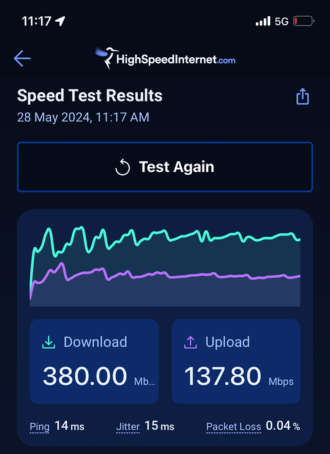
Image: Alissa Bird
T-Mobile's 5G network is where both carriers shine. Alissa technically saw the fastest 5G download speeds at 400Mbps with Google Fi’s coverage. That said, T-Mobile customers can experience these speeds too if they’re near a 5G UC (Ultra Capacity) tower. For an idea of the average T-Mobile 5G experience, Daphne saw download speeds ranging from 100–175Mbps in downtown Boise, Idaho.
These speeds are more than sufficient for high-demand tasks, including streaming videos, playing mobile games, and scrolling social media. Daphne and Adam reported smooth streaming on Netflix and YouTube, as well as seamless gaming without lag. Alissa noted she never had issues with FaceTime or web browsing while on her Google Fi plan.
Our key takeaway from T-Mobile's coverage

Lauren Hannula summarized how our testers felt about T-Mobile's coverage:
"Overall, our testers were happy with their plan's performance but had mixed reviews on its value. Both [Adam and Daphne] experienced reliably fast speeds in the urban and metro areas where they live, but each experienced slowdowns when testing their plans in places with less population.”
See more of her analysis and our tester's expereinces in our full T-Mobile review.
Customer service: T-Mobile offers in-person help
Both carriers offer digital-first customer service options, including apps, online chat, and phone support. That said, T-Mobile offers one special customer service perk that Google Fi does not: physical stores.
If you like in-person help with setting up your phone plan or troubleshooting problems, T-Mobile is the better option. During our testing, Daphne had positive interactions with T-Mobile support.
She used the AI chatbot for basic questions and called to remove an Apple Watch line, finding the representatives responsive and helpful. However, she noted that the T-Mobile app interface felt cluttered with ads for devices and promotions, making it slightly annoying to navigate just to check a bill.
For Google Fi, Alissa described managing her plan as a breeze. When she needed assistance removing a line, she called customer service and was connected to a representative in under three minutes. She also utilized the online chat feature effectively and praised the Google Fi app for its transparency, allowing users to easily view data usage and billing history.
Bottom line: Google Fi’s international perks vs. T-Mobile’s data allotments
If you are a frequent traveler or a single-line user looking for flexibility, Google Fi is your best bet. Its seamless international roaming in over 200 destinations and simple pay-for-what-you-use options make it unique in the market. No other wireless plans offer its extensive international coverage for just $65/month.
T-Mobile remains the champion for families and heavy data users who want a premium experience. If you will actually use the included entertainment perks and need truly unlimited premium data without a cap, the higher price tag delivers substantial value. Plus, its strong multi-line discounts for families can make the price of each line affordable and even competitive with T-Mobile’s other MVNO options.
Ultimately, since both carriers offer excellent access to the same high-speed 5G network, your decision comes down to whether you prioritize the travel flexibility of Google Fi or the entertainment perks and massive premium data allotments of T-Mobile.
How WhistleOut rates cell phone plans
WhistleOut evaluates phone plans based on the following criteria:
- Price & value: Not all cheap plans are “bad,” and not all expensive plans are worth it. We look at everything a plan includes and compare it both to other plans from the same carrier, as well as similar plans from competitors in the market, to determine whether the value is consistent with the price.
- High-speed data: Also called “premium” data, this is how much data you get at full 4G/5G speeds before they can or will slow down. The more guaranteed high-speed data the plan includes, the better experience you’ll generally have—but there’s also usually a limit to how much you actually need, and we ensure that you’re not overpaying for data that will go unused.
- Coverage & network reliability: The breadth of each carrier’s 4G LTE and 5G networks determines your reception and service. Particularly in the case of 5G, some carriers offer far more robust coverage than others, which affects how their phone plans perform in different parts of the country.
- Plan extras and perks: In addition to the basics—talk, text, and data—some plans throw in freebies like hotspot allowances, cloud storage, entertainment subscriptions, or service discounts.
Our mobile experts are longtime users of T-Mobile and Google Fi with years of customer experiences. In addition to leveraging proprietary data and real-world customer feedback, we compared the two carriers by analyzing their coverage, cost, and plan options. We considered plan-specific elements, including perks, premium data allowances, mobile hotspot allocations, and international features. After performing hands-on testing and extensive research, we picked the best carrier we felt met the needs of most people. We only compared Google Fi vs. T-Mobile; no other carriers, big or small, were included in our examination.
Visit our guide to choosing a phone plan to learn more about cell phone carriers and plans, and find the one that best meets your specific needs.
Max McCaskill
Sr. Staff Writer

Thousands of cell phone plans unpacked. All the facts. No surprises.




.png?w=280&h=280&usm=20&usmrad=0.8&fit=crop "The Best Cheap Phone Plans for 2026: We Tested Them All to Help You Save")