In 2026, social media holds a default space for connection. In fact, our survey found that 45% of Americans say social media is their main form of socialization—and broken down by generation, 58% of Gen Z and Millennials rely mainly on social media for socialization with their peers.
So if social media is where you share your life with most people, why not make it the place where you find love?
WhistleOut focuses on how we connect across the world, and with that in mind, we polled 1,000 U.S. social media users of all ages to find out how they're socializing online and if they ever venture into romantic territory. With social media's widespread use, it turns out that finding love through posts and likes is more common than you might think. But these stats also serve as a warning about finding love and friendship that are not anchored in reality. Read on to learn more about how social media impacts our social and romantic relationships.
Social media is the new coffee shop of love
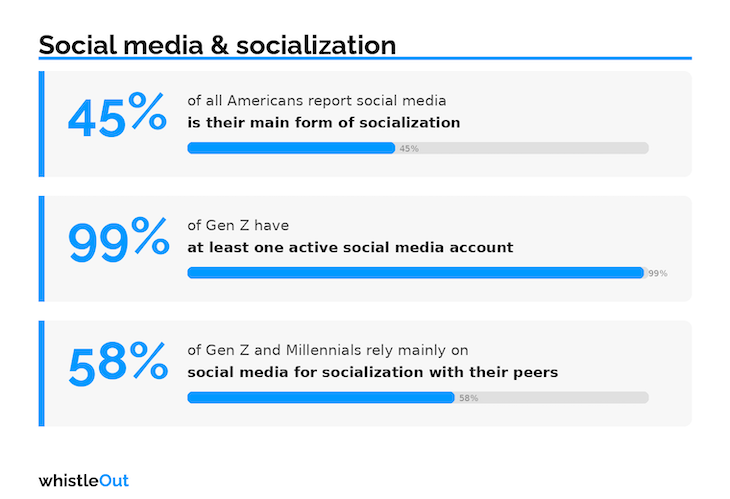
Social media use stretches through most people's lives, especially among the younger generations: 99% of Gen Z has at least one active social media account. And it isn't just about seeing endless ads or keeping up with political and celebrity news: 58% of Gen Z and Millennials rely mainly on social media to socialize with their peers. For most of Gen Z, that means less going out and more logging on.
Social media and socialization statistics:
- 45% of all Americans report that social media is their main form of socialization.
- 99% of Gen Z have at least one active social media account.
- 58% of Gen Z and Millennials rely mainly on social media for socialization with their peers.
Socials are a direct connection to a wide network of friends, family, and like-minded people, regardless of physical location, so it only makes sense that we've adapted our environment to span the digital and physical (more or less).
Online friends are real friends too (sometimes)
It's not just about keeping up with old school friends, coworkers, or family, either—we're also finding and meeting new people by being online: 42% of people have made friends with someone on social media before meeting them in person.
And even if we never meet IRL, our online friends can still be considered real friends: 54% of Gen Zers and Millennials consider their online-only friends just as important as friends made in person.
That means we care enough to notice them, or their absence: 42% of social media users notice when someone they follow stops posting, and Gen Z is more likely to take notice compared to the older generations (56% for Gen Z vs. 46% for Millennials, Gen X, and Boomers).
Platform-wise, TikTok, X, and Instagram users are more tuned in to the people they follow—maybe even more than their offline friends and family.
Social media friend trends:
- 42% of users have made friends with someone on social media before meeting them in person.
- Over half of Gen Zers and Millennials consider their online-only friends as important as in-person friends.
- 42% of social media users notice when someone they follow stops posting, with TikTok, X, and Instagram users being more attuned to their followers.
If you're curious about more stats on how social media impacts our relationships—along with our money and mental health—check out our Social Media Report.
Who needs dating apps when you can slide into their DMs?
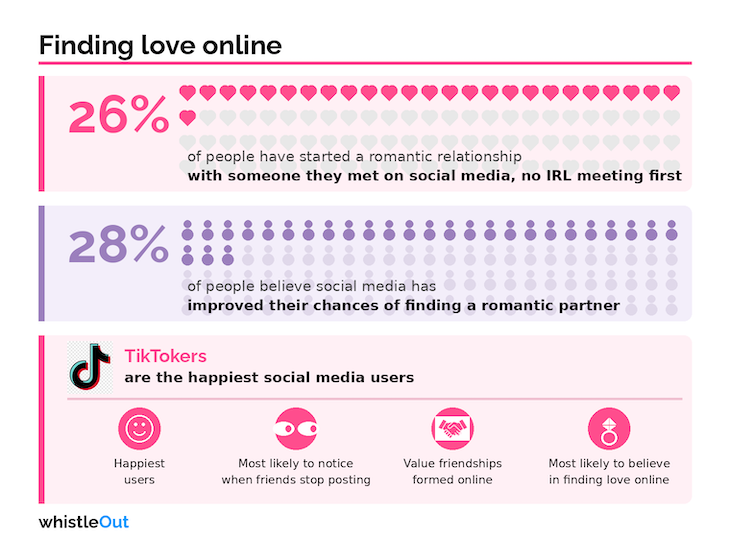
What used to be a potentially scary or strange prospect has now become somewhat common in dating trends: 26% of people have started a romantic relationship with someone they met through social media, without having met them in person first. And this figure jumps to 31% for Gen Z and 40% for Millennials.
According to our survey, 28% of people believe that social media has improved their chances of finding a romantic partner, with TikTok users the most hopeful in finding their match on the short-form video platform.
In general, TikTok seems to be where it's at for finding meaningful connections: TikTokers responded as the happiest users, most likely to notice when their friends stop posting, most likely to consider their friendships formed on social media important, and most likely to believe in finding love through social media. More than any other platform, TikTok is a place where people feel a more personal connection in a positive way.
To paraphrase Bieber, if "it's not clocking to you" yet, TikTok sits at the top for finding friends—and possibly reaching out to a new romantic partner if you want to ditch the dating apps.
Instagram, TikTok, and X dating trends:
- 26% of people have started a romantic relationship with someone they met on social media, without meeting them in person first.
- 28% of people believe that social media has improved their chances of finding a romantic partner, with TikTok users the most hopeful in finding their match on the short-form video platform.
- Overall, TikTokers are the happiest users, most likely to notice when their friends stop posting, most likely to consider their friendships formed on social media important, and most likely to believe in finding love through social media.
Friend, fling—or fan?
At a certain point, it's worth considering how healthy an online relationship can be. After all, not all feelings of affection for a social media personality or content creator stay grounded in reality.
Social media users may feel like interacting with, or even observing, anyone online is the same as swapping stories and sharing memories in real life. But sometimes these relationships fall into the category of parasocial relationships—defined as a more-than-average closeness or kinship with a celebrity, influencer, or content creator that they follow on social media but don't speak with directly.
According to our survey, 25% of people have formed a parasocial relationship with someone online. And the younger generations seem more susceptible to these illusions of kinship: Gen Z is the most likely generation to form parasocial relationships, with 41% reporting parasocial feelings for influencers they follow on social media, compared with 28% of Millennials and 19% of Gen X.
Our survey found parasocial relationships are most likely to take place on TikTok, X, Instagram, and YouTube—likely due to their combinations of popularity, daily user visibility, potential for doomscrolling, and sharing of personal details.
- 25% of social media users have formed a parasocial relationship, defined as a more-than-average closeness or kinship with someone online whom they follow on social media but don't speak with directly.
- Gen Z is by far the most likely generation to form parasocial relationships, and it happens most often on platforms like TikTok, X, Instagram, and YouTube.
In other words, it's worth recognizing what's a real connection and what's admiration better left at a distance. Following a celebrity or big content creator and feeling close is not quite the same thing as following a friend of a friend who likes the same things you do and messaging them about it.
Have you ever wanted to go from (Facebook) friends to lovers?
These days, people have more than enough options for finding dates, along with opinions about dating and dating apps' efficacy. But the social media networks you've built up can also be used to find love. It's not unreasonable to think that your future lover might be your mutual follower.
And for anyone still worried about falling for someone behind a screen, you can always stick with friendship (first) apps or even the most popular dating apps in your state. But social media still gives you a reliable way to meet friends and partners, and our data shows users are doing just that. So the next time your crush posts an AMA, your chances might be better than you think.
Methodology
We surveyed 1,000 American adults using Pollfish. Results are post-stratified.
Trevor Wheelwright

Thousands of cell phone plans unpacked. All the facts. No surprises.





.png?w=280&h=280&usm=20&usmrad=0.8&fit=crop "The Best Cheap Phone Plans for 2026: We Tested Them All to Help You Save")