With 96% of Americans having at least one active social media account, virtually everyone is online these days. However, the true depth of people’s reliance on social media for everything from friendships to shopping may still surprise you.
WhistleOut recently surveyed 1,000 American adults to find out how social media impacts their lives. We found that 45% of Americans report that social media is their main form of socialization. This reliance on social media for connections has led to some people forming parasocial relationships with influencers and caused others to develop severe anxiety when separated from their accounts. Additionally, many Americans are simply tired of scrolling, with nearly half of users reporting feelings of social media fatigue.
On the other hand, social media isn’t all bad. While Americans claim that X is the most toxic social media platform, users of Reddit and TikTok are generally happy with their accounts. Plus, many Americans have turned to social media as some of their important sources of news, shopping, and even romance.Let’s dive into the data surrounding social media in the United States. Our findings can help you utilize your account in a healthy way for your relationships, wallet, and sanity.
Overview: Social media statistics
- Platform user share: Facebook is the most popular social media website
- Social media & relationships: 45% of Americans report social media is their main form of socialization
- Parasocial relationships impact 1 in 4 people on social media
- Social media addiction and fatigue: 38% of Americans engage in doomscrolling
- Most toxic communities: Americans think X is the most toxic platform
- Social media ads: Over one-third of Americans have purchased something after seeing a social media ad
- Platform trustworthiness: Users think TikTok is the most trustworthy platform
- Mobile data usage: Social media could be costing you money
- Methodology
Platform user share: Facebook is the most popular social media website
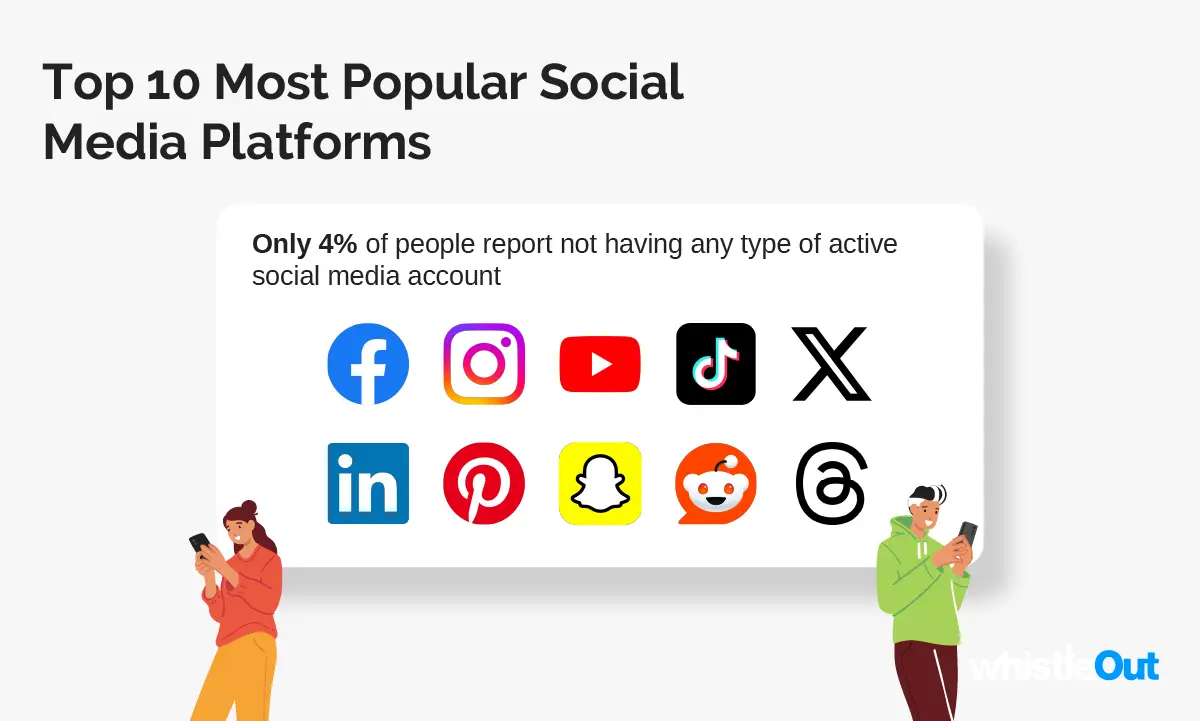
Facebook is the most popular social media platform by far, but you’ll find the majority of Americans also have accounts with YouTube and Instagram. Other popular platforms include Reddit, TikTok, and X, but they don’t come close to Facebook’s dominance.
- Facebook is the most popular social media platform in 2025, with twice as many people reporting an active account with Facebook than with TikTok or X.
- Only 4% of people overall report not having any active social media account—and only 1% of Gen Zers are totally off of social media.
- Lesser-used social media accounts with 5% or fewer users from our survey include Bluesky, RedNote, Truth Social, BeReal, Likee, Clubhouse, Gettr, Mastadon, and Fanbase.
- Over half of Americans have an account with Facebook, YouTube, and/or Instagram.
- 1 in 4 Americans are Reddit users, tied with TikTok for the happiest userbase.
It’s also important to note that Americans are not afraid of smaller or niche social media sites. While many maintain accounts on the large sites, millions of Americans are also on sites like Bluesky, Truth Social, and RedNote.
Social media & relationships: 45% of Americans report social media is their main form of socialization
As social media takes up an ever-increasing amount of our time and attention, it’s not surprising that it’s become an important part of how Americans socialize. This was especially true during the COVID era, as millions of people turned to social media platforms to maintain relationships. Those trends have largely continued, and the majority of users believe these platforms have been a good experience. That said, not everyone feels that social media has been a net benefit in their lives or on the world.
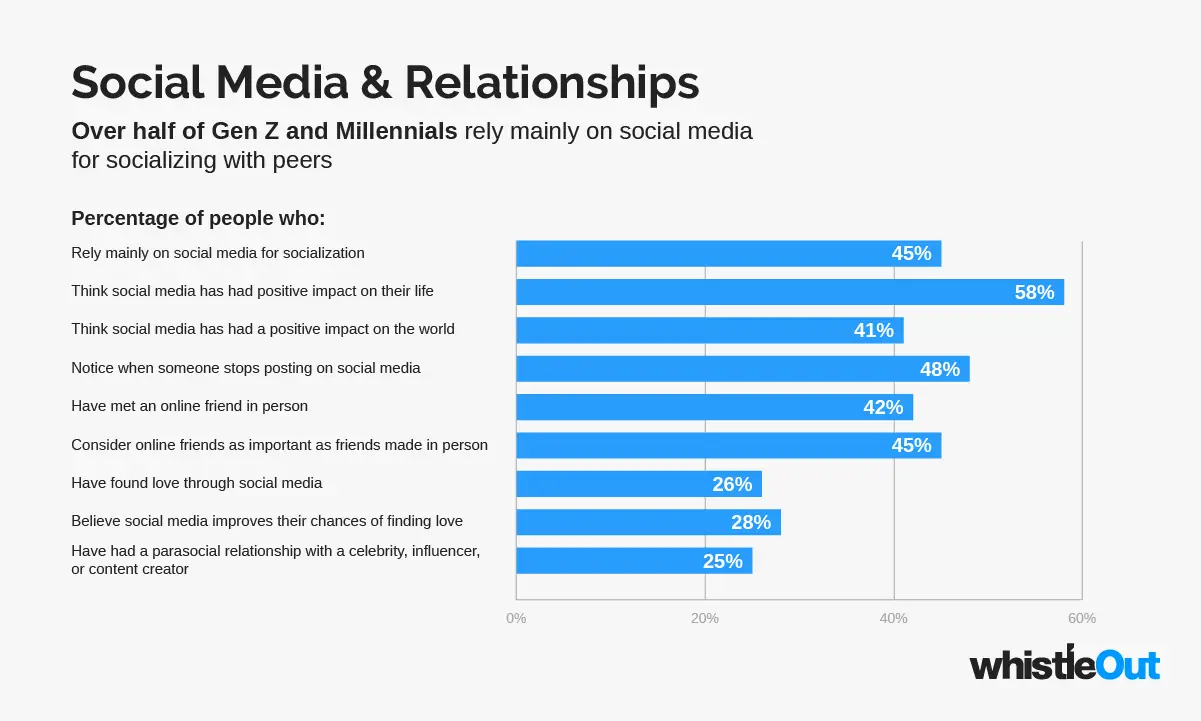
- 45% of all Americans report that social media is their main form of socialization.
- 58% of people say social media has had a positive impact on their life, with TikTok users reporting the most positivity, followed by X and Instagram.
- 41% of people say that social media has had a positive impact on the world at large, but that drops to 37% when speaking just to Gen Z, which is the most 'online' generation.
- Nearly half of social media users notice when someone they follow stops posting, with TikTok, X, and Instagram users being more 'tuned in' to the people they follow.
Many Americans—especially those in younger generations—consider their online friends just as important as their in-person friends. In fact, some people have taken that notion even further and use social media as a dating service.
- 2 out of 5 people have made friends with someone on social media before meeting them in person.
- Over half of Gen Zers and Millennials consider their online-only friends as important as friends made in person.
- Over 1 in 4 people have started a romantic relationship with someone they met through social media, without having met them in person first.
- Over a quarter of people believe that social media has improved their chances of finding a romantic partner, with TikTok users the most confident in that.
- Overall, TikTokers are the happiest users, most likely to notice when their friends stop posting, consider their friendships formed on social media important, and believe in finding love through social media.
Parasocial relationships impact 1 in 4 people on social media
Of course, not all relationships associated with social media are healthy. The rise of influencer culture and content creators has led some people to form unhealthy attachments to internet celebrities.
- 1 in 4 people have formed a parasocial relationship, defined as a more-than-average closeness or kinship with a celebrity, influencer, or content creator that they follow on social media but don't speak with directly
- Gen Z is by far the most likely generation to form parasocial relationships, and it happens more frequently than average on platforms like TikTok, X, Instagram, and YouTube
Although every generation is susceptible to parasocial relationships, they do occur more frequently with Gen Z. This could be because larger numbers of Gen Z members have social media accounts, and much of that generation’s entertainment is tied to social media and streaming.
Social media addiction & fatigue: 38% of Americans engage in doomscrolling
While 58% of people say social media has had a positive impact on their lives, that doesn’t mean it’s always a good thing. Millions of Americans suffer from symptoms of social media addiction and fatigue.
FOMO (Fear Of Missing Out) is an anxious feeling that one is missing out on or unaware of information, events, and experiences. As one of the clearest signs of social media addiction, it’s a feeling that causes people to compulsively return to their accounts so they don’t miss anything that’s happening online. One of our previous surveys found that 1 in 3 TikTok users suffered from anxiety and FOMO during the brief 24-hour TikTok ban in January of 2025.
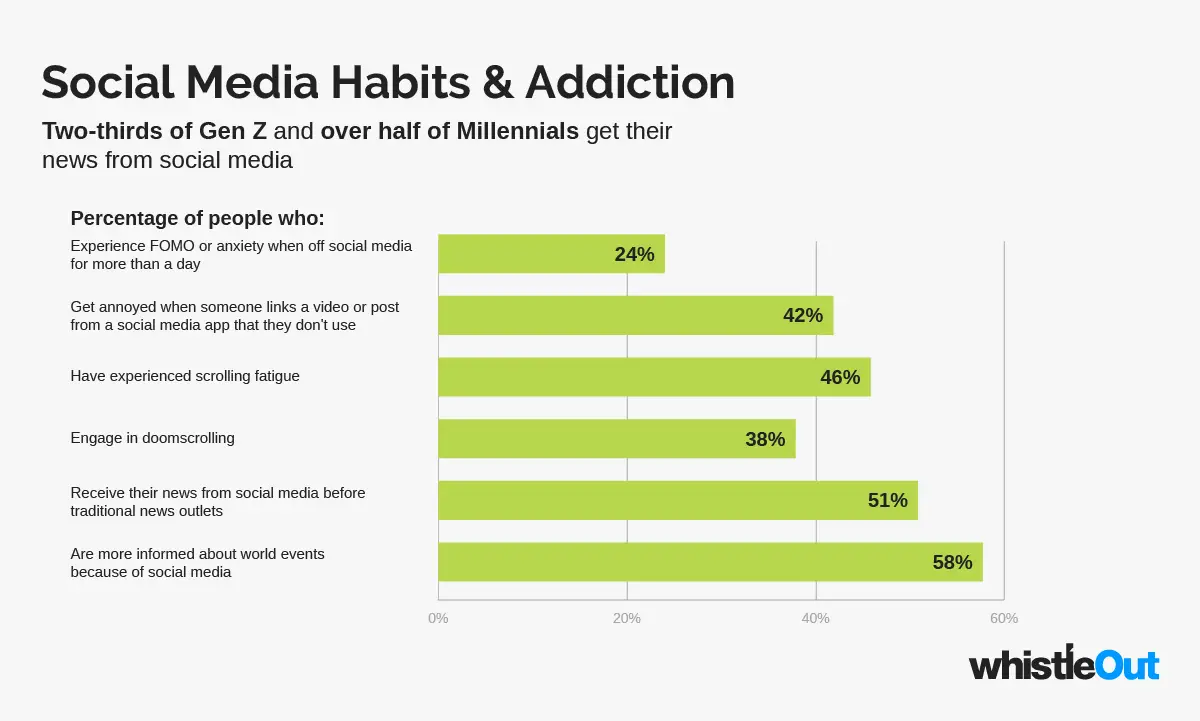
- 1 in 4 people experience FOMO if they're not active on social media for more than a day, with TikTok and X users reporting the highest rate of FOMO.
- Nearly half of social media users report experiencing scrolling fatigue, with X users having the highest rate of fatigue.
- 38% of Americans engage in doomscrolling (spending an excessive amount of time looking at negative news content online), but that number jumps to 46% for X users.
- 42% of people get annoyed when their friends link them a post or video from a platform they don’t have an account with.
- Gen Xers have the most scrolling fatigue out of any generation.
Why do people form social media addictions? Part of it is due to relationships and online friends. However, another factor is the idea that social media can provide rapid-fire news updates, especially during major events. Constantly looking for new information about the news is part of what leads people to doomscroll.
- 51% of people report that they mainly receive news from social media before hearing about it through traditional news platforms, with TikTok and X users most likely to receive their news from social media.
- 58% of Americans overall feel more informed about world events because of social media, but especially users of Instagram (67%), TikTok (71%), and X (72%).
- 66% of Gen Z receive their news from social media, along with over half of Millennials.
Let’s be clear: Social media can be a dangerous place to get news. While there are reputable news outlets and journalists on virtually all social media platforms, there are also conspiracy theorists, grifters, and scammers. Anyone who uses social media for news should verify the identity and credibility of anyone they follow.
Alternative apps to help your social media addiction
Feelings like FOMO, withdrawal, doomscrolling, and compulsive account checking are all classic signs of social media addiction. Other less obvious signs include phubbing (ignoring people around you to use your smartphone) and using your phone at inappropriate times, like on a date or while you’re at work.
If you’re ready to take a break from social media, try these apps instead:
- Get lost in another world with these books and reading apps
- Hit the gym or the trails with our top-reviewed health and fitness apps
- Grow your IRL friends circle with these friendship apps we tested and loved
- Give your mind and home a cleanse with the best apps for organizing your life
It may also help to curb your smartphone use overall. The average American is on track to spend 19 years of their life on their phone. If doomscrolling is keeping you awake at night, try to limit your screen time before bed. For parents concerned about their child’s social media habits, we’ve also listed the best parental control apps to help you monitor their devices. Finally, if all your efforts are failing, it might be time to say goodbye to all your apps and join the dumbphone trend.
Most toxic communities: Americans think X is the most toxic platform
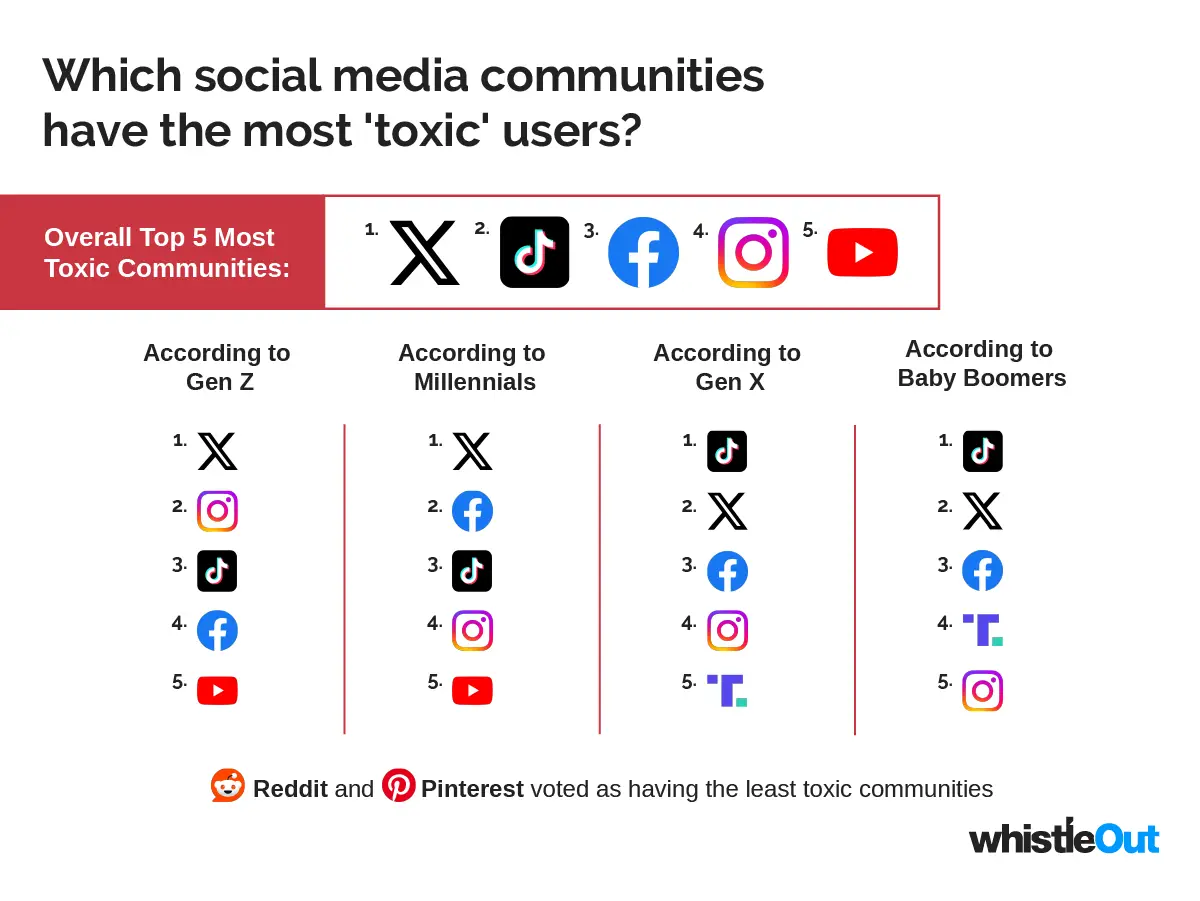
While there are dozens of social media sites, Americans broadly believe that X is the most toxic platform. After Elon Musk purchased Twitter and rebranded the platform as X, millions of users have noted an increase in toxicity on the platform. Much of that has to do with X’s reduced reporting features and Musk lifting bans on problematic accounts.
- According to Americans, X has the most "toxic" community, followed by TikTok, Facebook, & Instagram.
- Of the most popular social media platforms, Reddit and Pinterest are perceived as having the least toxic community.
- Over half of X users agree that the community on X is "toxic."
- Gen Z and millennials agree that X is the most "toxic" social media platform, while Gen Xers and baby boomers rated TikTok the worst for toxicity.
- Interestingly, only TikTok users ranked their own platform (barely) higher than X in terms of toxicity (TikTok came in a close second for Facebook, YouTube, Instagram, and X users).
X is still a popular platform, even with its toxicity problem, but that doesn’t mean people feel trapped there. The growth of competitors like Threads and Bluesky has been largely driven by people fleeing from X.
Social media ads: Over one-third of Americans have purchased something after seeing a social media ad
In addition to toxic users, one of the other big frustrations for social media users is targeted advertising. Americans are shopping online more than ever before. Social media companies know this, so they collect user data to sell ads. Facebook is notorious for showing more ads than other companies, but the practice has spread to virtually every social network.
- 77% of social media users agree that the rate of advertisements on social media has significantly increased over the past year.
- 63% of social media users report feeling fatigued and frustrated with the number of ads from influencers and content creators.
- X users are the most fatigued by influencer ads on social media, while TikTok users report being less fatigued than average.
- Over a third of Americans have been influenced to make a purchase after seeing it advertised on social media in the past year.
- Over half of TikTok users have been influenced to buy something they saw advertised on the platform in the past year.
TikTok users are less fatigued overall by ads. This could be due to TikTok’s method of allowing users to purchase things directly from the app instead of being taken to another site. Additionally, TikTok Shop allows influencers to advertise and sell their own products directly on the app. This means users see items recommended by an account they trust as opposed to a random company buying ad space.
Platform trustworthiness: Users think TikTok is the most trustworthy platform
Most people believe that tech companies are spying on them, and truthfully, they’re right. Most social media companies track your internet behavior and the kinds of content you interact with on their site. Most of this is not a nefarious activity. Platforms use that information for ads and to tweak their algorithms to provide content you’re interested in.
Unfortunately, most users have no idea how social media companies are using their data. They refuse to read the terms and conditions when signing up for a new account and never check their privacy settings. Despite that, many users still trust social media companies and aren’t worried about who has access to their data.
- Less than half of social media users read the terms and conditions before making an account, with Gen Zers being the least likely to go over the T&Cs.
- 60% of social media users don't know how to check if their personal data is being collected by a social media app or platform, although millennials are the most savvy by a slight margin.
- Despite most not knowing how to check their privacy settings, over half of social media users believe the platforms that they have accounts with are trustworthy.
- Gen Zers and millennials are the most trusting of their social media apps (57% and 56%, respectively).
- Of the most popular social media apps, users find TikTok to be the most trustworthy overall.
TikTok’s place as the most trusted social media platform is unique. Remember that the platform is being regulated by the federal government due to its Chinese ownership. However, users have pushed back against any efforts to block the app. Why do American TikTok users trust the app despite government warnings? Users may link TikTok’s trustworthiness with their favorite content creators instead of the company that owns the app.
Mobile data usage: Your social media habit could be costing you money
Social media can be a force for good in the world, but it can also be a drain on your mental health and finances. Even if you aren’t purchasing things off the app, you may be spending to scroll social media through your phone plan. We’ve found that popular social media apps are major drains on phone plans.
The top five apps using the most data on an average person’s phone plan include:
- YouTube
- TikTok
- Netflix
If you’re not sure how much data these apps use—or how much data you need—you can check out our mobile data usage guide. If you love your social media account, staying connected to the world doesn’t have to cost you your mental health, an arm, OR a leg. We’ve found some of the best cheap phone plans, so you have one less thing to worry about.
|
Visible

$25 Visible Plan
$25.00/mo
Taxes & Fees included
|
|
Mint Mobile

Unlimited Data Plan
$10.00/mo
$60 for 6 months of service
|
|
US Mobile

Unlimited Starter Plan
$25.00/mo
|
|
Spectrum Mobile®

Unlimited Plus
$40.00/mo
+ $20 Upfront
|
|
Cricket

Supreme Unlimited Plan
$55.00/mo
with AutoPay; $60 for the first month.
+ $9.99 Upfront
|
Methodology
We surveyed 1,000 American adults about their social media habits using Pollfish. Results are post-stratified.
Max McCaskill
Sr. Staff Writer

Thousands of cell phone plans unpacked. All the facts. No surprises.




.png?w=280&h=280&usm=20&usmrad=0.8&fit=crop "The Best Cheap Phone Plans for 2026: We Tested Them All to Help You Save")