From elementary schoolers to senior citizens, virtually everyone has a smartphone. These devices have become an integral part of keeping up with friends, family, and the world around us. That said, they’re also massive time sinks and potentially detrimental to our mental health. The average American has 6.9 hours of screen time every day. Smartphone overuse is also becoming increasingly associated with social isolation and social media addiction.
What’s the cure? For nearly half of Americans, the answer is simply to get rid of their smartphones. Welcome to the rebirth of the “dumbphone,” or what most people think of as their old flip phones or slide phones. These early-model devices are from the days before video streaming, photo editing, and scrolling social media were standard phone features. Instead, they are simply designed to text and make phone calls.
At WhistleOut, we wondered how prevalent the dumbphone movement was becoming. We found that while there are members of every generation ready to part with their smartphones, surprisingly, Gen Z is the most ready to pick up a dumbphone. On the other hand, Baby Boomers—the least tech-savvy generation—are the most comfortable keeping their smartphones.
Read on as we dive into the dumbphone trend and how it is impacting every generation. We’ll also cover how you can switch to a dumbphone and potentially save money in the process.
Which generations want a dumbphone
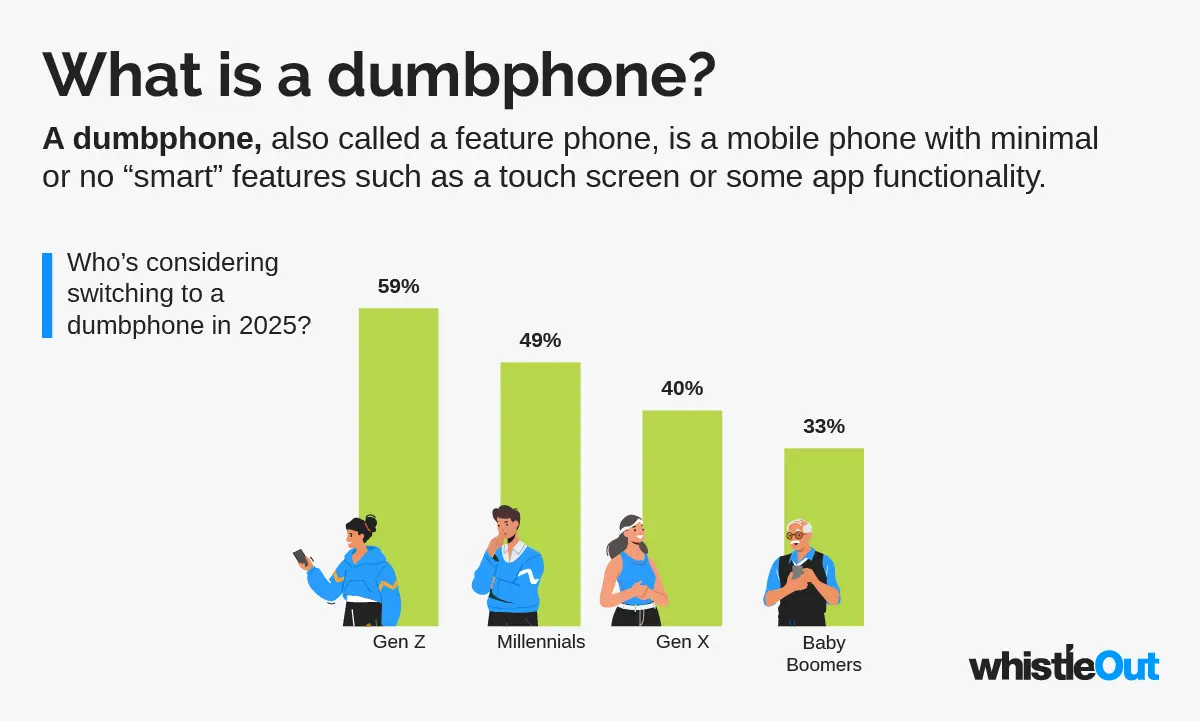
The idea of exchanging a smartphone for a dumbphone is appealing to all ages. In fact, 45% of smartphone users are considering switching to a "dumb" phone.
Broken down by generation, the percentage of members considering switching to a dumbphone is:
- 59% of Gen Z
- 49% of Millennials
- 40% of Gen X
- 33% of Baby Boomers
Gen Z has a reputation for spending most of their time online. However, numerous reports have shown that too much screen time can take a toll on mental health. Things like social media addiction can leave people feeling withdrawal and FOMO when unable to access their accounts. Additionally, users of some of the most popular sites—like X and TikTok—have stated these sites have become increasingly toxic. All of this has left Gen Z ready for a dumbphone digital detox.
- More of Gen Z than any other generation are considering making the switch to a dumb phone, with 1 in 4 stating that the phone doesn't even need to have access to apps.
- Baby Boomer smartphone users are the least likely to switch away from their smartphones, with 63% saying they wouldn't switch even if the dumb phone had access to essential apps.
- Smartphone users say the most essential apps for their daily life are navigation apps (such as Google Maps, Waze, or Apple Maps), social media apps (such as Facebook, Snapchat, or TikTok), music streaming apps (such as Spotify, YouTube Music, or Apple Music), and messaging apps (such as WhatsApp or Facebook Messenger).
Dumbphone options: Do I need a new device?
Transiting to a dumbphone is relatively easy. In fact, there are even entire subreddits—like r/dumbphone—that are dedicated to promoting dumbphones and helping users switch.
As part of the Gen Z dumbphone trend, many people aren’t even purchasing new devices. Instead, they’re looking for ways to disable features on their current smartphones and simplify the experience. This can include locking apps and even going into the settings of their phone to turn on accessibility features.
How to transition to a dumbphone
For those who do want to take the leap and switch to a dumbphone, you’ll need to purchase a new device, then switch your phone plan.
Don’t just dig out your old phone from the early 2000s. Time will not have been kind to the battery and other technical components. Luckily, cheap dumbphones are still available directly from most carriers, and you can also find them at third-party retailers. Pricing starts as low as $30 and stretches to over $200, depending on what kinds of features you want.
If your smartphone still uses a physical SIM card, you may be able to move your number and plan by simply swapping your card to your new device. However, many new smartphones rely exclusively on eSIM, a technology not supported by most dumbphones. For these devices, you’ll need to contact your carrier for help when switching.
Dumbphones can save you money
Other than regaining your sanity, the best part about switching to a dumbphone is the cheaper phone plan. Since most dumbphones don’t use data, many customers can get by with a talk and text plan or a very limited data plan.
Since you don’t need a massive unlimited plan, the best dumbphone plans come from smaller carriers called MVNOs. These carriers offer discounted service on the nation’s leading networks. You can get the same great AT&T, Verizon, or T-Mobile coverage at a fraction of the cost.
You can check out our list of the best no-data phone plans or browse some of the best dumbphone plans below:
|
Mint Mobile

6GB Data Plan
$10.00/mo
$60 for 6 months of service
|
|
US Mobile

2GB By the Gig Plan
$10.00/mo
Taxes and fees included
|
|
T-Mobile

$15 Connect by TMO 5GB
$15.00
Per 1 Month Refill
Taxes & Fees NOT included
+ $10 Upfront
|
Methodology
We surveyed 1,000 American adults using Pollfish. Results are post-stratified.
Max McCaskill
Sr. Staff Writer

Thousands of cell phone plans unpacked. All the facts. No surprises.




.png?w=280&h=280&usm=20&usmrad=0.8&fit=crop "The Best Cheap Phone Plans for 2026: We Tested Them All to Help You Save")