Here at WhistleOut, we love all things cell-phone related, but only when they're used safely and responsibly. Distracted driving has become a major issue in the U.S., killing thousands of people every year. Unfortunately, drivers using their cell phones while behind the wheel cause a significant number of these accidents.
In the most recent nationwide data available, the National Highway Traffic Safety Administration (NHTSA) reported that over 6,165 people were killed or injured by distracted driving in 2023. Distracted driving fatalities are also up 14.22% over a five-year period, and through our own surveys, we've discovered that 17% of Americans are currently using their cell phones behind the wheel.
As cell phones and touch screens have become standard fixtures found in virtually everyone's car, we decided to see how bad the situation is across the country. We dug into the most recent numbers to find which states have the most and least distracted drivers. We also polled 1,000 Americans on their driving habits and cell phone use. Using our analysis, WhistleOut experts offer some tips on how you can stay safe while driving without completely disconnecting your phone.
Overview: Distracted driving and cell phones
- Distracted driving data: Key findings and fatal crash statistics
- Distracted driving deaths by state: Which states are most and least dangerous?
- Cell phone safety while driving: How to avoid distracted driving accidents
- FAQ
- Methodology
What is distracted driving?
Distracted driving is any activity that takes a driver's attention away from driving. According to the NHTSA, there are three types of distracted driving:
- Visual: Taking your eyes off the road
- Manual: Removing your hands from the steering wheel
- Cognitive: Thinking about something other than driving
Using your cell phone while driving can be considered any type of distracted driving. Looking down at a notification, holding your phone to send a text message, or trying to remember the name of a song you want to add to your playlist are all forms of distracted driving that make you a less safe driver.
Distracted driving data: Key findings and fatal crash statistics
Distracted driving impacts all drivers on the road. Even if you always drive safely, you could still be in danger from the other drivers around you who do not.
Despite nationwide laws against distracted driving, fatality numbers and injuries from distracted driving have remained high.
- 6,165 people were injured or killed as a result of distracted driving in 2023
- May is the deadliest month when it comes to distracted driving
- Distracted driving fatalities in the U.S. are up 14.22% over a five-year period, but the increase has been leveling out since a peak in 2021. From 2021 to 2023, the total number of fatal distracted driving incidents decreased by 5%
Distracted driving is also not limited to younger Americans. In fact, older drivers over the age of 65 make up a larger percentage of fatal distracted driving accidents than drivers under 20.
- 15% of all fatal distracted driving crashes involve a young driver (20 years old and younger), while 23% involve a driver over the age of 65.
Does this mean younger Americans have better driving habits? Probably not. Our surveys on phubbing have shown that smartphone addiction has become a compulsive habit for Americans of all ages. In fact, our driving and phone use survey showed Gen Z and millennials are more likely to admit to using their phone behind the wheel, even if they aren't involved in the most fatal accidents.
- 17% of people from our survey of 1,000 U.S. adults admit to using their phone while driving. This jumps to 1 in 5 (21%) for Gen Z and millennials surveyed.
Deadliest states: Top 5 states with the most injuries and fatalities caused by distracted driving incidents
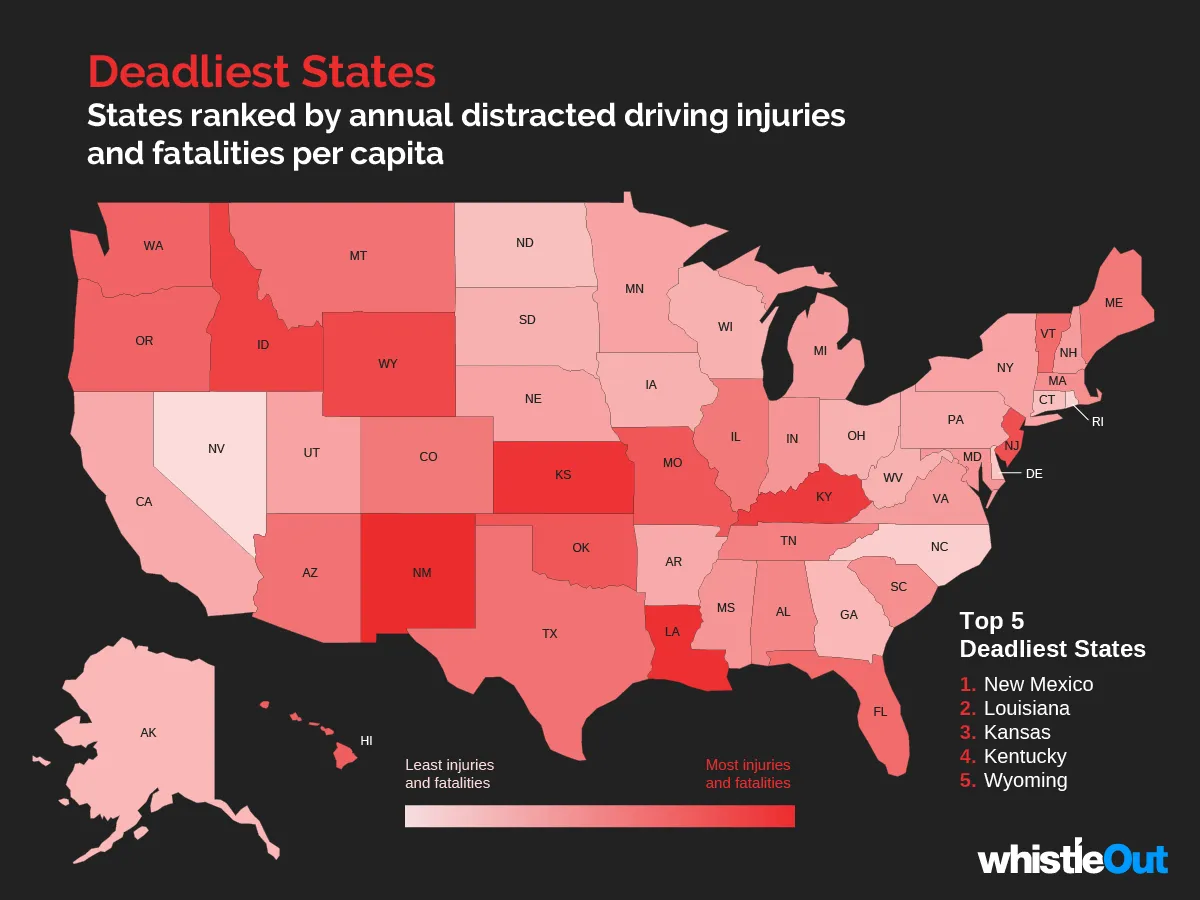
We've routinely updated the data for this piece since 2021, and New Mexico has retained the top spot for the nation's most dangerous distracted drivers for most of that time. With 286 victims in 2023, it once again led the country in distracted driving fatalities and injuries per capita.
The top five most dangerous states are:
- New Mexico
- Louisiana
- Kansas
- Kentucky
- Wyoming
Top 5 states with the least distracted driving-related injuries and fatalities
Nevada saw five people injured or killed in distracted driving accidents in 2023. North Dakota had just four. What's different about these states? Many of them have extensive public awareness campaigns explaining the dangers of distracted driving and strict enforcement of laws by police. Based on the data, it appears those actions do have a meaningful impact on road safety.
The top five safest states are:
- Nevada
- North Dakota
- North Carolina
- Rhode Island
- Delaware
Distracted driving deaths by state: Which states are most and least dangerous?
Check out the table below to find out where your state falls in our distracted driving rankings.
| Rank | State | Fatal distracted driving crashes |
Percent involving a young driver (15-20) |
Percent involving an older driver (65+) |
Fatalities | Non-fatal injuries | Total killed or injured |
|---|---|---|---|---|---|---|---|
| US Totals | 3,021 | 15% | 23% | 3,275 | 2,889 | 6,164 | |
| 1 | New Mexico | 149 | 14% | 23% | 163 | 123 | 286 |
| 2 | Louisiana | 227 | 16% | 27% | 254 | 287 | 541 |
| 3 | Kansas | 106 | 25% | 24% | 115 | 81 | 196 |
| 4 | Kentucky | 140 | 16% | 25% | 149 | 126 | 275 |
| 5 | Wyoming | 12 | 33% | 33% | 12 | 10 | 22 |
| 6 | Idaho | 36 | 11% | 19% | 40 | 34 | 74 |
| 7 | Missouri | 93 | 16% | 20% | 101 | 87 | 188 |
| 8 | New Jersey | 165 | 12% | 25% | 172 | 114 | 286 |
| 9 | Oregon | 51 | 18% | 27% | 67 | 58 | 125 |
| 10 | Oklahoma | 58 | 14% | 19% | 64 | 43 | 107 |
| 11 | Washington | 123 | 8% | 23% | 136 | 59 | 195 |
| 12 | Florida | 253 | 13% | 28% | 277 | 297 | 574 |
| 13 | Vermont | 7 | 0% | 14% | 8 | 7 | 15 |
| 14 | Texas | 366 | 19% | 19% | 404 | 335 | 739 |
| 15 | Hawaii | 25 | 12% | 24% | 25 | 6 | 31 |
| 16 | Maine | 17 | 18% | 24% | 17 | 13 | 30 |
| 17 | Arizona | 63 | 19% | 22% | 71 | 90 | 161 |
| 18 | Illinois | 115 | 11% | 14% | 122 | 126 | 248 |
| 19 | Montana | 17 | 24% | 18% | 17 | 5 | 22 |
| 20 | Colorado | 56 | 14% | 11% | 59 | 57 | 116 |
| 21 | Tennessee | 63 | 14% | 25% | 66 | 58 | 124 |
| 22 | Alabama | 37 | 24% | 32% | 37 | 41 | 78 |
| 23 | South Carolina | 36 | 6% | 25% | 37 | 39 | 76 |
| 24 | Mississippi | 13 | 15% | 15% | 14 | 23 | 37 |
| 25 | Indiana | 47 | 23% | 15% | 50 | 37 | 87 |
| 26 | Maryland | 40 | 5% | 25% | 42 | 35 | 77 |
| 27 | Virginia | 52 | 17% | 19% | 53 | 55 | 108 |
| 28 | Massachusetts | 42 | 14% | 17% | 44 | 38 | 82 |
| 29 | Michigan | 54 | 15% | 37% | 57 | 55 | 112 |
| 30 | Iowa | 14 | 14% | 29% | 18 | 17 | 35 |
| 31 | Utah | 18 | 22% | 11% | 19 | 19 | 38 |
| 32 | Pennsylvania | 65 | 12% | 29% | 66 | 70 | 136 |
| 33 | Minnesota | 29 | 14% | 31% | 31 | 29 | 60 |
| 34 | Arkansas | 13 | 8% | 31% | 15 | 16 | 31 |
| 35 | Alaska | 2 | 0% | 0% | 2 | 5 | 7 |
| 36 | Wisconsin | 26 | 12% | 31% | 27 | 28 | 55 |
| 37 | New York | 105 | 12% | 20% | 113 | 61 | 174 |
| 38 | West Virginia | 6 | 17% | 17% | 6 | 9 | 15 |
| 39 | New Hampshire | 7 | 14% | 43% | 7 | 5 | 12 |
| 40 | Nebraska | 10 | 20% | 30% | 10 | 7 | 17 |
| 41 | California | 140 | 14% | 16% | 158 | 163 | 321 |
| 42 | Ohio | 38 | 11% | 13% | 40 | 53 | 93 |
| 43 | South Dakota | 4 | 25% | 0% | 4 | 3 | 7 |
| 44 | Georgia | 39 | 5% | 13% | 44 | 35 | 79 |
| 45 | Connecticut | 12 | 8% | 33% | 12 | 12 | 24 |
| 46 | Delaware | 4 | 25% | 25% | 4 | 2 | 6 |
| 47 | Rhode Island | 2 | 50% | 50% | 2 | 2 | 4 |
| 48 | North Carolina | 18 | 17% | 39% | 18 | 13 | 31 |
| 49 | North Dakota | 2 | 0% | 50% | 2 | 0 | 2 |
| 50 | Nevada | 4 | 50% | 0% | 4 | 1 | 5 |
Cell phone safety while driving: How to avoid distracted driving accidents
The biggest culprit for distracted driving is looking at or using a cell phone while driving. While we love cell phones at WhistleOut, there is a time and place for them, and we want everyone to stay safe on the road.
Texting and driving is considered the most dangerous form of distracted driving, but virtually any activity that involves your phone can be problematic. Looking at notifications, setting up your GPS, starting your playlist, or even trying to charge your phone can quickly lead to disaster.
Luckily, you do have plenty of ways to stay safe. Modern vehicles have made it possible to use your phone in a limited capacity while driving with hands-free programs like CarPlay and Android Auto. Plus, many smartphone models can now disable key features when they sense you're on the road, eliminating the temptation to play with your phone.
Here are some ways you can prevent your own distracted driving behaviors and keep yourself—and everyone around you—safe.
- Do not text and drive: Many states have laws prohibiting texting while driving or even holding your phone while behind the wheel. Putting your phone down and using its hands-free features keeps you and others on the road safe.
- Stop driving if you're drowsy: It's easy to get tired on long drives, but driving while drowsy is unsafe. If you start to feel tired, take a pitstop where you can get some caffeine, stretch your legs, or even stop for the night.
- Multi-task outside of the car: If you need to eat, stop at a rest area. If you need to fix something rolling around in your back seat, pull over on the side of the road. Do not multitask while driving, even if you think it's just a quick and easy thing. If you're driving with passengers, ask them to do some tasks for you instead.
- Don't touch your phone at all while driving: You can still play music or a podcast through your car's speakers, make a hands-free Bluetooth call, or even use your device's smart assistant through CarPlay or Android Auto to send a text message. But if you're holding your phone to talk, text, search, or tap the screen, that's a major distraction.
- Enable your smartphone's driving mode: iPhones (Driving Focus) and Android devices (Google Assistant driving mode) have dedicated do-not-disturb modes for drivers. These features can prevent distractions from popping up on your device and allow you to verbally tell your phone to complete tasks like making phone calls or playing music. They will also tell people trying to reach you that you're currently driving and unavailable.
Distracted driving and cell phones: FAQ
What states ban cell phones while driving?
Almost every state in the nation has some form of cell phone ban while driving. According to the Governors Highway Safety Association:
- Handheld Cellphone Use: 33 states, D.C., Puerto Rico, Guam, the Northern Mariana Islands, and the U.S. Virgin Islands prohibit all drivers from using handheld cellphones while driving.
- All Cellphone Use: No state bans all cellphone use for all drivers, but 36 states and D.C. ban all cellphone use by novice drivers, and 25 states and D.C. prohibit it for school bus drivers.
- Text Messaging: 49 states, D.C., Puerto Rico, Guam, the Northern Mariana Islands, and the U.S. Virgin Islands ban text messaging for all drivers. Montana is the only state without a statewide texting and driving ban.
Most of these cell phone bans are primary enforcement laws. That means an officer can cite drivers for using their devices without any other traffic offense occurring.
What percent of distracted driving is caused by phones?
According to the FCC, cell phone use was cited as the primary distraction in 14% of distracted driving accidents they tracked that resulted in a fatality in 2024. This means that at least one of the drivers involved was talking on, listening to, or engaged in a cell phone activity at the time of the crash.
Is cell phone use the only type of distracted driving?
Cell phone use is one of the most prevalent types of distracted driving, but it is not the only kind. Talking to passengers, messing with the radio, fixing your makeup, and eating or drinking are all other common forms of distracted driving.
Methodology
WhistleOut conducted a survey of 1,000 U.S. adults, in addition to gathering data from the NHTSA and U.S. Census.
To compile our data for this report, we used the Fatality Injury Reporting System Tool (FIRST) from the National Highway Traffic Safety Administration (NHTSA). To focus on crashes, we looked at "Fatal Motor Vehicle Crashes" in each state 2018–2023, filtering for "Involving a Distracted Driver." 2023 U.S. Census data was then pulled into the report to determine the number of fatal distracted driving crashes, injuries, and fatalities per 1 million people (based on the population of each state). The most recent data available for this research is from 2023 and we reviewed this data in 2026 to confirm its accuracy.
We then applied the same methodology to find data for a variety of filters including region, age group, gender, injury type, and month of crash.
After determining the number of crashes per 1 million people, the states were ranked with the highest-ranked state being the state with the most fatalities and non-fatal injuries involving a distracted driver per capita.
Max McCaskill
Sr. Staff Writer

Thousands of cell phone plans unpacked. All the facts. No surprises.





.png?w=280&h=280&usm=20&usmrad=0.8&fit=crop "The Best Cheap Phone Plans for 2026: We Tested Them All to Help You Save")