Smartphones have taken a prominent role in our lives, being the first thing many people look at when they wake up and the last thing they see before going to sleep. Americans use their cell phones in the bathroom, when eating, at work, while driving, and even on dates.
All that screen time adds up. With current trends showing people using their phones for about 6.9 hours per day, the average American is forecast to spend 19 years of their life on their smartphone.
As horrifying as that may initially sound, most people are actually okay with it, seeing smartphones as an important part of how they socialize, entertain themselves, and connect with the rest of the world. In fact, 57% of Americans say that their level of screen time is necessary to get through or enjoy their day.
We surveyed 1,000 Americans to find out just how much screen time everyone has. We'll dive into the screen time statistics by generation, talk about the reasons people are hooked on their phones, and offer some suggestions for cutting down if you think your device uses up too much of your time.
Overview: Does America have a screen time problem?
- Screen time statistics: The average American will spend 19 years of their life on their smartphone
- Why is it uncomfortable to leave our phones at home?
- Do we need our high screen time to function? Most people say yes
- Unlocking the power of your phone without locking yourself out of your life
- Losing too much time to your screens? We can help with that
- Methodology
Screen time statistics: The average American will spend 19 years of their life on their smartphone
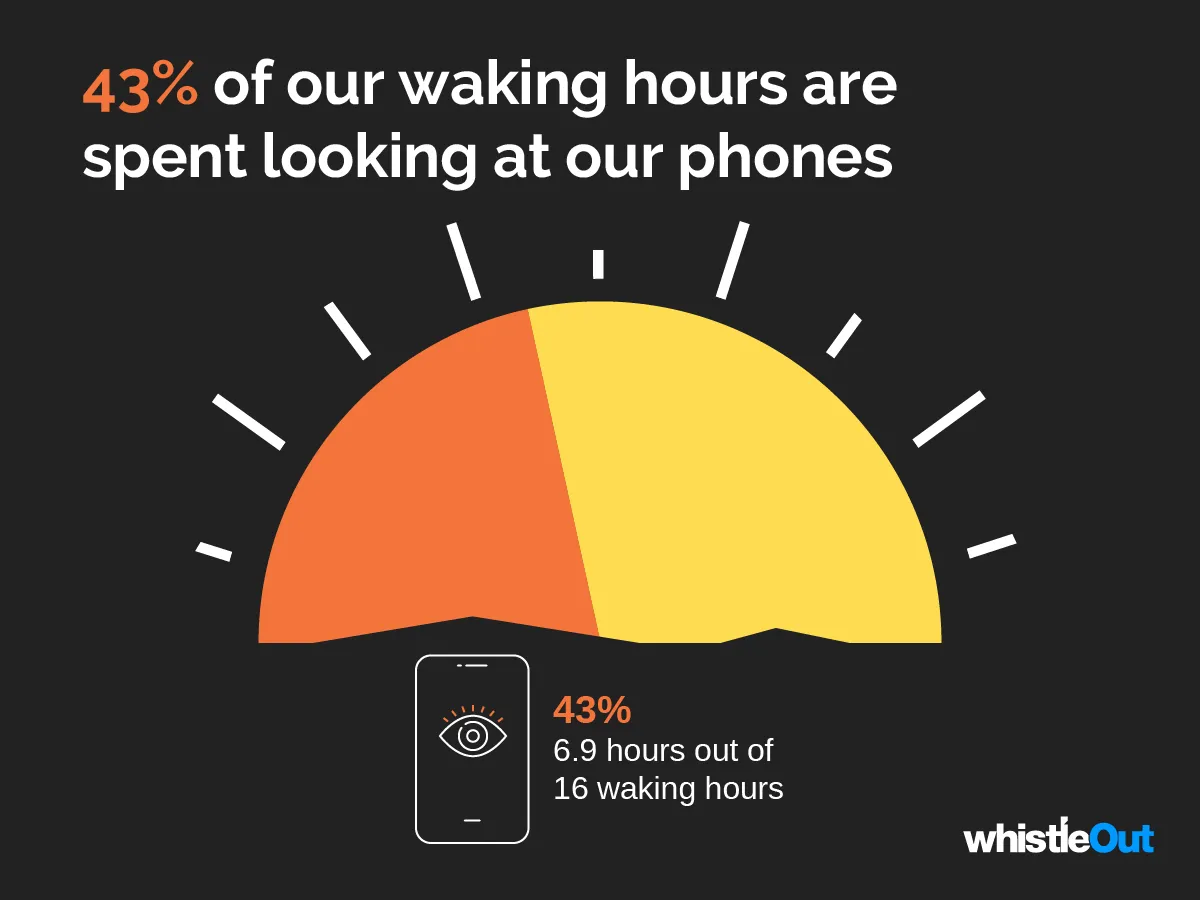
Americans love their smartphones. We found that the average American currently spends 6.9 hours every day on their smartphone, from texting to scrolling social media to watching videos. If you get an average of eight hours of sleep each night, that means you'd spend 43% of your waking hours looking at your phone.
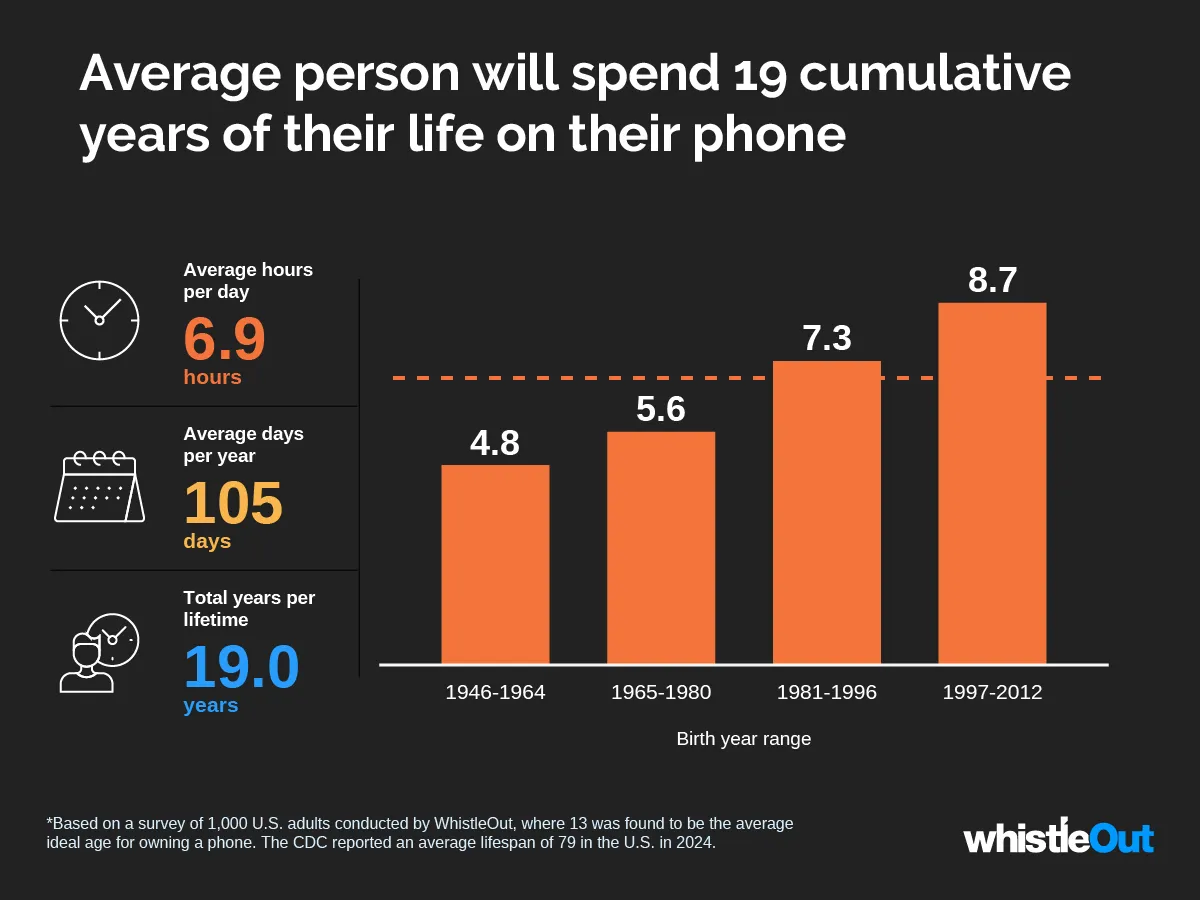
If those trends stick, the average American can expect to spend 19 years of their life on their smartphones. While that sounds like a shocking amount, that number looks slightly different when broken down by age.
Gen Z and millennials are the true smartphone power users, with each generation on track to spend more than 20 years on their phones. That said, older users are certainly smartphone addicts too, with both Gen X and the baby boomers on track to spend well over a decade of their later years on their phones as well.
- On average, U.S. adults spend 6.9 hours a day looking at our phones. This works out to be a cumulative 19 years of screen time based on our findings in an earlier study, which found 13 as the ideal age for getting a phone, according to most Americans. [1]
- Gen Z has the highest screen time at 8.7 hours per day, followed by millennials at 7.3, Gen X at 5.6, and baby boomers at 4.8 hours.
Screen time by generation
| Generation | Hours per day | Days per year | Years per lifetime |
|---|---|---|---|
| Overall | 6.9 | 105 | 19.0 |
| Born 1946–1964 | 4.8 | 73 | 13.2 |
| Born 1965–1980 | 5.6 | 86 | 15.5 |
| Born 1981–1996 | 7.3 | 111 | 20.1 |
| Born 1997–2012 | 8.7 | 132 | 23.9 |
How much screen time is normal for adults?
The good news is that there are no "normal" screen time amounts or official guidelines. If you're hitting the average screen time amounts—or exceeding them like I am—there's no need to panic…yet. It turns out that how you're spending your screen time is more important than the total amount.
Experts say you should try to limit your recreational screen time to under four hours per day. Productive screen time is much more flexible.
Productive screen time activities include things like:
- Using a computer for work
- Reading a digital book
- Online classes or skill development
- Writing or creating digital art
Recreational screen time activities include things like:
- Scrolling social media
- Playing video games
- Watching videos, movies, or TV
- Browsing the web
- Texting or video chatting
Why is it uncomfortable to leave our phones at home?
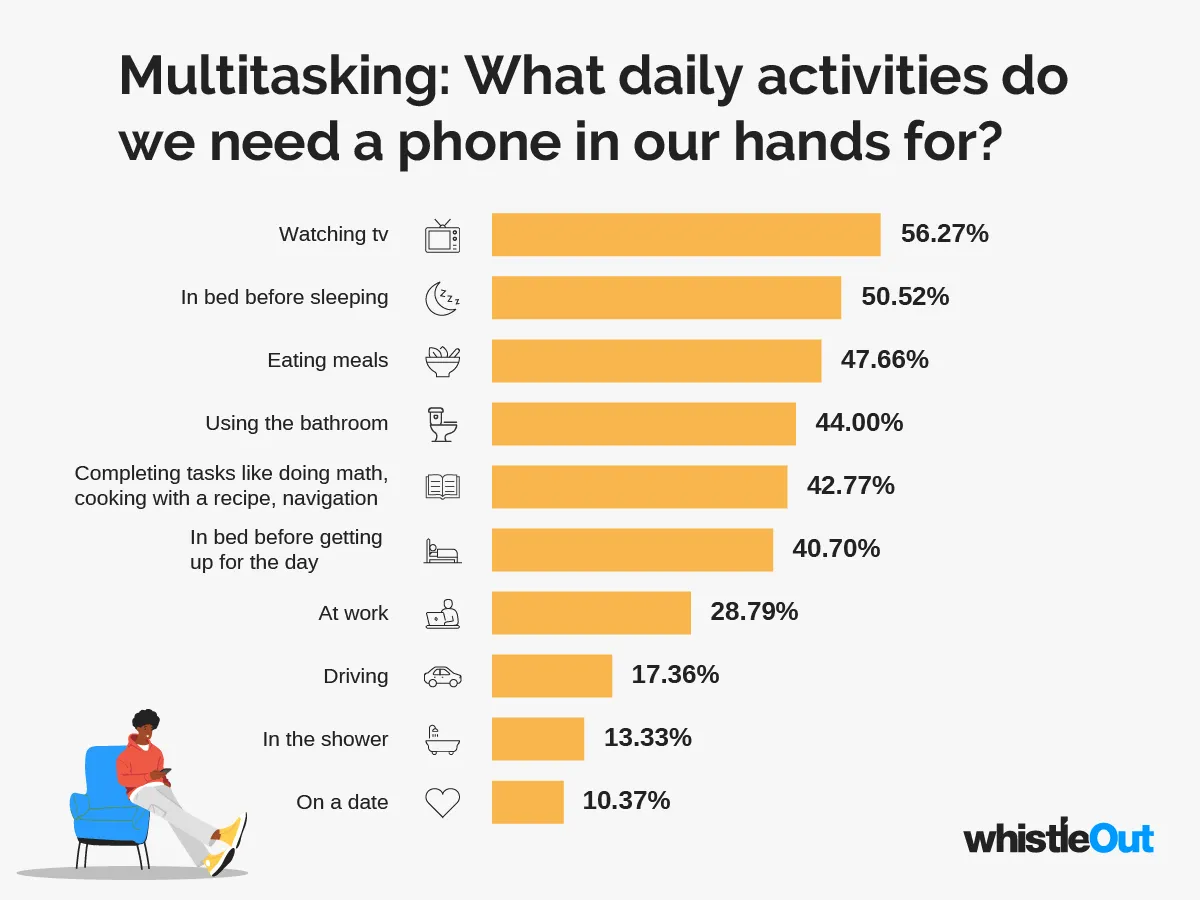
Why is screen time so high for many Americans? A major reason is that we use them everywhere, even in places we shouldn't.
Smartphones are a genuinely useful tool. They can help us solve problems, keep up with the news, and help people feel safe by keeping them connected to their friends and family. During appropriate times, they are also incredibly entertaining as a handheld source of games, social media, and videos.
That said, constant access to smartphones has also led to an increase in smartphone addiction, causing some people to use their phones when they shouldn't. Using a cell phone behind the wheel is one of the leading causes of distracted driving accidents, which injure and kill thousands of people each year.
There's also been a massive increase in behaviors like phubbing, which is snubbing the people around you in favor of using your cell phone. And while half of Americans say using their phone at work helps their productivity, good luck explaining that to your boss if you get caught scrolling TikTok on the clock.
When we asked people about their daily phone use, we found:
- 1 in 4 people (25%) would struggle with completing daily tasks if they lost their phone.
- Half of Americans (50%) feel uncomfortable leaving their phone at home.
- 31% of people get uncomfortable when someone else uses their phone, even if there's nothing controversial for them to find.
- Baby boomers are the most likely to get uncomfortable when they don't have access to phone service or Wi-Fi, even if they don't urgently need it.
12% of Gen Z don't trust people without cell phones
As the generation that has grown up with cell phones as part of their entire lives, Gen Z has some of the strongest opinions on cell phone access and screen time. A significant number feel like they always need access to their phones, and some don't even trust people who have decided to go device-free.
- 37% of Gen Z feel like something bad might happen if they don't have access to their phone at all times.
- 1 in 4 Gen Zers (26%) feel like they have nothing to do when they don't have access to their phone.
- Over 1 in 10 (12%) of Gen Zers say meeting someone who doesn't have a cell phone is a red flag.
While Gen Z is the generation with the highest screen time, many members also believe their smartphones are causing problems. In a survey last year, we found 59% of Gen Z would consider switching to a dumbphone to help their mental health, a higher percentage than any other generation.
Do we need our high screen time to function? Most people say yes
It's safe to assume that high screen time amounts are the new normal. In fact, they may continue to grow, as our stats show screen time has more than doubled since the last time we collected data on this topic in 2022. People see smartphones as an essential part of their lives, keeping them entertained and connected, despite the concerns around screen addiction.
While some people do believe that people spend too much time on their phones, the majority of Americans believe the amount of time they spend on their cell phones is necessary to stay happy.
- 45% of people (47% of millennials and 48% of Gen Z) say that life would be more difficult with less screen time.
- 46% overall say that it's extremely difficult to cut down on screen time, and 57% even say that their level of screen time is necessary to get through or enjoy their day.
- 60% of Gen Z say that in their opinion, people worry about screen time too much.
Smartphones and screen time are also tied to social media, which is another important part of Americans' digital lives. Despite issues with doomscrolling or misinformation, social media is a key way many people stay connected with friends and family, learn about the world, and even get their news.
- 45% of all Americans report that social media is their main form of socialization.
- 58% of people say social media has had a positive impact on their lives.
- 58% of Americans overall feel more informed about world events because of social media.
- 66% of Gen Z receive their news from social media, along with over half of millennials.
Unlocking the power of your phone without locking yourself out of your life
Most of us are glued to our phones and are willing to admit it. Still, while many Americans may not see anything negative about having so much screen time, some feel like it's too much.
- 75% of people think most people spend too much time on their phone or computer, while 59% admit that their own screen time is too high.
Luckily, there are ways to reduce your screen time without completely giving up your device.
As smartphone and technology experts, we here at WhistleOut likely have more screen time than most people. While I typically average around 7 hours of smartphone screen time per day, that still doesn't include the many additional hours I spend on my work laptop and gaming computer, which pushes me well into the double digits.
Many of us have noticed how screen time can have both positive and negative impacts on our lives. Here are the ways some of us have figured out how to cut down without completely throwing our phones away, and why some of us are—mostly—content with our usage.
How the WhistleOut team deals with too much screen time:

"As someone who has to use their phone all day for work, it's impossible to avoid screens during the week. Doomscrolling is basically part of my job, and it definitely takes a toll on my mental and physical health. To deal with it, I try not to use my phone much on the weekends. Outdoor activities like yard work, gardening, hiking, and kayaking are some of the easiest ways to force myself out of the house and away from my phone and computer screens for a while."
- Max McCaskill

"One thing I like to do is have a 'no phones during TV, movies, etc.' rule. If Jake (my husband) and I are watching something together, we put our phones on silent. If I'm by myself, I have to choose between phone scrolling or TV. That's hard, so I also put on a podcast or music if I'm scrolling. While I don't always manage to follow these rules, I try to adhere to them. I'm also a big fan of Apple's Do Not Disturb options. I find that if I don't let myself SEE notifications, I pick up my phone less to mindlessly scroll and fall down rabbit holes. It doesn't stop screen time, but it stops how often I pick up my phone in the first place."
- Daphne Kelly

"Oh, man. I'm already failing at my screen time limits on TikTok (I catch myself always tapping the add 10 more minutes option). I even had to get rid of my limit entirely on Saturdays. I'm disappointed I need it so much. But, I also love seeing the TikTok trends (*computah!*), and I get a good chuckle every day. Would I sacrifice my screen time entirely? Never."
- Jessica Santero
Losing too much time to your screens? We can help with that
While many of us can find a healthy screen time balance, some people may simply need to get away from their devices for a while. If you find yourself having trouble focusing, showing signs of smartphone addiction, or doomscrolling when you get on your device, it's probably time for a change.
The best options for reducing your screen time include:
- Productivity apps: Apps like Todoist and Focus Friend can help you organize your day and block distractions on your phone. For people who don't want to quit their devices cold turkey, productivity apps can serve as a way to gamify reducing your screen time.
- Setting screen time limits: Both iPhone and Android devices have built-in tools to help users cut down on screen time. There are also special features specifically designed for parents to help them remotely monitor and control their child's screen time.
- Dumbphones: Old flip phones or basic smartphones are a great way to stay connected without all the extra baggage that comes with a true smartphone. They offer texting, calling, and some even have basic data capabilities for things like GPS. Check out our list of the top dumbphones to find the perfect device for you.
- Limited data plans: If you find yourself scrolling a lot while away from home, a limited data plan may be a solid solution. Plans like US Mobile's 2GB By the Gig are cheap and offer just enough data to stay connected. However, they incur heavy fees if you go over your monthly allotment, forcing you to limit your usage. You can see some of our top no-data plans below.
|
Tello

Unlimited Text, 300 Minutes, and 2GB Plan
$8.00/mo
|
|
US Mobile

2GB By the Gig Plan
$10.00/mo
Taxes and fees included
|
|
Ultra Mobile

Talk & Text 3-Month Plan
$13.00/mo
$39.00 advance payment for 3 months (equals to $13.00/month).
|
Methodology
We surveyed 1,000 American adults using Pollfish. Results are post-stratified.
Notes:
- We're defining a "lifetime" based on a separate survey of 1,000 U.S. adults, where 13 years old was found to be the average ideal age for obtaining a first phone. The CDC reported an average lifespan of 79 in the U.S. in 2024.
Max McCaskill
Sr. Staff Writer
Thousands of cell phone plans unpacked. All the facts. No surprises.

Related Articles


Related Topics
Research and ReportsPopular Topics
Featured App Reviews iOS News Coverage Device Reviews Device Explainers Carrier Explainers App Roundups T-Mobile


Free iPhone 18 Pro, up to $1,200 off, with a trade-in in any condition or a line switch on Experience Beyond





.png?w=280&h=280&usm=20&usmrad=0.8&fit=crop "The Best Cheap Phone Plans for 2026: We Tested Them All to Help You Save")