Social media is no longer just for following your friends and favorite content creators. From Facebook to TikTok to Reddit and more, the feeds of your social media accounts are filling up with advertisements and spam. Whether you realize it or not, it’s changing how you and millions of other Americans shop online.
Social media companies are leveraging your account information and personal data against you. By feeding you targeted ads and streamlining the purchasing process, it’s easier than ever to impulse buy while killing time online.
Here at WhistleOut, we decided to see how pervasive advertising has become on social media. We polled 1,000 U.S. adults on their interactions with social media ads and sent our WhistleOut experts to complete audits of their own favorite platforms.
We found that 1 out of every 4 social media posts is currently an advertisement, though platforms like Pinterest, TikTok, and Instagram have an even higher ad ratio. This trend has also had an impact on consumers with 63% of social media users reporting feeling fatigued and frustrated with the number of ads. Unfortunately, with an estimated 104.4 million social media shoppers projected for 2025, don’t expect the number of ads to decline any time soon.
Let’s dive into the statistics around social media advertising. We’ll see which platforms have the most ads, learn how social media users feel about these posts invading their feeds, and talk about how you can prevent impulse buying from becoming as easy as liking a post.
Overview: Social media advertising trends
- How many ads do you see on each social media platform?
- WhistleOut reports: Our team audits their social media feeds
- Advertising on social media stats: Like, share, and smash that buy button
- Black Friday: ‘Tis the season for even more ads
- Don’t let social media and targeted advertising break your budget
- Methodology
How many ads do you see on each social media platform?
While there are ads on virtually every social media platform, some are more guilty of the practice than others.
- Pinterest — 1 ad for every 2 posts
- TikTok — 1 ad for every 3 posts
- Instagram — 1 ad for every 4 posts
- Facebook — 1 ad for every 4 posts
- Snapchat — 1 ad for every 6 posts
- X (Twitter) — 1 ad for every 6 posts
- Reddit — 1 ad for every 8 posts
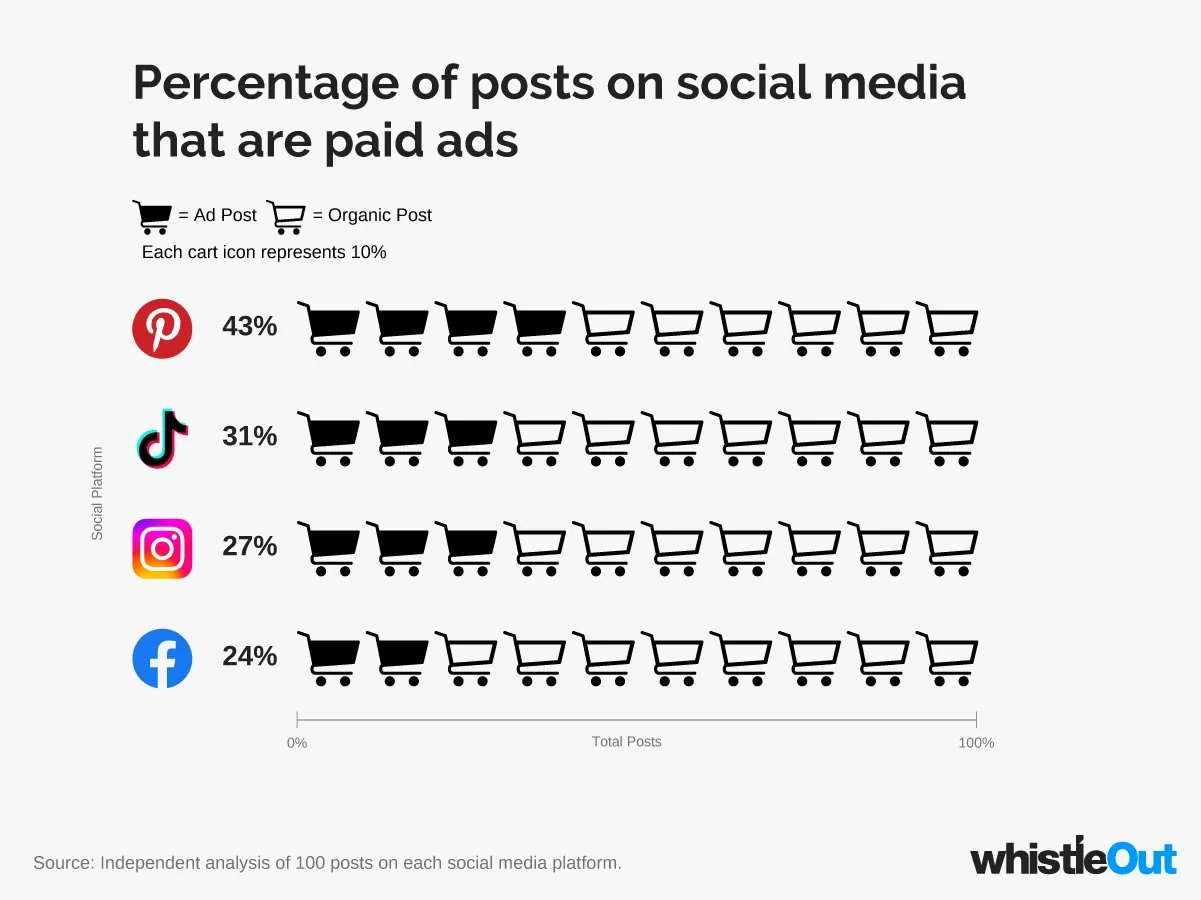
Platforms like Pinterest, TikTok, and Instagram show the highest rates of ads, but this shouldn’t be surprising. All of them are designed for users to make hyper-specific feeds based on their likes and interests. Social media platforms are able to use that same information to create targeted advertising, showing ads they think users will like.
What is targeted advertising?
Targeted advertising is a marketing strategy where companies rely on collected data to show users personalized ads. It’s serving up a specific ad to a specific user, as opposed to a general ad for a broad audience.
For your social media account, this means companies are analyzing virtually every interaction you have. This could include your profile information, likes, reposts, location, friends lists, how long you watch a video, the influencers you follow, the kinds of topics you search for, and more. All that information is bundled up to create a profile telling marketers what kinds of products you might want to buy.
WhistleOut reports: Our team audits their social media feeds
The WhistleOut team spent some time scrolling social media during the workday and auditing our accounts. We analyzed hundreds of posts across seven social media platforms.
Here are some of the experiences that stood out for each one:
-
Ammy:
- Facebook had the most ads that piqued my interest, even though it’s the platform I use the least and I’ve never used their ecommerce tool before. The interesting ads still made up only about 15% of the ads I saw on Facebook.
- Some of TikTok’s ads were up my alley, but about a third of the ads I saw were for the exact same product, one that I’d clicked on previously and didn’t buy, and the rest were things I wasn’t interested in at all.
- Pinterest had the most ads of all the social platforms by far, and I was surprised how few actually interested me despite that being the platform I’m on the most. With the stacked grid scrolling it really felt like I was seeing one normal post to every three ads. Also, when you search for something in the app it often defaults to their ‘shopping’ setting now even if you’re not looking for products, which can be difficult to get around.
-
Scott:
- I was surprised by how interested I was in the ads on Snapchat, because I never scroll on it. I expected the ad experience to be more random, but every ad I saw except for one was something that I was interested in and previously looked up on a different social media platform.
- I scroll a lot more on Instagram, so it was not surprising that the ads were generally interesting to me. However, I was surprised by how many there were. Every ad I saw appealed to me and two of them were for things that I wanted to buy. Those were a skateboard and a board game, which were ads that I have previously clicked on.
-
Max:
- I’ve been a certified X (Twitter) addict for over a decade, but I never paid close attention to how many ads were truly on my feed. I’ve always scrolled past them because they’ve never catered to my interests. After looking closely, I was shocked to see not only were there a lot of them, but many seemed like scams. They were nothing like the kinds of targeted high-quality ads I’ve seen on Facebook or Instagram.
- Reddit had a smaller number of ads compared to the other platforms I looked at. However, the few ads that were there generally appealed to my interests, or at least the interests of that particular Reddit account. Because of Reddit’s layout as a primarily text-based platform, I imagine it’s more difficult to successfully advertise there. Full disclosure: I still use Old Reddit, so it’s pretty easy to ignore ads.
Advertising on social media stats: Like, share, and smash that buy button
Why do we see so many ads on social media? Because millions of Americans are clicking on them. According to Capital One, 100.7 million or 36.8% of American online consumers shopped on social media in 2024. That number is projected to increase to 104.4 million social media shoppers in 2025.
Social media sites have already impacted Americans’ mental health and relationships. Altering our shopping habits is simply the next step. Sites like Instagram and TikTok have even created their own native shopping platforms, allowing users to purchase things without ever leaving their feed.
For some users, ads on their social media are a fun and easy way to shop. For others, it’s ruining their experience of spending time online.
- 77% of social media users agree that the rate of advertisements on social media has significantly increased over the past year.
- 63% of social media users report feeling fatigued and frustrated with the number of ads from influencers and content creators.
- X users are the most fatigued by influencer ads on social media, while TikTok users report being less fatigued than average.
- Over a third of Americans have been influenced to make a purchase after seeing it advertised on social media in the past year.
- Over half of TikTok users have been influenced to buy something they saw advertised on the platform in the past year.
TikTok users are less fatigued overall by ads. This could be due to TikTok’s method of allowing users to purchase things directly from the app instead of being taken to another site. Additionally, since TikTok Shop allows influencers to advertise and sell their own products directly on the app, users can see items recommended by an account they trust as opposed to a random company buying ad space.
Black Friday: ‘Tis the season for even more ads
Certain times of the year are even more notorious for advertising. Black Friday is one of them. In the lead up to the holiday season, don’t be surprised to see even more ads popping up in your social media feeds.
While you can’t prevent ads, you can take steps to ensure you’re getting a good deal on the products you see, or can you do your shopping somewhere else to ignore them all together.
Here at WhistleOut, we track all the best Black Friday phone deals from major carriers and retailers. You can also check out the best Black Friday shopping apps to find deals you may not see on social media.
Don’t forget that the holidays are more than just shopping. If you feel hectic this time of year, we can also recommend the top apps to help you prepare for the holidays and the best mental health apps to help you decompress.
Don’t let social media and targeted advertising break your budget
Social media ads make it easy to find things online you may want to buy. Sometimes it’s nice to see products you’re interested in pop up on social media, and I’m also guilty of impulse buying off my favorite platforms. That said, it becomes a problem when you buy without thinking and can even fuel an online shopping addiction.
It’s easy to overspend when shopping on social media thanks to features like one-click checkout and platforms that automatically save your card information. Plus, you may not always realize what you’re buying. In the age of AI and bots, it doesn’t take much effort to make a lackluster product look like a great buy, or a small business look like a major company.
Here are some tips to stay safe when shopping though your social media feed:
- Research before you buy: If you’re unfamiliar with a product or company you see advertised, search for it online and read some first-hand reviews to make sure it’s really worth the money.
- Shop around: Advertisements don’t always have the best pricing, so search out other retailers and websites to see if you can find a better deal.
- Don’t buy with one click: Forcing yourself to type in your credit card information each time you make a purchase is less convenient, but it may give you a few more minutes of time to decide if you’re buying something you really need.
- Beware of influencers: If your favorite content creator is pushing a product, there’s a good chance they’re being paid to do it. That doesn’t mean everything hawked by influencers is bad, but it does mean you should be skeptical of any claims they offer until you’ve done your own research.
If you’d like some more help managing your budget or saving money on your purchases, you can also check out apps like Upside.
Methodology
Independent review of social media advertising frequency over the course of 100 posts per platform. Survey results are from a survey of 1,000 U.S. adults using Pollfish. Results are post-stratified.
Max McCaskill
Sr. Staff Writer

Thousands of cell phone plans unpacked. All the facts. No surprises.




.png?w=280&h=280&usm=20&usmrad=0.8&fit=crop "The Best Cheap Phone Plans for 2026: We Tested Them All to Help You Save")