Image: Samsung Livestream
Samsung Galaxy S26 price hike: Fast facts
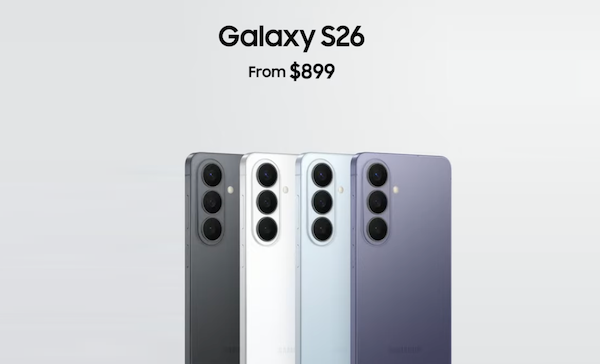
- Samsung confirmed the Galaxy S26 starts at $899, a $100 increase over the Galaxy S25's launch price of $799.
- The Galaxy S26+ is also getting a $100 price increase to $1,099.
- These price hikes are driven by inflation and a global memory chip shortage caused by surging AI infrastructure demand.
- If Apple and Google follow Samsung's lead, the iPhone 18 and Pixel 11 could also launch at $899, officially ending the era of $799 flagship phones.
- A price increase across all three brands would also likely eliminate the typical $100 discount previous-generation phones receive when new models launch.
Samsung just wrapped up its 2026 Galaxy Unpacked event. Alongside the usual wave of new hardware developments and AI features came a pricing announcement that may ripple through the entire smartphone industry: $899. That's the new starting price of the Galaxy S26, and it's the first time Samsung has raised the base model's price since 2021.
With the price of all Samsung, Apple, and Google flagship models previously holding at $799 for the past several generations, it's likely the new iPhone 18 and Pixel 11 will also see a price hike.
All smartphone manufacturers are facing headwinds driving up costs. While inflation has been a factor for the past several years, a new supply crunch for memory chips—caused by expanding AI infrastructure—is increasing the price of electronics across the board.
The market may have finally reached a breaking point where smartphone companies can no longer afford to absorb growing manufacturing costs and are now passing them on to customers.
Why Samsung raised the Galaxy S26 price
TL;DR: Memory chips are more expensive than ever thanks to AI, and that cost is getting passed along to you.
What this boils down to is a supply-and-demand problem at the chip level. The global race to build AI infrastructure (think data centers for ChatGPT, Gemini, and similar tools) has absorbed a massive share of DRAM and flash memory production. Smartphone makers are competing for the same chips as AI companies and being forced to pay much more than usual.
Inflation is piling on too. The Galaxy S21 launched at $799 back in 2021. Samsung held that price through five consecutive generations including the S21, S22, S23, S24, and S25.
As inflation ticked up during that period, instead of raising the base model's price, Samsung pushed price increases onto its premium Ultra lineup and absorbed the remaining costs. It appears that lever is not enough this time, and Samsung is giving the Galaxy S26 and S26+ a $100 price increase instead.
Why the iPhone 18 and Pixel 11 may also cost $899
Samsung isn't the only company facing these problems. Apple's CEO Tim Cook acknowledged in a January earnings call that iPhone memory chip prices were expected to rise sharply in 2026. However, he declined to comment on if Apple would raise costs in response.
If Apple and Google hold the line at $799, they may be forced to compress their own margins significantly or find ways to cut costs elsewhere (slower chips, less RAM, reduced camera hardware, etc.).
The more realistic outcome—if memory prices stay elevated through the rest of 2026—is that $899 becomes the new standard price for Android and iOS flagships alike.
How the Galaxy S26 price stacks up against the competition right now
Any price increases will only impact future Apple and Google models, so their current devices won't see a price hike no matter what happens with Samsung.
The current pricing for all major flagship models looks like this:
- Samsung Galaxy S26 (256GB): $899
- Apple iPhone 17 (256GB): $799
- Google Pixel 10 (256GB): $799
Samsung's entry-level flagship now costs $100 more than either of its two biggest rivals. It's a tough sell recommending a $899 Galaxy S26 when the iPhone 17 and Pixel 10 offer competitive systems, storage, and features at a much lower price point.
Another issue is Samsung releases its devices much earlier in the year than Apple and Google, who prefer launches in September and October respectively. Samsung will have to compete with two cheaper smartphone phones for over six months, and potentially even later if Apple delays the flagship iPhone 18 to next spring like some rumors suggest.
What a $100 price increase means for last year's phones
This is the part that will hurt smartphone buyers on a budget.
During a normal release cycle, the previous generation gets around a $100 price cut when the new model launches. For example, the iPhone 16 dropped to $699 when the iPhone 17 was released in 2025. That discount has been consistent enough over the past several years that savvy shoppers can plan around it.
If the iPhone 18 and Pixel 11 launch at $899, the math changes. Since the new flagship is more expensive, there's no pressure to cut the older model's price. Instead, the older model's full $799 price tag will likely be considered the discount, since it's still cheaper than the newest phone.
This means that apart from the used and refurbished market, buyers looking for a deal on last year's phone may find that deal is smaller than it used to be or simply non-existent.
The iPhone 18 and Pixel 11 pricing aren't confirmed yet
To be clear, neither Apple nor Google has announced pricing for their 2026 flagships.
Tim Cook suggested Apple may attempt to absorb some of the memory cost increase rather than raise prices, which would be a real threat to Samsung's sales numbers. If Apple holds the line, it would put pressure on Google to maintain pricing too, and mean Samsung's $100 premium will need a much stronger justification for customers to purchase.
The Galaxy S26 ships March 11, 2026. At least part of Apple's iPhone 18 lineup is expected in September and Google's Pixel 11 typically follows in October. A lot can change in memory markets between now and then.
Keep an eye on carrier promotions as the year goes on. When flagship prices rise, carriers tend to get more aggressive with trade-in deals and installment pricing to soften the sticker shock. Even as prices are increasing, you can still find great deals to make your next device more affordable.
Max McCaskill
Sr. Staff Writer

Thousands of cell phone plans unpacked. All the facts. No surprises.





.png?w=280&h=280&usm=20&usmrad=0.8&fit=crop "The Best Cheap Phone Plans for 2026: We Tested Them All to Help You Save")