You may not realize it, but the native Health app on your iPhone has access to two powerful clinical-level mental health questionnaires:
- The Patient Health Questionnaire-9 (PHQ-9)
- The Generalized Anxiety Disorder Questionnaire-7 (GAD-7)
These structured assessments are the same ones used by many doctors to look for signs of depression and anxiety. As part of Apple's Mental Wellbeing suite, they ask direct questions about mood, anxiety, and daily functioning, and return a scored result about your current emotional state.
To be clear: These questionnaires are not meant to diagnose conditions like depression or anxiety. That said, they’re still incredibly useful for people monitoring their emotions, and your score can easily be shared with your doctor or therapist.
What the Health app’s questionnaires are—and aren’t
The PHQ-9 and GAD-7 mental health questionnaires inside the iPhone Health app are based on clinically validated screening tools commonly used in healthcare settings. They’re designed to assess the likelihood or severity of symptoms associated with conditions like depression or anxiety, based on how you answer a series of questions.
These screening tools are not diagnostic. They don’t confirm a condition, and they don’t replace a conversation with a qualified professional. What they do is provide a structured snapshot of how someone is feeling over a defined period.
You then use this information to decide on your next steps, whether that involves talking to a doctor or finding some other way to ease your symptoms, like meditation or journaling.
How the questionnaires work
Each questionnaire asks you to reflect on recent experiences, such as changes in mood, interest, sleep, or anxiety levels. You select from predefined responses, and once complete, the app presents a score range that indicates whether your responses suggest minimal, mild, moderate, or higher levels of concern.
The process is quick. Most questionnaires take only a few minutes, and they’re easy to access from within the Health app. As a native feature to your iPhone, there’s no account setup, no third-party app, and no requirement to share your results.
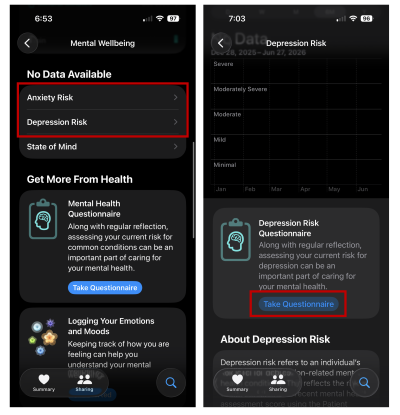
To take either of the questionnaires:
- Go into your Health app.
- Tap Search in the bottom right corner.
- Select Mental Wellbeing from the Health Categories.
- Choose Anxiety Risk or Depression Risk.
- Select Take Questionnaire.
Apple also lets you export the results as a PDF. If you feel you need professional help, you can use the data as a starting point for a conversation with a doctor.
Want to learn more about these questionnaires? Check out our PHQ-9 vs. GAD-7 guide.
So, why are these tools genuinely helpful?
While your Health app can’t actually diagnose depression, the strongest use case for Apple’s questionnaires is decision support. They help answer a quieter, more common question: Is this something I should take seriously?
For people who are unsure whether their feelings warrant professional help, a structured assessment can lower the barrier to seeking advice. It can also give language and numbers to experiences that are otherwise hard to articulate.
The bottom line
If you feel like you need some help with symptoms of anxiety or depression, Apple’s mental health questionnaires give you a solid starting point. They’re free, low-pressure, and can give you an answer in a matter of minutes.
While these features don’t diagnose depression, they do offer a private, accessible way to check your mental health risk and decide what to do next.
Max McCaskill
Sr. Staff Writer

Thousands of cell phone plans unpacked. All the facts. No surprises.

Related Articles


Related Topics
iOS FeaturedPopular Topics
Featured App Reviews iOS News Coverage Device Reviews Device Explainers Carrier Explainers App Roundups T-Mobile


Free iPhone 18 Pro, up to $1,200 off, with a trade-in in any condition or a line switch on Experience Beyond





.png?w=280&h=280&usm=20&usmrad=0.8&fit=crop "The Best Cheap Phone Plans for 2026: We Tested Them All to Help You Save")