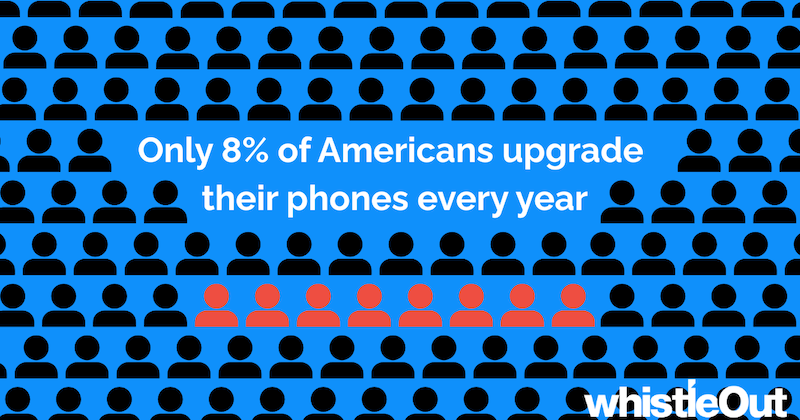
Every year, like clockwork, tech manufacturers like Samsung, Google, and Apple all release their latest and greatest phones, touting massive upgrades that they say will completely change how you interact with your smartphone. But in reality, only 8% of 1,000 people WhistleOut polled upgrade their phone every year, and another 17% upgrade only when their old phone leaves them no choice.
With mobile device prices now reaching upwards of $2,000, you might wonder whether an upgrade makes financial sense, or if you should skip the upgrade this year. In fact, a broken or unusable device is still the top reason people finally switch, followed by free or discounted carrier offers. For everyone else, waiting a year or two before pulling the trigger is ultimately the best bet.
The smartphone market: Are new phones really getting better?
Technically, yes, each new yearly rendition of flagship smartphones offers better upgrades than their predecessors. They have newer and more capable processors and often have upgrades in terms of camera and battery technology. But the difference from one year to the next isn't very noticeable.
With most smartphone manufacturers launching new devices every single year, most device upgrades underwhelm with limited changes or innovations. From Apple's yearly iPhone launch to Samsung's Galaxy releases and Google's Pixel launches also happening once a year, there's little time for major innovation between models.
Just because something is better doesn't mean it's much better.
Processor speed upgrades are usually minor at best, not to mention battery and camera tech. That means that if you have last year's model, it's almost certainly not worth paying all that cash for the latest and greatest device. Those tiny upgrades do add up, though, and a phone from today is likely dramatically better than one from five years ago.
Why you shouldn't upgrade your phone
Your phone is still perfectly fine
If you're happy with the phone you have, why upgrade to a new model? Unless the new model gives you a feature you can't live without, it likely isn't worth a swap. If you're on the fence about upgrading, consider whether your current phone handles everything you need it to. Ask yourself:
- Does it easily process the tasks you do daily?
- Does it take photos that you like?
- Can it still support the latest software updates?
If you answered "yes" to all of the questions above, you probably don't need a new phone. There might be a feature or two you're excited about. However, that doesn't mean that you need an upgrade.
Your current phone is paid off
If your phone still performs to your satisfaction and you have completely paid it off, you are in a very good place. Chances are, you're eligible to have your phone unlocked, which, living in a world without a cell phone contract, means you're free to take it to a new carrier. You can jump to any cell phone plan that fits all your needs at the best price possible, then do it again later in the year if you want.
If you're still on an installment plan, you can often pay off your financed phone early. Take a look at some of the most popular BYOP cell phone plans and see if one is right for you.
|
Visible

$25 Visible Plan
$25.00/mo
Taxes & Fees included
|
|
Mint Mobile

Unlimited Data Plan
$10.00/mo
$60 for 6 months of service
|
|
Verizon

Simplicity Plan
$30.00/mo
+ Taxes & Fees. Price includes AutoPay & Bring a Number discount
|
|
AT&T

Premium 2.0℠
$90.00/mo
+ $35 Upfront
|
|
T-Mobile

Experience Beyond 2.0
$100.00/mo
with Auto-Pay + Taxes and fees
|
The new devices aren't that interesting to you
With such a constant stream of new smartphones, we've reached a point where big, sweeping cell phone innovations are few and far between. Yes, phones are still getting faster, battery life is still improving, and cameras are getting better. But for many of us, these features already exceed expectations on the phones we currently own.
Upgrading smartphones seems less likely to impact our lives than it has in the past. This isn't necessarily a bad thing, and companies are starting to innovate with tech like folding phone screens. For now, new tech doesn't exactly make us feel like we need to get the new phone immediately.
Like above, if your phone still easily meets your daily needs, put that upgrade money to something better.
Signs you need to upgrade your phone
Some very valid reasons to think about upgrading to a new phone include:
- Your phone is slow, lagging, and freezing.
- Your screen or casing is damaged and likely to continue to degrade.
- Your software no longer supports new iOS updates or Android updates (and more importantly, new security updates).
- Your battery won't hold a charge.
There are more subjective reasons to upgrade, too. Maybe you really like taking photos with your phone, but find that its camera simply doesn't come close to newer camera phones. Or maybe you like gaming on your phone but find that its performance no longer keeps up. Perhaps you simply feel better having the most recent tech at your fingertips. If you have the funds to upgrade, then the choice truly is yours.
Holding out for the iPhone 18? Here's how to get it cheap.
Check out our full breakdown of what's new with the iPhone 18 to see whether Apple's latest features are worth the upgrade right now, or whether your current phone can hold you over a little longer.
Even better, we've detailed all the best deals to help you save on the newest iPhone. That includes device discounts and carrier offers for the best price possible.
Here are the best iPhone deals currently available:
iPhone 18 Pro 256GB
- 6.3 inch display
- Rear Cameras: 48MP, 48MP, 48MP
- Front Camera: 18MP

iPhone 18 Pro Max 256GB
- 6.9 inch display
- Rear Cameras: 48MP, 48MP, 48MP
- Front Camera: 18MP

iPhone 18 Pro 512GB
- 6.3 inch display
- Rear Cameras: 48MP, 48MP, 48MP
- Front Camera: 18MP


How to make your smartphone last longer
There are plenty of ways to ensure your phone lasts as long as possible. Some of them are obvious, but others might still be new to you.
Perhaps the most obvious way to take care of your phone is to simply be careful with it. Put a case on it, and don't submerge it in water. Don't throw it across the room or let it fall out of your pockets if you can help it.
Another way to keep your phone running longer is to make sure to upgrade to new software versions whenever you can. Often these updates come with new features designed for efficiency. While over time your phone will find it harder and harder to handle the updates, the trade-off for the latest and greatest security features is worth it.
Ready to upgrade? Financing options
If you need to upgrade but don't want to shell out the full price at once, plenty of financing options can lower your initial payment and split the cost into smaller increments. Financing your new phone is actually more common than you'd think. In a poll of 1,000 people, WhistleOut found that 37% of Americans couldn't afford a new phone without an installment plan, and 24% would skip upgrading entirely without one.
Financing through your carrier
You can snag serious device deals and discounts when you finance through a major carrier like Verizon, AT&T, and T-Mobile. If you sign up for a plan with one of the Big Three, you can qualify for a cheap monthly installment plan and trade in your current device for credits on your monthly bills. Depending on which plan you choose, you can also upgrade every year or two if you want to get your hands on the latest tech.
Check out our guides to major carrier upgrades:
- Verizon's early upgrade program
- AT&T's Next Up early upgrade program
- T-Mobile's JUMP!, Yearly UPgrade, and New in Two programs
Apple's financing program
Apple is debuting its all-new leasing program. Having discontinued the iPhone Upgrade Program in July 2026, Apple replaced it with Apple Upgrade, a leasing plan run through Klarna. The old program financed your iPhone, so it was yours free and clear once you finished paying it off. Apple Upgrade is a lease, which means that you don't own the phone at the end of your term unless you pay the buyout fee. You'll need to return the phone at the end if you don't pay it off.
Upgrading your smartphone: FAQ
What's the average smartphone lifespan?
The average smartphone lifespan is currently around six to seven years, but it seems shorter every decade. That's how long smartphone manufacturers like Apple and Samsung guarantee software updates for their devices. On average, you should expect to be able to keep a smartphone for at least four or five years without issue.
Are refurbished phones worth buying?
Whether a refurbished phone is a worthwhile purchase depends on where you're purchasing it from. Buying directly from a manufacturer or a carrier is the most reliable option and almost guarantees that the refurbished phone will be as good as new, though they'll be more expensive than refurbished phones from third parties. But buying refurbished phones from elsewhere can be a risk, and they sometimes arrive in worse condition—and you might have no recourse if it does.
When does the newest iPhone come out?
Apple releases new iPhones every September. The only exception to that rule was in 2020 when the company had trouble in the manufacturing process due to COVID. Since then, however, it has returned to its September release schedule.
How often should I upgrade my phone?
It's really up to you when you should upgrade your device. You might find that you're forced to upgrade every six or seven years when your phone no longer supports software updates or has gotten damaged. Other than that, it really comes down to how much new features and better processing power appeal to you and how you want to use your phone. Note, though, that you can often get a great deal on the previous year's model when the price drops right before the next model releases—this makes a great time to upgrade to last year's model and save a few bucks.
Christian de Looper
Contributing Writer

Thousands of cell phone plans unpacked. All the facts. No surprises.





.png?w=280&h=280&usm=20&usmrad=0.8&fit=crop "The Best Cheap Phone Plans for 2026: We Tested Them All to Help You Save")