If it feels like you’re spending too much on your mobile phone bill, you aren’t alone. Popular phone plans from major carriers like AT&T, T-Mobile, and Verizon are more expensive than they’ve ever been. Our survey shows that the average cost of an unlimited data plan for American families is $244/month.
In the wake of economic uncertainty and rising prices, many people are realizing that they can save by switching their phone service to smaller carriers called MVNOs. These carriers use the major carrier networks, but at significantly lower cost. MVNO unlimited plans can start as cheap as $30/month. That means a family using a major carrier instead of an MVNO is overpaying by over $2,200/ per year to get the exact same coverage.
We surveyed 1,000 Americans about their cell phone bill and current carriers. Let’s dive into the data and learn more about wireless plan overspending and how you can potentially save your family thousands.
Overview: Cell phone overspending
- Cell phone plan cost breakdown
- Household overspending by state
- What does your phone plan get you?
- Data usage statistics
- Big 3 carriers vs. MVNOs: Switching statistics
- MVNO misconceptions: Do they really have the same service?
- Ways to save on your phone bill
- Recap
- Methodology
MVNOs vs. The Big 3: What’s the difference??
The Big 3 is the nickname of the three largest wireless carriers in the United States: AT&T, T-Mobile, and Verizon. Also known as an MNO (mobile network operator), these companies sell phone plans that run on their own wireless infrastructure.
MVNO stands for mobile virtual network operator. These are smaller wireless carriers that rent access to the major carriers’ networks. Because they don’t pay for tower infrastructure, they can pass additional savings on to their customers.
Putting this into practice, Mint Mobile is an example of an MVNO. It’s a smaller carrier that rents access to T-Mobile’s massive network. Mint’s customers pay a fraction of the cost to get the same 4G LTE and 5G coverage as T-Mobile’s customers.
Cell phone plan cost breakdown
At WhistleOut, we track plan pricing for over 40 of the most popular wireless carriers in the U.S. That’s how we can confirm the price of many phone plans has been increasing over the past several years. The worst offenders are major carriers, which have raised prices, changed plans, canceled discounts, and even removed perks to steadily make phone service more expensive.
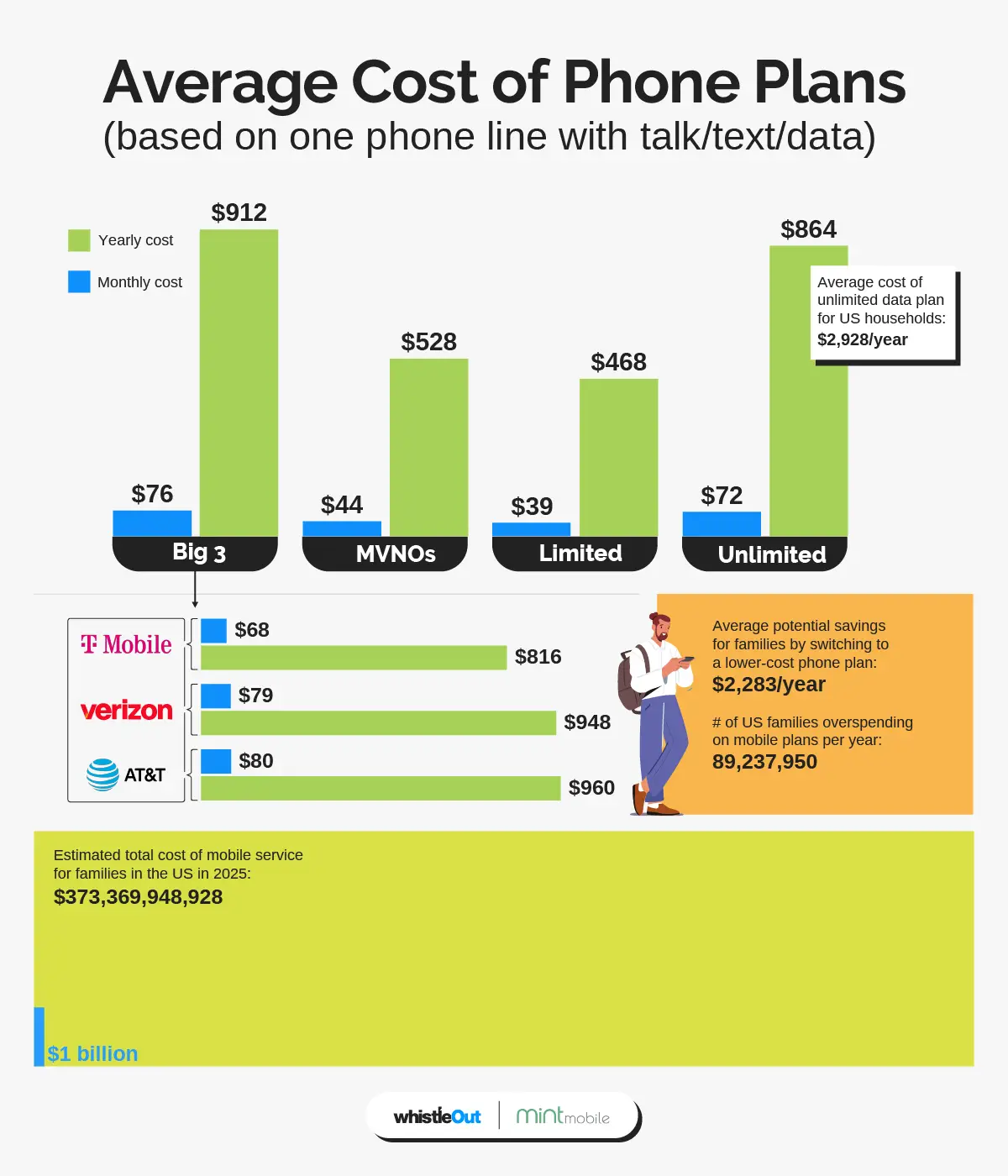
For a single-line phone plan, 59% of customers are currently spending more than $50/month. The most notorious culprits for these high prices are the Big 3, whose customers spend an average of $76/month ($912/year).
Breaking that down by each carrier looks like this:
- AT&T - $80/month ($960/year)
- Verizon - $79/month ($948/year)
- T-Mobile - $68/month ($816/year)
MVNO customers tend to save much more, with the average single-line costing $44/month ($528/year).
Of course, remember that many customers are on family phone plans. While these plans can score multi-line discounts from select carriers, it also means the overall cost of the bill is much higher.
- The average cost of an unlimited data plan (including taxes and fees) for US households is $2,928/year ($244/month).
- The average potential savings for families switching to a low-cost MVNO phone plan is $2,283/year.
- We estimate the number of US households overspending on mobile plans every year is 83,237,950.
- The estimated total cost of mobile service for households in the US for 2025 is $373,369,948,928.
Household overspending by state
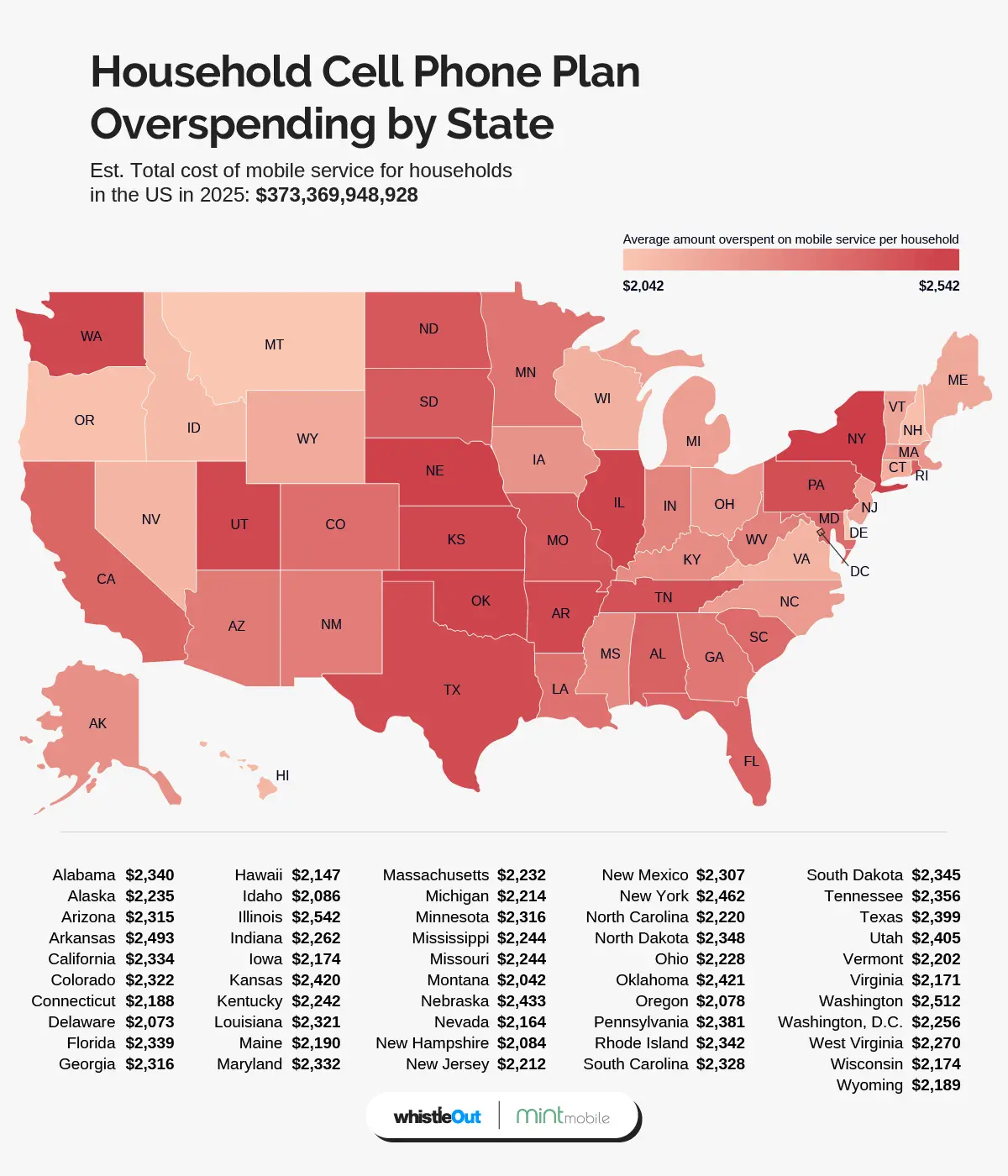
Here is how much we estimate households in each state are overspending on their wireless bill.
| State ▲ | Total Avg Annual Spend Per Household ▲ | Percent of Household Income ▲ | Total $ Spent on Phone Plans by Families in Each State ▲ | Total Potential Avg Annual Spend With Lowest Unlimited Plan Option Per Household ▲ |
Overspending Amount Per Household Per Year ▲ |
|---|---|---|---|---|---|
| Alabama | $3,002 | 4.95% | $5,911,917,692 | $662 | $2,340 |
| Alaska | $2,867 | 2.92% | $768,062,548 | $633 | $2,235 |
| Arizona | $2,971 | 3.59% | $8,308,001,168 | $655 | $2,315 |
| Arkansas | $3,198 | 5.06% | $3,803,086,481 | $705 | $2,493 |
| California | $2,994 | 3.33% | $40,228,950,641 | $661 | $2,334 |
| Colorado | $2,979 | 3.08% | $6,927,511,199 | $657 | $2,322 |
| Connecticut | $2,807 | 3.04% | $3,986,193,199 | $619 | $2,188 |
| Delaware | $2,659 | 3.08% | $1,053,674,909 | $587 | $2,073 |
| District of Columbia | $2,895 | 2.61% | $930,942,379 | $639 | $2,256 |
| Florida | $3,001 | 4.16% | $25,661,704,970 | $662 | $2,339 |
| Georgia | $2,971 | 4.10% | $11,908,310,621 | $655 | $2,316 |
| Hawaii | $2,754 | 2.83% | $1,346,787,475 | $608 | $2,147 |
| Idaho | $2,677 | 3.62% | $1,857,318,560 | $591 | $2,086 |
| Illinois | $3,262 | 3.71% | $16,315,231,521 | $720 | $2,542 |
| Indiana | $2,902 | 3.77% | $7,782,429,013 | $640 | $2,262 |
| Iowa | $2,866 | 3.54% | $3,736,383,595 | $632 | $2,234 |
| Kansas | $3,106 | 3.66% | $3,604,643,064 | $685 | $2,420 |
| Kentucky | $2,877 | 4.64% | $5,154,987,210 | $635 | $2,242 |
| Louisiana | $2,978 | 5.17% | $5,309,927,809 | $657 | $2,321 |
| Maine | $2,810 | 3.71% | $1,655,186,515 | $620 | $2,190 |
| Maryland | $2,992 | 2.93% | $6,998,862,055 | $660 | $2,332 |
| Massachusetts | $2,863 | 2.69% | $7,908,955,352 | $632 | $2,232 |
| Michigan | $2,841 | 3.69% | $11,477,976,773 | $627 | $2,214 |
| Minnesota | $2,971 | 3.29% | $6,783,475,295 | $655 | $2,316 |
| Mississippi | $2,880 | 5.23% | $3,258,960,843 | $635 | $2,244 |
| Missouri | $3,019 | 3.86% | $7,502,756,332 | $666 | $2,353 |
| Montana | $2,620 | 3.31% | $1,186,046,834 | $578 | $2,042 |
| Nebraska | $3,122 | 3.50% | $2,456,533,439 | $689 | $2,433 |
| Nevada | $2,776 | 3.41% | $3,285,630,395 | $612 | $2,164 |
| New Hampshire | $2,674 | 2.71% | $1,473,908,837 | $590 | $2,084 |
| New Jersey | $2,838 | 3.10% | $9,871,619,013 | $626 | $2,212 |
| New Mexico | $2,960 | 4.85% | $2,441,871,450 | $653 | $2,307 |
| New York | $3,158 | 3.87% | $24,219,836,168 | $697 | $2,462 |
| North Carolina | $2,849 | 4.15% | $11,926,986,868 | $628 | $2,220 |
| North Dakota | $3,012 | 3.91% | $979,214,758 | $664 | $2,348 |
| Ohio | $2,859 | 3.88% | $13,806,288,819 | $631 | $2,228 |
| Oklahoma | $3,106 | 4.61% | $4,792,466,024 | $685 | $2,421 |
| Oregon | $2,667 | 3.00% | $4,537,320,232 | $588 | $2,078 |
| Pennsylvania | $3,055 | 3.83% | $15,995,852,416 | $674 | $2,381 |
| Rhode Island | $3,004 | 3.67% | $1,312,584,668 | $663 | $2,342 |
| South Carolina | $2,986 | 4.32% | $6,183,022,605 | $659 | $2,328 |
| South Dakota | $3,009 | 3.68% | $1,078,743,580 | $664 | $2,345 |
| Tennessee | $3,023 | 4.16% | $8,368,616,245 | $667 | $2,356 |
| Texas | $3,078 | 3.89% | $33,074,977,323 | $679 | $2,399 |
| The United States | $2,929 | 3.63% | $373,369,948,928 | $646 | $2,283 |
| Utah | $3,085 | 3.05% | $3,378,005,400 | $681 | $2,405 |
| Vermont | $2,825 | 3.32% | $761,239,294 | $623 | $2,202 |
| Virginia | $2,786 | 2.89% | $9,266,452,580 | $615 | $2,171 |
| Washington | $3,223 | 3.45% | $9,736,311,124 | $711 | $2,512 |
| West Virginia | $2,912 | 4.82% | $2,100,759,443 | $642 | $2,270 |
| Wisconsin | $2,789 | 3.50% | $6,822,212,864 | $615 | $2,174 |
| Wyoming | $2,809 | 3.64% | $668,926,450 | $620 | $2,189 |
What does your phone plan get you?
Phone plans aren’t just for minutes, texts, and mobile data anymore. Carriers have gotten incredibly talented at adding extra perks and features to their wireless offerings. Some of these are helpful and can even save you money, like annual billing or bundles. Unfortunately, many others can drive up the price of your plan by charging you for features you don’t frequently use.
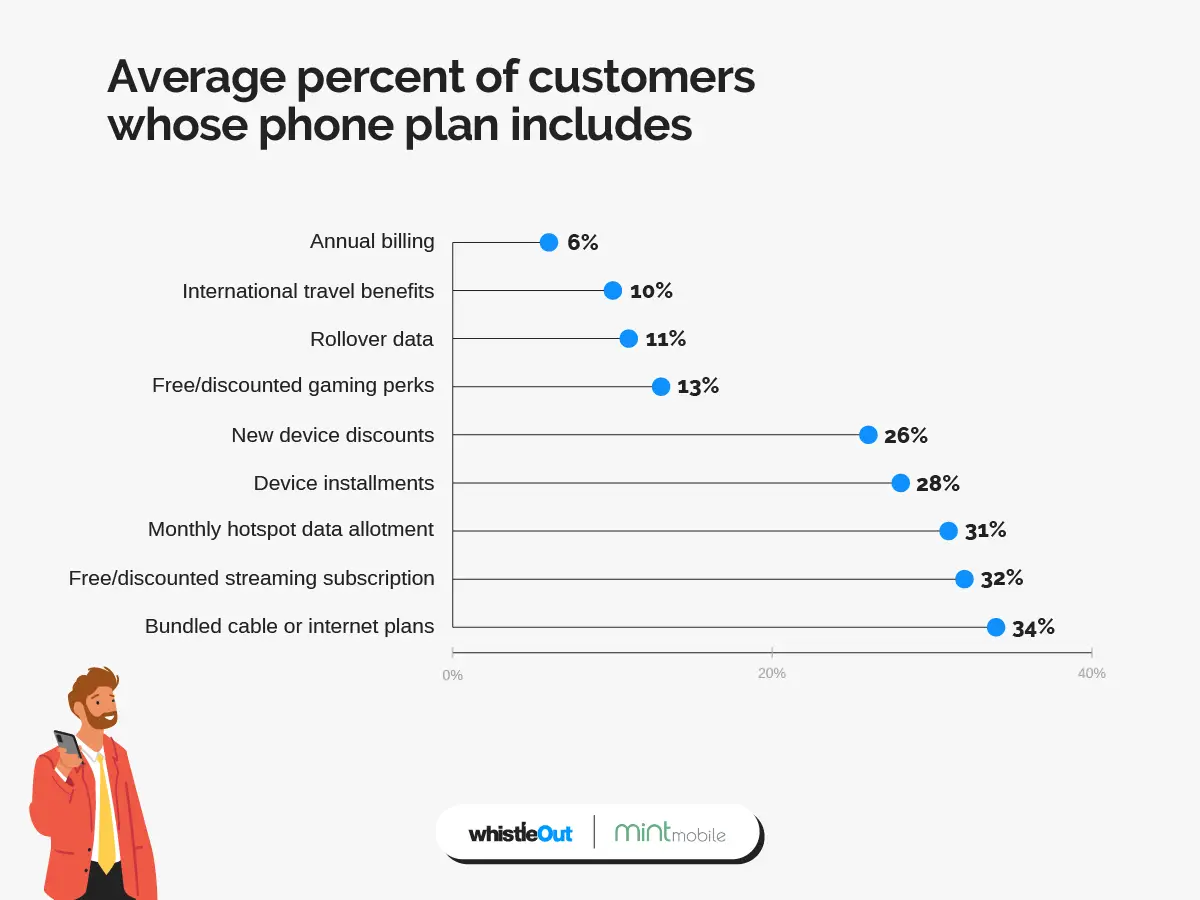
In addition to wireless data, here is the percentage of customers whose phone plans include extra features:
- Bundled cable or internet plans - 34%
- Free/discounted streaming subscription - 32%
- Monthly hotspot data allotment - 31%
- Device installments - 28%
- New device discounts - 26%
- Free/discounted gaming perks - 13%
- Rollover data - 11%
- International travel benefits - 10%
- Annual billing - 6%
Data usage statistics
If you’re on a plan from a major carrier, not only are you overpaying, but you’re probably paying for a lot more data than you need. Unfortunately, most customers don’t know how much data they need for a month.
- 23% of cell phone users don't know how to check their monthly data.
- Cell phone users use an average of 24GB of mobile data per billing cycle.
- Unlimited data customers use an average of 3x the amount of data as limited data customers.
- However, most customers with unlimited data plans (64%) use Wi-Fi exclusively for their daily activities, similar to 68% of limited data customers.
- 71% of limited data customers and 65% of unlimited data customers specifically seek out free WiFi outside the home.
- Only 21% of people use cellular data for most of their daily cell phone activities.
If you spend most of your time on Wi-Fi or only use around 20GB of data per month, you don’t need a massive premium unlimited plan from a major carrier.
Like the Big Three, MVNOs also offer unlimited plans with premium data, but they’re generally more in line with what customers actually need. Mint Mobile’s Unlimited plan includes 50GB of premium data (with unlimited 5G data after that allotment) and a 20GB mobile hotspot for only $30/month. A family of four switching from Verizon’s mid-range Unlimited Plus plan to a family plan of Mint Unlimited would save $720 annually. The savings only increase if you’re on a more expensive Verizon plan or pick a less expensive Mint option.
|
Mint Mobile

Unlimited Data Plan
$10.00/mo
$60 for 6 months of service
|
Big 3 carriers vs. MVNOs: Switching statistics
As wireless customers have started seeing the potential savings of switching to an MVNO, millions of them have left major carriers behind. If prices continue to increase, that number will only grow.
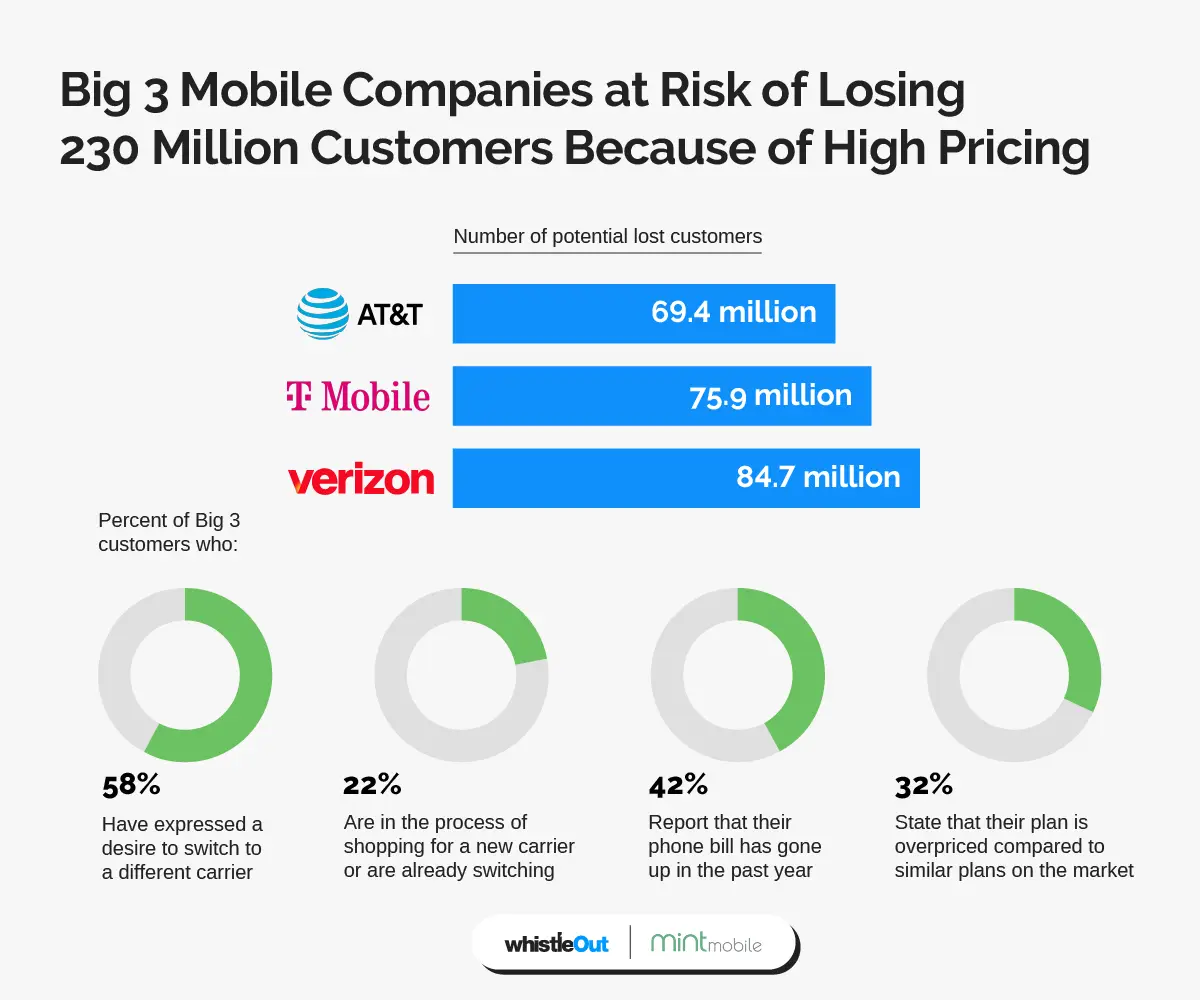
Based on our survey, the Big 3 carriers are at risk of losing 230 million customers combined because of high mobile plan pricing. What’s keeping many people from switching already? 35% of Big 3 customers are hesitant to switch to an MVNO because they’re not sure how to find the best plan, or don’t feel like doing the research.
- 58% of Big 3 customers have expressed that they would consider switching to a different carrier.
- 22% of Big 3 customers are already either shopping around or are in the process of switching.
- 34% of Big 3 customers say they'd consider switching to an MVNO within the next year.
- Over half of Americans (61%) surveyed didn't know that MVNOs operate on the same networks as the Big 3 prior to our survey.
- 42% of Big 3 customers say their phone bill has gone up in the past year (7% higher than average).
- 32% (nearly one third) of Big 3 customers think they're overpaying for their phone plan.
- Only 1 in 10 people think they're getting a good deal on their phone plan.
MVNO misconceptions: Do they really have the same service?
As you can see, a lack of knowledge about MVNOs and how major carriers operate is one of the biggest barriers keeping customers from switching. It pops up continuously in the top concerns about MVNOs from current Big 3 customers:
- I've been with my current carrier a long time and am loyal to that brand - 45%
- I'm worried about decreased quality of coverage - 28%
- I don't feel like doing the research for a new plan - 20%
- I believe that my monthly phone bill is already low enough - 16%
- I don't know how to switch carriers or don't know how to find the best plan - 15%
- I don't want to lose my current plan perks - 14%
- I'm worried about decreased quality of customer service - 14%
- I'm not sure what MVNOs are or haven't heard of them before - 12%
- I don't know how much data I need - 10%
Let’s tackle the biggest concern first: Customer loyalty. While you may feel loyal to your wireless carrier, remember that it feels no loyalty to you. In fact, Verizon just eliminated a slew of loyalty discounts in July of 2025, infuriating long-time customers and causing massive bill hikes overnight. While Verizon is the most recent culprit, T-Mobile and AT&T can also eliminate discounts, raise prices, and alter plans whenever they want.
As for worries about coverage, remember that MVNOs operate on the same networks as major carriers, so your coverage is the same. The MVNO you switch to may even be owned by the carrier you’re leaving. For example, Mint Mobile, Visible, and Cricket Wireless are owned outright by T-Mobile, Verizon, and AT&T, respectively.
Many MVNOs also offer perks as add-on services, like international roaming or extra mobile hotspot data. While MVNOs generally don’t have streaming subscriptions, you may find it’s cheaper overall to pay for the less expensive phone plan and a streaming service out of pocket than to pay for these services together.
Finally, if you’re struggling with research, WhistleOut is here to help. We can help you measure your mobile data usage, pick the best unlimited plan, and walk you through how to switch carriers.
Ways to save on your phone bill
While switching to an MVNO is one of the easiest ways to save on your phone bill, there are plenty of other things you can do to save even more.
- Annual plans: Some carriers will allow you to prepay for service for up to a year. By locking in your rate and plan, annual phone plans will generally provide a lower bill overall.
- Cheap family plans: Some MVNOs offer multi-line discounts and other special perks for customers on family plans. It may be worth considering joining a parent’s plan or getting a group of friends together on one bill.
- Limited data plans: Not everyone needs unlimited data. If you are connected to Wi-Fi most of the time (as most people are), you can save by switching to a limited plan.
- Cutting down on screentime: Smartphone addiction can drive up your data usage and phone bill. Setting screen time limits or reducing your smartphone use at bedtime is healthier for your brain and wallet.
- Bundling services: Save by bundling your internet and wireless services. Some wireless carriers and internet service providers have begun offering these bundles to help customers save and make billing more convenient.
What’s even better about these methods is that many can be combined. For example, carriers like Mint Mobile offer annual plans, cheaper rates for families, and have a selection of limited plans for low-data customers.
|
Mint Mobile
Unlimited Data Plan
$10.00/mo
$60 for 6 months of service
|
|
Mint Mobile
23GB Data Plan
$10.00/mo
$60 for 6 months of service
|
|
Mint Mobile
17GB Data Plan
$10.00/mo
$60 for 6 months of service
|
|
Mint Mobile
6GB Data Plan
$10.00/mo
$60 for 6 months of service
|
Recap: Switch to an MVNO and save
Phone plans are expensive, but you don’t have to pay top-dollar prices for them. MVNOs offer a way to score access to the nation’s top networks at a fraction of the price of postpaid plans from AT&T, Verizon, and T-Mobile.
Carriers like Mint Mobile offer one of the easiest ways to save big on your wireless bill. Mint has an excellent $30/month Unlimited Plan with 50GB of premium data and a 20GB hotspot, which is a perfect option for most average customers. All of Mint Mobile’s plans provide coverage through T-Mobile, which offers the largest 5G network in the nation and incredibly fast data speeds.
|
Mint Mobile
Unlimited Data Plan
$10.00/mo
$60 for 6 months of service
|
Methodology
We surveyed 1,000 U.S. adults using Pollfish. Results are post-stratified. MVNO average cost calculated using internal data.
Additional citations:
- Federal Reserve Bank of St. Louis: Median Household Income by State, Annual.
- World Population Review: Households by State 2025.
- Tax Foundation: Excise Taxes and Fees on Wireless Services Increased 8.8 Percent in 2024.
- Statista: Total Number of Customers/Subscribers of T-Mobile in the United States from 2018 to 2025.
- Verizon Fact Sheet - July 21, 2025.
- AT&T: Financial and Operational Schedules & Non-GAAP Reconciliations - April 23, 2025.
This page is sponsored by Mint Mobile in paid partnership with WhistleOut.
Max McCaskill
Sr. Staff Writer

Thousands of cell phone plans unpacked. All the facts. No surprises.





.png?w=280&h=280&usm=20&usmrad=0.8&fit=crop "The Best Cheap Phone Plans for 2026: We Tested Them All to Help You Save")