Growing up typically involves moving out of your parents' house and becoming financially independent. One of the easiest ways for young adults to assert their independence is by purchasing their own phone plan. However, that's not always what happens. In fact, 1 in 5 American adults is still on their parents’ phone plan.
This trend is not limited to the youngest adults in Gen Z. Overall, 34% of Millennials and 12% of Gen X are still on their parents' phone plan. For 1 out of 3 adults, their parents are even still paying for part or all of their plan. While the best family plans can save folks money, these situations can also lead to increased tension between parents and their children.
WhistleOut polled 1,000 adults to determine the trends surrounding adults on their parents’ phone plans. Here's what we learned.
The generational divide: How old is each generation in 2024?
Before diving into the data, it’s important to note the ages of each generation and who is covered in our data. This survey only includes adults aged 18 and up, so the younger members of Gen Z are not impacting our findings.
As of 2024, the age breakdown of each generation looks like this:
- Gen Z: Ages 12-27 (we only surveyed adults aged 18 and up)
- Millennials: Ages 28-43
- Gen X: Ages 44-59
- Baby Boomers: Ages 60-78
Adults on parents’ phone plan: Overview
- How many people are on their parents’ phone plan?
- Sharing tech expenses with family
- Trouble in paradise: Sharing expenses can cause family tension
- Financial independence: When should you get your first phone plan?
- Save money with an MVNO plan
- Methodology
How many people are on their parents’ phone plan?
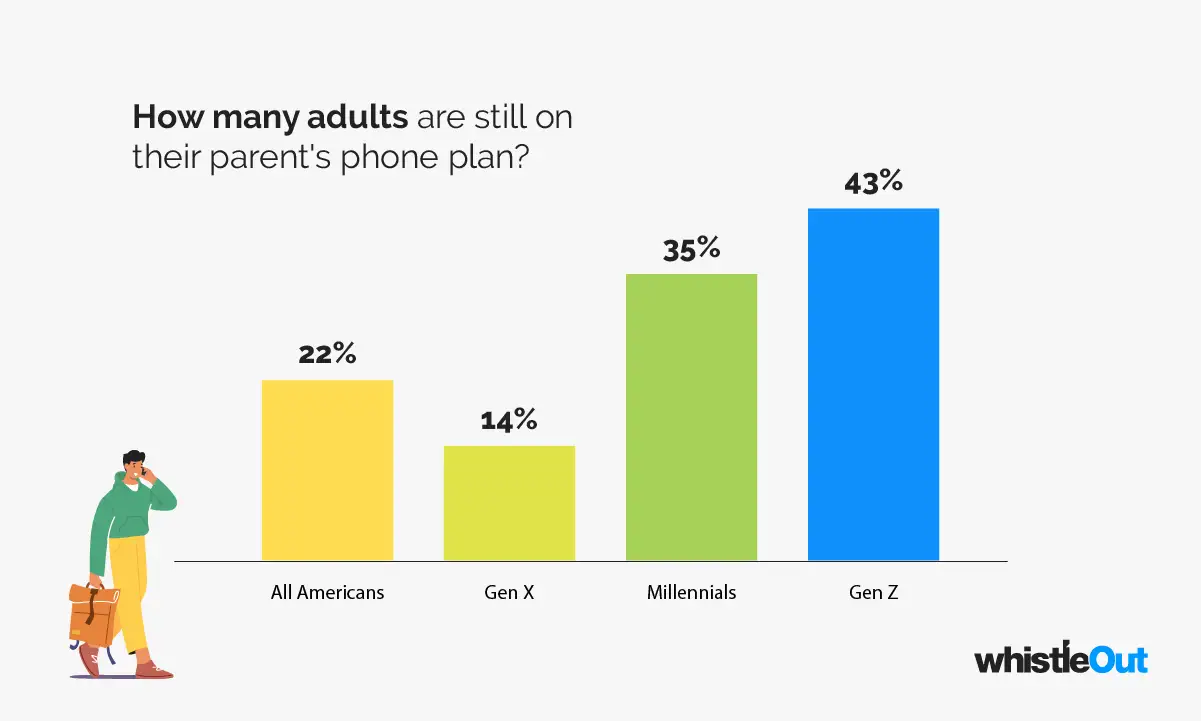
The percentage of adults still on their parents’ phone plan may surprise you, with 1 in 5 American adults still on their parents’ phone plan. This trend includes adult members of Gen Z, Millennials, and Gen X.
- 1 in 5 adults are on their parents’ phone plan, but over 1 in 3 admit to their parents paying for all or some of their phone bill.
- 35% of Millennials are still on their parent's cell phone plan, along with 43% of Gen Z and 14% of Gen X.
- Less than half of Gen Z-ers still on their parent's phone plan are planning on getting one of their own soon, but 66% don't want to stay on their parents' plan forever.
- Gen Z is the most likely generation to insist on contributing to the bill.
- 36% of adults on their parents’ phone plan don't help pay the bill—and 35% don't even know how much their plan costs.
In most cases, the adult children contribute to part of the bill. That said, 36% of adults don’t help pay at all. What’s surprising are the demographics of who is paying. Gen Z holds the largest share of adults on their parents’ plans, yet it is also the most likely generation to insist on contributing to the bill.
Does this trend mean Gen Z is more likely to stay on their parents’ phone plan, compared to Millennials or Gen X? Not necessarily. Many Gen Z adults are in college or early in their careers. In these cases, parents may be allowing their kids to remain on their plans while they’re getting themselves established. A Gen Z adult who insists on helping to pay the phone bill may eventually get their own plan once they’re fully financially independent.
The number of adults on their parents’ phone plans is decreasing
Our data from 2022 showed 34% of American adults were on their parents’ phone plan. Today, that number is down to around 22%. The impact of inflation and rising phone plan costs have likely pushed many parents to remove their children from their plans or caused families to change carriers altogether. AT&T, T-Mobile, and Verizon have all increased the costs of their plans over the past two years. “Grandfathered” plans—old plans no longer available to new customers—have been hit with rate hikes, too.
In the wake of this, more Americans are dropping plans with major carriers and switching to MVNOs. In our 2024 Mobile Overspending Report, we found that 47% of Americans now subscribe to an MVNO. In 2023, 62% of Americans were on plans from major carriers like AT&T, T-Mobile, and Verizon. This year, that number is down to 53%.
Both of these trends—adults leaving their parents’ plans and a major increase in MVNO carrier subscribers—point to many Americans looking for ways to save on their phone bills.
Sharing tech expenses with family
Sharing costs is not limited to phone plans. Adults split costs with their families across the board for all kinds of technology and services. This can include internet plans, streaming subscriptions, and even devices.
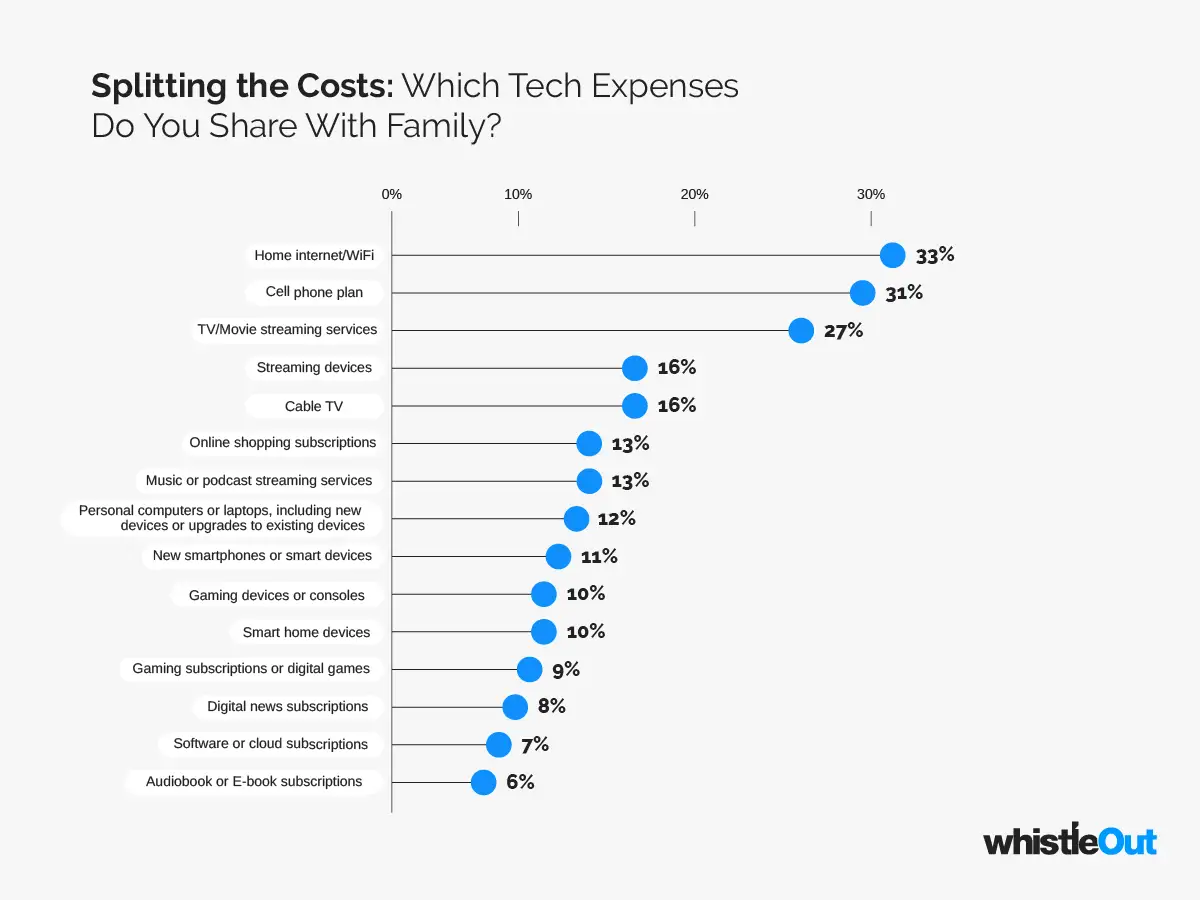
- 60% of adults split the cost of one or more tech expenses with family members (parents, siblings, children, etc.).
- Cell phone and internet bills are the most popular tech expenses to split costs with family members, followed by streaming services/devices, and cable TV.
- Gen Z is the most likely generation to split the costs of tech expenses with family.
- 27% of Americans share streaming services with family members—but 33% of adults still use their parents' streaming accounts.
While sharing costs among family members can make sense, parents are still largely paying for the majority of the services.
- Half of Millennials use cell phones, Wi-Fi, and streaming services paid for by their parents.
- 80% of Gen Z and 76% of Millennials have one or more tech bills that their parents pay for, including cell phone plans, home Wi-Fi, subscriptions, or devices.
- 49% of Millennials use their parents' streaming services, and 26% still use their parents' cable TV.
While these numbers may seem high, remember that many families are sharing costs. Streaming subscriptions are a great example. Many families share the costs of streaming to access multiple services on the cheap. For example, I’m 27 and one of the oldest members of Gen Z. My parents pay for YouTube TV and Netflix. I pay for Max and the Disney+ bundle. I would qualify as part of the 80% of Gen Z with parents paying tech bills, yet I’m still contributing overall.
Password sharing
Amid all this family sharing, you should note that data security is put at risk if you have to share passwords. The more people that know your password, the more likely it is that it could be stolen. Someone breaking into your Netflix account is probably not a big deal. However, someone accessing your phone plan could potentially wreak havoc. They’d have access to your account information and could potentially take over your phone numbers.
Make sure to create a strong password for all your services. For family phone plans, we also recommend just one person controlling access to the account. Make sure it’s someone in your family that you trust and can handle the responsibility of paying the bill.
Trouble in paradise: Sharing expenses can cause family tension
Anything involving finances can inevitably cause tension among family members. Some parents may want their adult children off their phone plans. On the other hand, many adults who are on their parents' plans simply don’t want to deal with the hassle of getting their own plan and managing the bill.
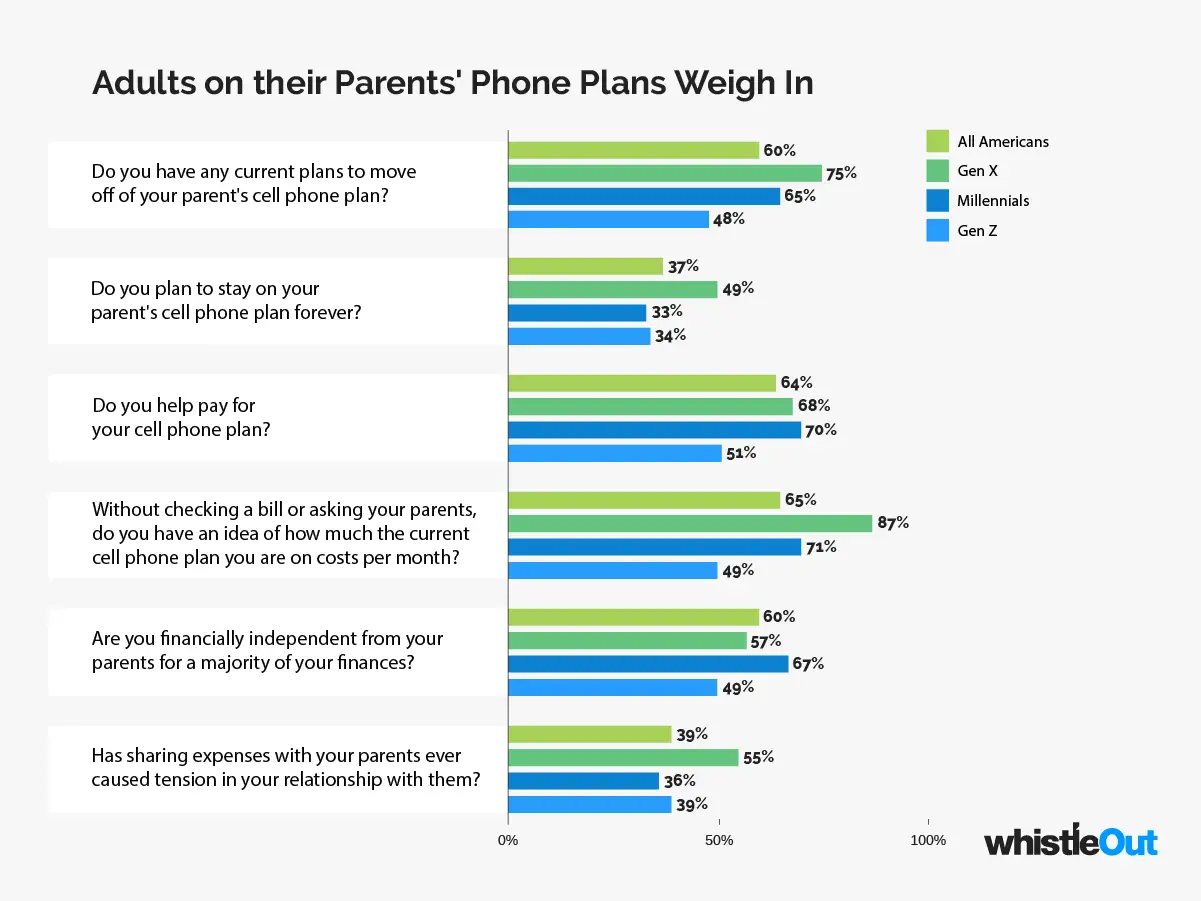
- 39% of adults who share expenses with their parents have experienced tension in their relationship because of it, with Gen X the most likely generation to feel the strain (55%).
- Despite this, half of Gen X-ers on their parents’ phone plan want to stay on it forever (compared to only 33% of Millennials and 34% of Gen Z-ers).
Half of Gen X adults on their parents’ plan reported strain and tension due to sharing a plan. This does make sense. Gen X’s ages stretch from 44-59 years old. There’s a lot going on in people’s lives during this time. As for their parents, they’re seniors and likely need a smaller and cheaper phone plan. Gen X-ers may also have kids of their own who need a phone plan. All of this means someone may get stuck with a plan that is more expensive than they want or doesn’t meet their needs.
WhistleOut team: Our experiences as adults on our parents’ plans
Some of our team members here at WhistleOut have recently dealt with parents and family phone plans. I left my parents’ phone plan this past May. Ammy Archer, our Digital PR Specialist, went the other route and recently joined a phone plan with their parents.
Check out the dropdown boxes below to read about our experiences:
1. What was the biggest factor in your decision to move off of your parents' phone plan?
I was looking for more flexibility, both with my plan and device. I realized I didn’t need as much data as my parents’ plan offered, so I could save money overall. Plus, there were other plans with cheaper options for international coverage when I traveled abroad. As for my device, my phone was originally on an installment plan. The process of going through my parents to pay it off and upgrade early was just a pain.
2. Has your overall stress increased or decreased since making that decision? Have you faced any particular challenges because of it?
At first, my overall stress increased. I left AT&T for a cheap carrier with access to both AT&T’s and T-Mobile’s networks. Unfortunately, I didn’t get to choose which network I received, and the carrier put me on T-Mobile—which does not have great service in my area. I was dropping phone calls and texts were failing to send. I eventually switched to Boost Mobile, which placed me on AT&T’s network from the start. Now, my stress levels have greatly decreased because I have good coverage and a cheaper bill.
3. How did this decision affect your finances?
This was a great decision for my finances. My line with AT&T was around $40/month on my parents’ plan. With Boost, it’s around $25/month. Plus, I have the ability to switch carriers whenever I want. When I take a trip abroad, I pop over to a Google Fi plan for a month for its international coverage. On AT&T, I could pay up to $120/month on top of my regular bill for international roaming (that’s $160 total). With Google Fi, international data is a standard part of the Unlimited Plus plan at just $65/month.
4. What was your user experience with getting your own plan? Was it complicated?
Getting my own plan was not complicated. Most carriers walk you through the process of switching. That said, I have needed to contact customer service for help a couple of times. If you’re not a technical person, make sure your carrier has an active phone customer service line. I’ve used carriers that only offer customer service through online chat, and it’s an incredibly frustrating experience if you have a complicated problem.
5. If you could give one piece of advice to a young adult seeking financial independence from their parents, what would you share with them?
Make sure to look at all your options and have a good understanding of what you need from a phone plan. Most people can get by on a smaller and cheaper plan. That said, if you need a massive data allotment or use your mobile hotspot extensively, the cheapest option might actually be a family plan from a major carrier. Additionally, don’t forget your device when making this decision. Cheaper phone plans generally don’t include device installment options. If you can’t afford to pay out of pocket for a new phone, you might need the two- or three-year installment plans of the major carriers.
1. What was the biggest factor in your decision to join or stay on your parents’ phone plan?
Saving money and convenience were the two biggest factors for us. We’re all close, and after doing some research, we realized we could all save a lot of money, and it just made the most sense if we went in on a family plan together.
2. Has your overall stress increased or decreased since making that decision? How have you handled any communication challenges?
It’s always a little challenging to navigate finances and bills with someone else, especially when that someone is your parent, but communication is key. It was pretty stressful at first, but now that we’re on the same page, I think we’re all less stressed about our bills overall.
3. How did this decision affect your finances?
I was previously with AT&T before switching to Mint Mobile, and now I save an average of around $45 per month (not including taxes and phone installment payments), so I’d say my finances have improved. That $45 might not seem like a lot, but I can put it towards groceries or other things my kids need.
4. What was your user experience with getting a family plan? Was it complicated?
It felt really daunting for all of us—me, my parents, and one of my brothers—to switch away from our previous carriers to a new family plan all at once, and we put it off for too long. Honestly, the process was a lot easier than I expected it to be, and it didn’t require all of us to coordinate with each other. We just set up our own accounts, clicked an invite for the family plan, and that was it. I’m also able to pay my own portion of the bill through Mint’s app instead of trying to remember to send my parents money every three months when our bill comes out, which is an incredible bonus.
5. If you could give one piece of advice to a young adult seeking financial independence from their parents, what would you share with them?
Get your own cheap phone plan as soon as you’re able. Even though I’m on a plan with my parents now as an adult, I had a few years of complete financial independence first that I think were a key factor in learning how to manage my money and set financial boundaries with my loved ones. It can be a lot harder to have good communication with your parents if you’re not seeing each other as equals, even if you’re paying your fair share of the bills. While saving money is a huge appeal these days, there’s power in being able to confidently make your own financial choices.
Financial independence: When should you get your first phone plan?
There is no right or wrong time to get your first phone plan. If your parents don’t mind you sticking around, and you’re contributing to the bill, you may even be helping reduce the costs of their phone lines, too. Remember, family plans generally offer additional multi-line savings over single-line plans. That said, if your parents want you off their plan, it might be time to strike out on your own.
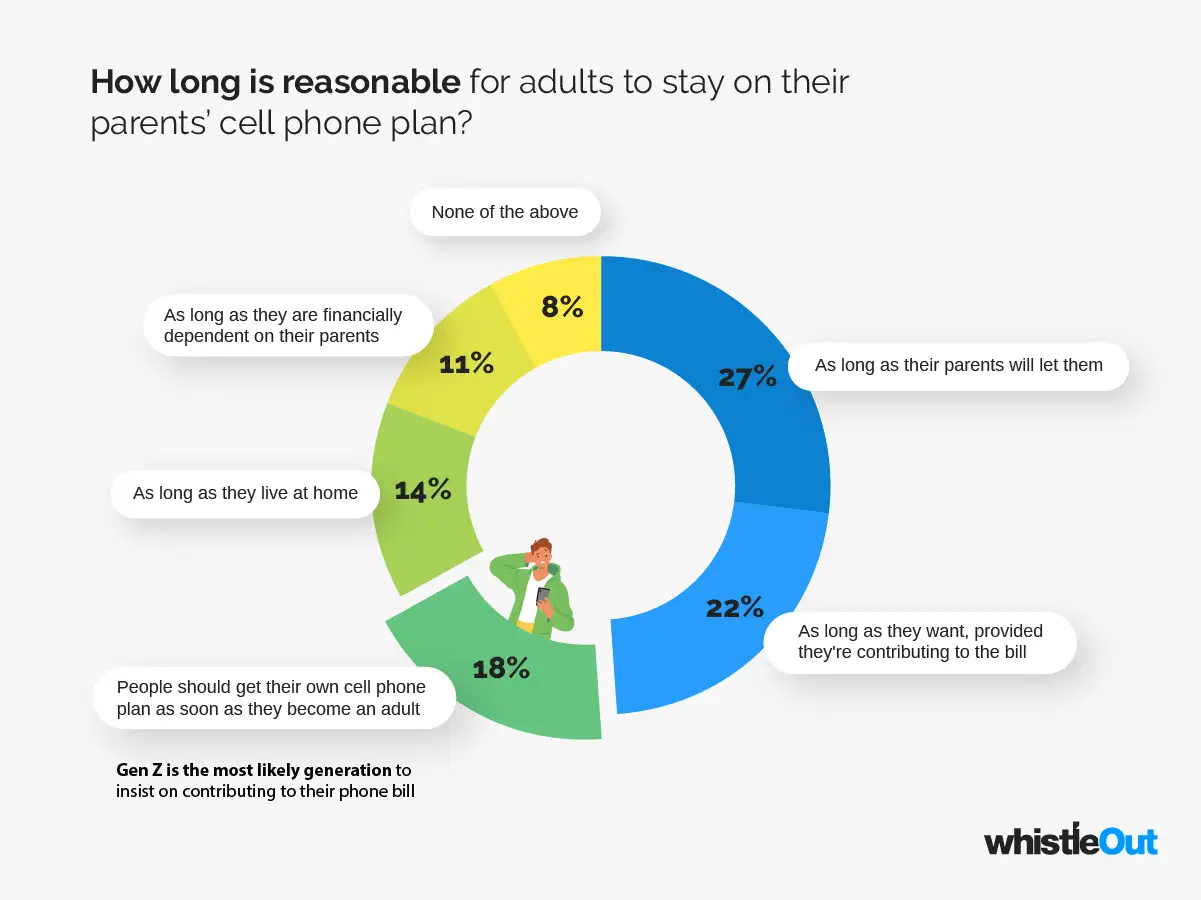
- Most people don't have a problem with adults staying on their parents’ cell phone plan, but 22% say they should be contributing to the bill, and 1 in 4 think an adult should only be on their parent's plan if they still live at home or are financially dependent on their parents.
- Nearly 1 in 5 Americans think people should get their own cell phone plan as soon as they hit adulthood, but not every generation agrees—Baby Boomers are the most likely to kick new adults off their phone plan (25%) versus Gen X and Millennials (15%).
- Only 12% of Gen Z think that you should get your own phone plan as soon as you're an adult, but out of every generation, they're the most likely to insist on contributing to the bill (27%).
- Only 57% of Gen X claim to be financially independent from their parents for a majority of their expenses, surpassed by 67% of Millennials.
- Unsurprisingly, Baby Boomers are the most financially independent generation—but nearly half of them still share expenses with family members.
Pros and cons of the family phone plan
Family plans are a great tool for saving money if everyone contributes. In the wake of recent inflation trends, some families are even rejoining family plans to help everyone save. That said, remember that family plans take patience and trust from your other members. You may have fewer options to adjust your plan, and often, you must rely on someone else to pay your bill.
Family plan pros and cons
Pros:
- Generally cheaper per line
- Access additional perks from some carriers
- Avoid the responsibilities of owning a plan
Cons:
- Less flexibility
- Potential for family conflict
- May end up paying for more than you need
You can save with an MVNO phone plan
At the end of the day, your relationship with your parents and family’s sanity is likely worth more than saving a few bucks on a phone plan. Luckily, there are plenty of options to save whether you’re looking for your first-time phone plan or if your family wants to keep their plan intact.
MVNOs are smaller carriers that operate on the AT&T, T-Mobile, and Verizon networks. Since they rent access to the major networks, they generally offer plans at much cheaper prices. You can find MVNOs offering both single-line and family plan options.
First-time phone plans
If you’re leaving your family plan and searching for a single-line plan, here are some of the best first-time phone plans on the market. Remember, you can bring your current phone and number to your new plan.
Cheap single-line plans
| Carrier | Visible |
Mint Mobile | US Mobile |
|---|---|---|---|
| Plan | Visible $25 plan | Unlimited | Unlimited Premium |
| Data | Unlimited (subject to deprioritization) |
Unlimited (50GB premium before deprioritization) |
Unlimited (100GB premium before deprioritization) |
| Best for | Value | 5G speeds | Mobile hotspot |
| Network | Verizon | T-Mobile |
T-Mobile, Verizon, or AT&T |
| Starting price | $25/month | $30/month ($15/month for the first 3 months) | $44/month |
| View plan | View plan | View plan |
Family plan MVNOs
If your family decides to stick together, you can still save big by picking a family plan from an MVNO. While some MVNOs only offer single-line plans, others offer family plans with multi-line discounts and might even include special perks. For example, Mint Mobile’s Modern Family Plan guarantees the cheapest price for each line with its family plans, and US Mobile includes a streaming perk with three or more lines on the Unlimited Premium plan.
Cheap family plans
| Carrier | Twigby Mobile |
Mint Mobile | US Mobile |
|---|---|---|---|
| Plan | Unlimited Talk, Text, and 10GB |
Unlimited | Unlimited Premium |
| Data | Unlimited (10GB premium, then throttled to 2G) |
Unlimited (50GB premium before deprioritization) |
Unlimited (100GB premium before deprioritization) |
| Best for | Value | 5G speeds | Mobile hotspot |
| Network | Verizon | T-Mobile |
T-Mobile, Verizon, or AT&T |
| Starting price (4 lines) |
$100/month ($25/line) |
$120/month ($30/line) | $176/month ($44/line) |
| View plan | View plan | View plan |
Methodology
We conducted a survey of 1,000 adults via Pollfish. Results of the survey have been post-stratified.
Max McCaskill
Sr. Staff Writer

Thousands of cell phone plans unpacked. All the facts. No surprises.

Related Articles


Related Topics
Research and ReportsPopular Topics
Featured App Reviews iOS News Coverage Device Reviews Device Explainers Carrier Explainers App Roundups T-Mobile


Free iPhone 18 Pro, up to $1,200 off, with a trade-in in any condition or a line switch on Experience Beyond





.png?w=280&h=280&usm=20&usmrad=0.8&fit=crop "The Best Cheap Phone Plans for 2026: We Tested Them All to Help You Save")