According to the FCC, U.S. consumers receive approximately 4 billion robocalls per month. Advances in technology have made it easy to bombard people with these kinds of calls. Virtually no one is safe with the majority of Americans now reporting they have been targeted by phishing or vishing scams through their phones.
The rise of AI and the current hyper-charged political environment of the U.S. could make the situation worse. Despite the practice being illegal, AI-generated voices have already been used in scams and political robocalls. Unfortunately, nearly half of Americans doubt they could identify an AI-generated robocall, leaving a potential opening for bad actors.
Here at WhistleOut, we analyzed robocall data across all 50 states from the YouMail Robocall Index (2020–2025) and the FTC's National Do Not Call Registry to determine which states are most affected by spam calls in 2026. We also polled 1,000 American adults about their phone habits.
Our findings show an out-of-control robocall epidemic targeting Americans of all ages and backgrounds. We've also found information on the most common scams, the states with the highest number of robocalls, and what steps you can take to protect yourself.
Robocall epidemic: Overview
- What is a robocall and how does it work?
- What are the most common robocall scams Americans are receiving?
- Are robocalls legal?
- Robocalls in your state
- Spam calls by the numbers: Expect 58 billion robocalls by 2028
- Who is getting robocalls?
- Robocall victim demographics: Millennials are most susceptible
- New threats: AI scams and political disinformation
- Fighting back: 74% of Americans have joined the Do Not Call Registry
- How to stop spam calls
- Methodology
What is a robocall and how does it work?
A robocall is an automated phone call that delivers a pre-recorded message, typically sent to thousands of numbers at once using a computerized autodialer. Basically, it's a robot making a phone call, hence the name "robocall."
Although frequently associated with scams, many legitimate institutions use robocalls. If you opt into them, groups like schools, civic organizations, churches, and municipalities can use them for announcements. Additionally, charities and political parties can use them for fundraising.
Telemarketers can also use robocalls. While these are typically not illegal, many people consider them a form of spam.
What are the most common robocall scams?
Robocalls are the most prevalent type of spam calls, followed by telemarketing calls, scam calls, and debt collections.
The simplicity of robocall systems makes them easy for bad actors to abuse for scams. These operations can be complex and extremely varied. Most involve robocalls connecting victims to real people who walk them through the steps of a scam. The people running these operations may not even be in the U.S., but the ability to spoof phone numbers and mimic legitimate websites can fool anyone.
The most common kinds of phone scams Americans report receiving are tech support scams (37%), IRS scams (33%), lottery scams (32%), vacation scams (31%), and extortion scams (19%). That said, thieves are incredibly creative and there are multiple ways they target victims.
Here are some of the most popular phone scams and their definitions:
- Impostors: Calls pretending to come from a legitimate company or an individual that victims know in person, such as a friend or family member.
- Extortion: A call claiming to have negative information about victims that won't be released if they do as the call says.
- Medical calls: Fraudulent calls related to the health care industry—such as a hospital or insurance company—asking for information.
- Debt consolidation or collecting: Calls targeting individuals with debt demanding they pay immediately or offering opportunities to reduce it.
- IRS: Calls mimicking the IRS informing victims they owe unexpected taxes that must be paid immediately.
- Lottery: The caller claims you've won the lottery and need to provide information to collect your winnings.
- Expiring warranty: A scam that tricks customers into purchasing a fake or largely useless extended warranty on their vehicle.
- Vacations: Calls telling victims they've won a free trip or attempting to sign individuals up for a timeshare presentation.
- Money-making opportunities: Calls from fake financial advisors offering incredible investment opportunities at deep discounts.
- IT assistance: A fraudulent call claiming to come from a major tech company—like Microsoft or Apple—saying there are issues with your computer or smartphone.
Important note: Texts can be spam too
Don't forget that many of the most popular scams can also come through text messages. Avoid clicking links sent through text and don't respond to messages from unknown numbers.
Are robocalls legal and what does the law say about them?
Not all robocalls are illegal, but most unsolicited ones are. Any and all prerecorded telemarketing calls are illegal without explicit written consent. However, informational messages (like appointment reminders) or non-commercial calls (from your political party) are not illegal.
The Telephone Consumer Protection Act (TCPA) is the primary federal law governing robocalls. It prohibits automated calls to cell phones without prior written consent and bans robocalls to numbers on the Do Not Call Registry. The Federal Communications Commission then enforces the TCPA, with violations subject to fines of up to $1,500 per call.
Robocalls in your state
All states enforce federal anti-robocalling laws (TCPA), while a handful of states have stricter state-level enforcement, including California, Colorado, Indiana, Florida, Oklahoma, Washington, Missouri, and Arizona. These measures range from dedicated Do-Not-Call lists, automated text restrictions, and requiring prior written consent for telemarketing calls.
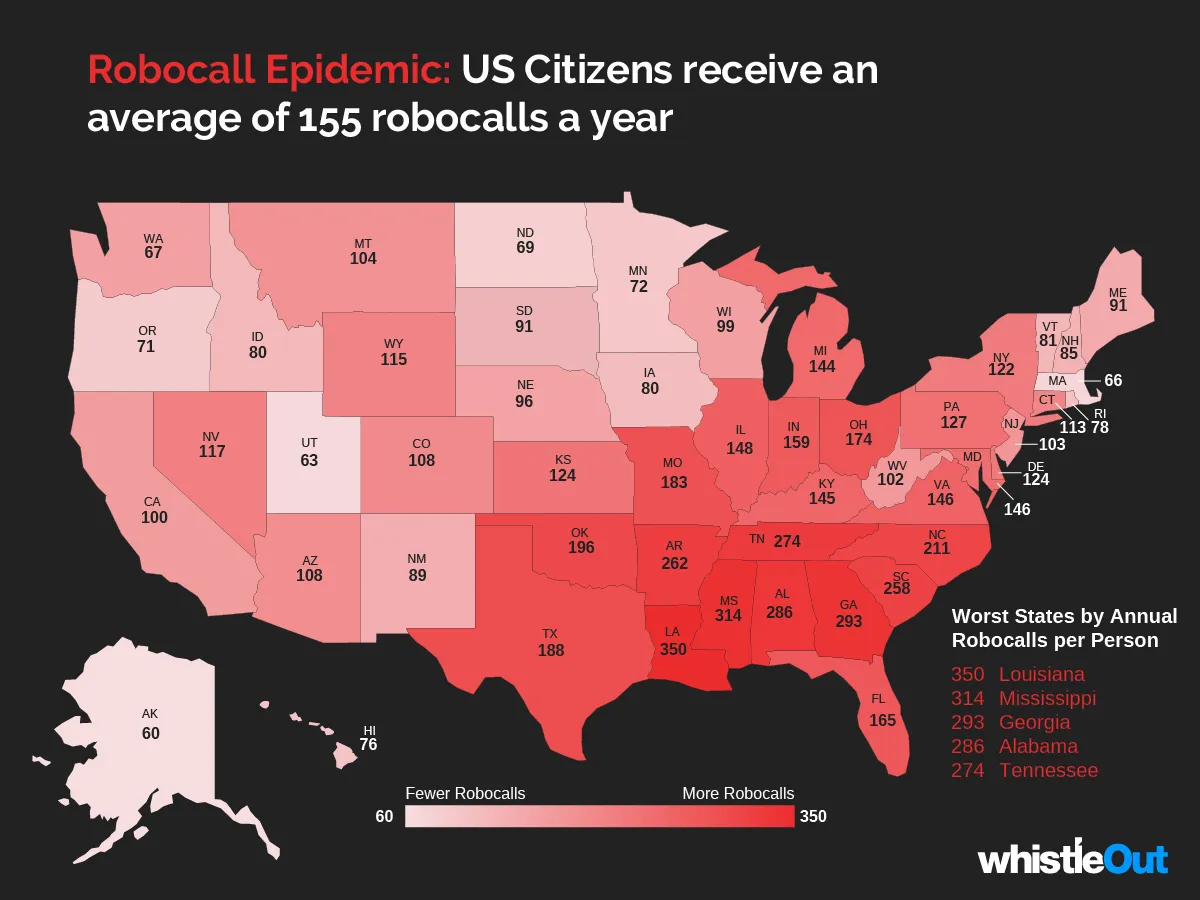
Top 10 states receiving the most robocalls per person
While robocalls are widespread, not every state suffers equally. Individuals from states like Louisiana and Mississippi can expect well over 300 calls per person each year. On the other end of the spectrum, states like Alaska and Utah see fewer than 65 per person annually.
The top 10 states with the most robocalls per person are:
- Louisiana (350 calls per person)
- Mississippi (314 calls per person)
- Georgia (293 calls per person)
- Alabama (286 calls per person)
- Tennessee (274 calls per person)
- Arkansas (262 calls per person)
- South Carolina (258 calls per person)
- North Carolina (211 calls per person)
- Oklahoma (196 calls per person)
- Texas (188 calls per person)
Louisiana tops the robocall list with an astounding 792% increase from 2020-2025. In total, Louisiana residents suffer more calls per person than residents of the five least-spammed states combined. Mississippi's rise to second place is also notable, with a 117% increase in robocalls over the same period.
States receiving the fewest robocalls per person per year
The five states with the fewest robocalls per person are:
- Alaska (60 calls per person)
- Utah (63 calls per person)
- Massachusetts (66 calls per person)
- Washington (67 calls per person)
- North Dakota (69 calls per person)
Contrary to the increase in robocalls in most states, Utah has actually seen a 34% decrease in robocalls from 2020-2025, one of the largest drops in the nation. That said, it's likely many of these states have lower call numbers because they have lower populations overall.
Where does your state rank for robocalls?
Check out the full state list below to see how many robocalls plague your area and how much call volume has changed since 2020.
| Rank [1 is the worst] | State | 2025 (Total Spam Calls) | Spam Calls Per Person Annually | % Change 2020–2025 |
|---|---|---|---|---|
| 1 | LA | 1,614,679,600 | 350 | 791.67% |
| 2 | MS | 923,007,800 | 314 | 117.22% |
| 3 | GA | 3,340,066,000 | 293 | 12.34% |
| 4 | AL | 1,497,196,800 | 286 | 33.68% |
| 5 | TN | 2,023,584,800 | 274 | 39.02% |
| 6 | AR | 817,492,900 | 262 | 42.17% |
| 7 | SC | 1,459,240,700 | 258 | 39.66% |
| 8 | NC | 2,395,731,200 | 211 | 35.33% |
| 9 | OK | 816,936,200 | 196 | 62.00% |
| 10 | TX | 6,107,772,500 | 188 | 17.50% |
| 11 | MO | 1,158,075,500 | 183 | 67.52% |
| 12 | OH | 2,089,343,500 | 174 | 15.87% |
| 13 | FL | 4,015,047,900 | 165 | 6.98% |
| 14 | IN | 1,117,330,800 | 159 | 77.62% |
| 15 | IL | 1,899,881,500 | 148 | 18.19% |
| 16 | VA | 1,305,471,500 | 146 | 8.22% |
| 17 | KY | 675,062,500 | 145 | 24.96% |
| 18 | MI | 1,481,362,500 | 144 | 24.69% |
| 19 | MD | 883,512,200 | 139 | -8.62% |
| 20 | PA | 1,670,429,800 | 127 | 2.36% |
| 21 | KS | 374,428,500 | 124 | 51.93% |
| 22 | DE | 133,992,700 | 124 | -8.94% |
| 23 | NY | 2,456,022,000 | 122 | -4.09% |
| 24 | NV | 395,300,400 | 117 | -18.83% |
| 25 | WY | 68,310,900 | 115 | -12.40% |
| 26 | CT | 422,450,500 | 113 | -9.61% |
| 27 | CO | 655,308,900 | 108 | -9.75% |
| 28 | AZ | 839,824,700 | 108 | -14.80% |
| 29 | MT | 119,861,700 | 104 | 5.56% |
| 30 | NJ | 1,005,598,200 | 103 | -12.48% |
| 31 | WV | 181,063,200 | 102 | 37.94% |
| 32 | CA | 3,993,702,700 | 100 | -11.52% |
| 33 | WI | 597,756,800 | 99 | 43.64% |
| 34 | NE | 196,615,000 | 96 | 20.66% |
| 35 | SD | 85,133,200 | 91 | 17.34% |
| 36 | ME | 128,270,100 | 91 | 24.00% |
| 37 | NM | 191,677,200 | 89 | -1.39% |
| 38 | NH | 120,627,300 | 85 | -3.33% |
| 39 | VT | 52,494,500 | 81 | 18.80% |
| 40 | ID | 164,924,300 | 80 | -13.01% |
| 41 | IA | 262,520,500 | 80 | 8.51% |
| 42 | RI | 88,049,700 | 78 | -12.25% |
| 43 | HI | 110,042,400 | 76 | -7.62% |
| 44 | MN | 421,897,800 | 72 | 5.12% |
| 45 | OR | 305,918,200 | 71 | -8.31% |
| 46 | ND | 56,118,800 | 69 | 0.58% |
| 47 | WA | 547,977,500 | 67 | 1.82% |
| 48 | MA | 479,595,900 | 66 | -1.04% |
| 49 | UT | 226,532,700 | 63 | -33.61% |
| 50 | AK | 45,195,600 | 60 | 83.85% |
States filing the most and fewest complaints to the Do Not Call Registry
When it comes to filing complaints per 100,000 residents, the data shows a wide gap between the most and least proactive states.
States with the highest number of DNC complaints:
- Arizona (1,028)
- Tennessee (1,017)
- Nevada (960)
- Illinois (943)
- Florida (933)
States with the fewest DNC complaints:
- Hawaii (393)
- North Dakota (425)
- Rhode Island (441)
- Iowa (498)
- Minnesota (525)
Arizona sits at the top of the DNC complaint list despite its absence from the list of the top ten states suffering from robocalling. Tennessee, on the other hand, is both among the most vocal complainers and one of the most heavily spammed states in the country.
Spam calls by the numbers: Expect 58 billion robocalls by 2028
Robocalls come to cell phones and landlines, so the average number of calls placed is higher than you may realize. On average, Americans will receive:
- 52 billion robocalls a year
- 143 million robocalls per day
- 155 robocalls per year for every person in the U.S.
.webp "Chart highlighting Louisiana's 792% increase in robocalls from 2020 to 2025.")
Those numbers are also growing. There was a 17% increase in robocalls from 2020 to 2025. Based on current trends, that number is only expected to climb. In fact, over two-thirds of Americans already report receiving more spam calls and texts in 2024 than in 2023.
- 45 billion robocalls in 2020
- 52 billion robocalls in 2025
- Estimated 58 billion robocalls by 2028 based on YoY trajectory
At the same time, complaints to the DNC registry are slowing. There was a 34% decrease in complaints to the DNC registry from 2020–2025, which corresponds with the uptick in calls from the same period. Our survey data shows that over half of Americans are unaware they can report illegal robocalls. Slowing DNC complaints and a lack of knowledge are likely fueling part of the robocall uptick at large.
- 1,597,063 robocall complaints filed with the FTC in 2025
- There was only 1 complaint filed for every 32,571 robocalls received in 2025
Who is getting robocalls?
Almost everyone. Over 90% of Americans report receiving an unwanted spam call at some point. They target Americans of all backgrounds regardless of age, income, or location.
- 92% of Americans have received an unwanted spam call
- 81% of Americans have received a robocall
- 87% of Americans have received an unwanted spam text
- 53% report being a victim of deceptive spam-calling tactics
Despite the near-universal experience of receiving a robocall, only around half of Americans have reported being victims of deceptive spam calling tactics. Unfortunately, the consequences of falling for a robocall scam can be severe.
Who is most likely to be targeted by robocalls and scams?
Millennials are the most susceptible generation to phone scams, despite the common assumption that older Americans are the most at risk.
If you've ever fallen victim to a phone scam, you're not alone. Our survey showed that 66% of Americans have given personal information to an unknown caller over the phone, including their name, email address, phone number, home address, birthday, and even family members' personal information. That's a massive number and shows many Americans aren't practicing basic phone security.
.png "24% of people have given their name to unknown callers.")
Stereotypes would have you believe that older generations are more likely to fall for a scam over the phone. In truth, Millennials are the most susceptible to phone scams, followed closely by Gen Z. Why? Younger generations generally despise talking on the phone and place higher levels of trust in online platforms. Phone calls are seen as sources for customer service or emergencies, which is exactly what scammers mimic. With less experience dealing with phone calls overall, it's easier for them to be tricked.
- Baby Boomers are the least likely generation to give out personal information to an unknown person over the phone (38%), while Millennials are the most likely to give out personal information (80%), followed by Gen Z (75%), and Gen X (61%).
- Gen Z is the most likely generation to give out a family member's identifying information over the phone.
Phone call security practices to avoid scammers
Keeping your data safe from scammers is easier than you realize. Here are a few basic tips to keep in mind:
- Don't answer calls or texts from unrecognized numbers.
- Listen closely to voicemails before returning a missed call.
- Never give out personal information over the phone.
- Slow down. Most scams rely on you quickly making a bad decision.
- If an offer is too good to be true, it's probably not real.
- Government agencies will never demand immediate payment for taxes or a bill.
New threats: AI and new technologies in robocalling
AI is making robocall scams harder to detect by enabling bad actors to clone real voices and impersonate people you know or trust.
The introduction of AI means bad actors can clone voices to trick unsuspecting victims. Americans already struggle to identify AI-generated images, but AI-generated voices pose a new threat that most people haven't yet grappled with.
- Nearly half of Americans don't think they would be able to identify an AI-generated robocall in 2024.
On the financial side, scams led by AI voices could be devastating. Over half of Americans have already been the target of a vishing or phishing scam caller. Now, scammers have an even larger advantage by using AI-generated voices. This can include impersonating reputable people when speaking to you or even cloning your voice to use when targeting others.
Political disinformation is also a major threat. Governments can legally use robocall systems for legitimate reasons. Campaigns also rely on them for fundraising with over a third of Americans having reported receiving some kind of political spam call. With legitimate uses existing, a nefarious robocall using the AI-generated voice of a politician or government official could cause chaos.
This has already happened during the 2024 election cycle. An AI-generated robocall was unleashed in New Hampshire the day before the state's primary in January. It featured an AI copy of President Joe Biden's voice encouraging Democratic primary voters to stay home the next day instead of voting. These kinds of calls are illegal, but that may not stop bad actors.
Most people identified the New Hampshire call as phony. After all, it is unlikely that the President would use a robocall system to encourage people not to vote for him. The bigger concern for the 2024 election is AI-generated robocalls imitating local officials. Imagine calls going out on election day to targeted areas of swing states saying precincts had closed or giving false instructions to voters.
Ask yourself: Do you know the sound of your election officials' voices well enough to tell if a robocall is fake?
Fighting back: 74% of Americans have joined the Do Not Call Registry
The Do Not Call Registry is a free government database that lets you request telemarketers stop contacting you. You can register at donotcall.gov, and 74% of Americans have already done so.
As robocalls have continued to grow, many Americans are fighting back.
- 83% have blocked a number for spam calling or texting
- 74% of people have added their number to the Do Not Call Registry to avoid spam calls
These tactics work, but most Americans have found the best method is to simply ignore the calls and texts. After all, answering the phone or messaging back shows scammers the phone number is active and has a potential victim on the other end.
.png "31% of Americans send unknown numbers to voicemail.")
- The most popular way to deal with a call from an unknown number is to screen the call by sending it to voicemail (1 in 3 Americans use this tactic to avoid spam calls)
- Only 23% of Americans answer calls from unknown numbers, even when they're not expecting a call
- Nearly 1 in 5 Americans go straight to blocking unknown numbers that call them rather than bothering to engage at all
- The most popular way to deal with texts from unknown numbers is to ignore or delete the texts, followed by blocking the number or reporting the text for spam
- Only 19% of Americans bother answering texts from unknown numbers
Still, there is work to be done. Most Americans are not on the DNC registry and over half don't realize they can report illegal robocalls to the government. While it may seem like a waste of time, reporting calls can give officials information that allows them to act. While they may not be able to stop the calls, they can at least alert members of the public when a new type of scam is found.
- Over half of Americans are unaware that they can report illegal robocalls to the FTC
- Only 22% of people have reported robocalls they've received
- Almost 1 in 3 people don't know about the United States Do Not Call Registry
How to stop spam calls
There are ways to stop robocalls, scammers, and spam before you become a victim.
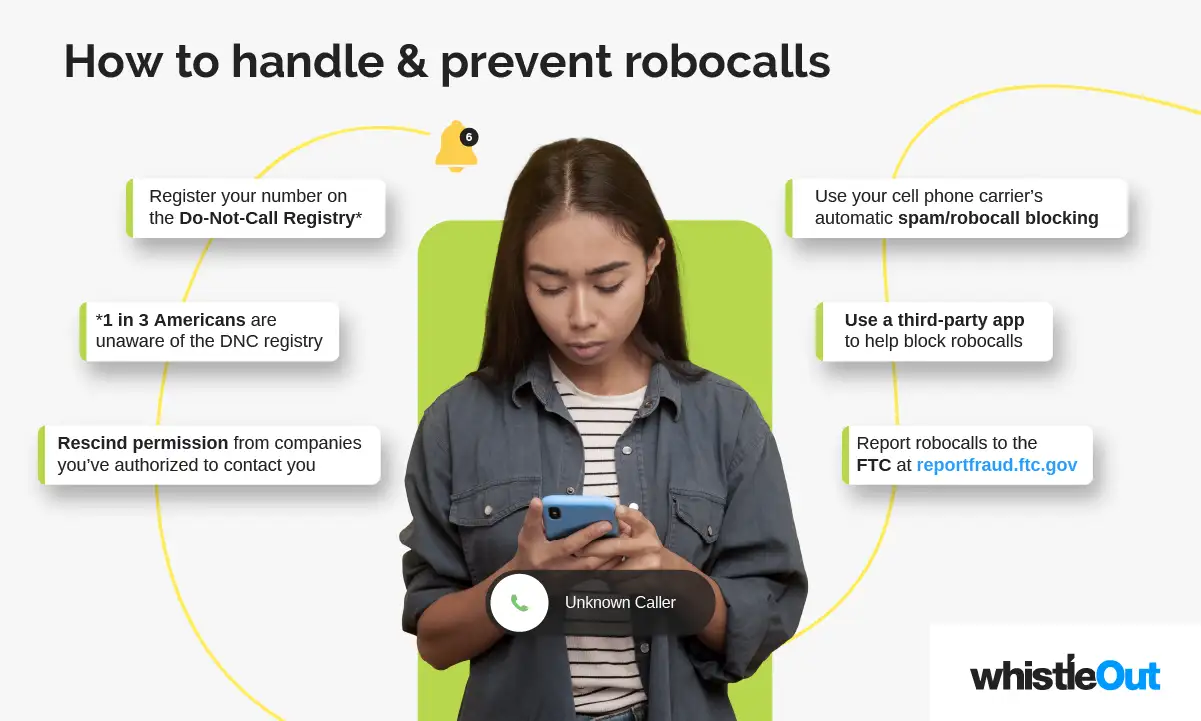
The simplest method to avoid spam calls is also the most effective: Don’t answer phone calls or respond to texts from unknown numbers. Interacting with these numbers tells spammers that your phone line is active and can result in an increased volume of calls.
Many phone companies also include spam/robocall blockers with their plans. Make sure this feature is enabled. On your device, iPhones and Androids can block numbers if you’re receiving repeated calls, and blocking text messages is also simple.
If you’re receiving calls or texts from companies that allow you to opt out of their marketing, make sure to do that as well.
Here are some other steps you can take:
- YouMail: This is a free app offering screening features that stop spam calls and texts. It also removes your number from known spam lists and can provide information to authorities.
- Do Not Call Registry: This is a government database tracking the phone numbers of individuals who have requested telemarketers not to contact them. Registering is free and open to anyone.
- FTC Fraud Report: If you have been defrauded by a spam call—or experienced one but managed to avoid becoming a victim—make sure to report it to the FTC. Your report is shared with law enforcement officials across the nation who warn other consumers and potentially use the information to shut scams down.
Methodology
We collected data from the YouMail Robocall Index (2020–2025) as well as the FTC's National Do Not Call Registry (2020–2025) to determine which states receive the most robocalls. We also surveyed 1,000 U.S. adults about their phone habits.
Sources:
Max McCaskill
Sr. Staff Writer

Thousands of cell phone plans unpacked. All the facts. No surprises.





.png?w=280&h=280&usm=20&usmrad=0.8&fit=crop "The Best Cheap Phone Plans for 2026: We Tested Them All to Help You Save")