Data roaming is when your phone leaves its primary network and connects to a different one to ensure continued voice and data coverage. Not all wireless networks are available in every single corner of the country. So when your phone finds itself in a dead area, it will roam to find service elsewhere.
Most carriers have both domestic and international roaming agreements, and the process of jumping on and off networks is seamless. But each carrier's roaming policies differ, including how much monthly data you receive and whether you're charged for roaming.
Let’s take a look at how data roaming works and how it affects your service quality—and your cell phone bill.
What is data roaming?
When your phone drops out of your carrier's coverage area and is no longer connected to the main service network, it searches for another network to operate on in the meantime. All of the major cell phone carriers (AT&T, Verizon, and T-Mobile) have roaming agreements with other providers to cover their customers in areas of little to no primary service. This helps to keep their customers talking, texting and consuming data in more areas.
MVNOs, on the other hand, aren't necessarily aligned with the roaming agreements of their parent networks. Unless an MVNO has its own roaming agreement, its customers will simply be without service in areas uncovered by their parent network. Thankfully, most of the major MVNOs do.
Data roaming limits and speeds
You may experience certain roaming limits or restrictions—namely, in your speeds and data use. T-Mobile, for example, limits domestic roaming data to 200MB (more on domestic vs. international roaming below), while AT&T offers just 100MB. Your speeds will also often slow to 3G or even 2G once you've reached your roaming limit—or your data will be cut off altogether. For specifics, hop down to our section below on carrier roaming policies.
Domestic vs. international data roaming
Domestic roaming refers to your phone's use off-network within the United States. Most carriers also don't levy extra roaming charges if your phone goes off-network while you're within the country.
Carriers also often have international roaming agreements that allow you to use your phone beyond U.S. borders—but in this case, you'll likely have to pay for the privilege. If you purchase a small international data roaming plan, make sure your phone's settings are correct so you get the most out of it.
Note that international roaming and international calling are not the same thing, despite having a similar name. International calling is your plan's ability to call international numbers while within the United States, and it usually carries an additional fee.
International coverage with major U.S. carriers
Verizon, AT&T, and T-Mobile all sell unlimited plans that include talk, text, and data within Canada and Mexico at no extra charge. To use your phone overseas, however, you'll have to pay—either by subscribing to a cell phone plan with international benefits included, purchasing an add-on travel plan before you go abroad, or incurring pay-as-you-go rates.
Verizon international travel plans
If you're on Verizon, you can purchase a daily TravelPass for $5-10/day (depending on your location) for unlimited talk and text, plus 0.5GB of high-speed data with unlimited 2G data thereafter. For those on an extended trip or who travel frequently, Verizon's Monthly International Travel Plan ($70-130/month) lets you choose how much talk, text, and high-speed data you want for 30 days.
AT&T international travel plans
AT&T offers an International Day Pass that functions just like Verizon's TravelPass. For $10/day, you can use your AT&T phone and plan overseas in 210+ locations without needing an international SIM card. Some locations also include 5G coverage. The International Day Pass also includes unlimited calling back to the United States while you're abroad.
T-Mobile international travel plans
All of T-Mobile's unlimited plans include high-speed data to use while traveling abroad, not just in Canada or Mexico—a seriously nice perk that its competitors don't offer. Those destinations vary based on the plan.
- Experience Beyond plans:
- 30GB of high-speed data in Mexico and Canada (then unlimited 3G)
- 15GB of high-speed data in 215+ other destinations (then unlimited 3G)
- Experience More:
- 15GB of high-speed data in Mexico and Canada (then unlimited 3G)
- 5GB of high-speed data in 215+ other destinations (then unlimited 3G)
For further coverage, you can purchase a daily, weekly, or monthly International Pass add-on, ranging from $5 to $50. The monthly International Pass includes 15GB of data for up to 30 days, while the weekly pass offers 5GB and the daily pass provides 512MB. All International Passes can also be used as mobile hotspots and include unlimited calls.
Roaming policies by carrier
Carrier roaming at a glance
| Verizon | AT&T | T-Mobile | |
|---|---|---|---|
| Domestic roaming charges? | No | No | No |
| Domestic roaming data limits | Up to plan's monthly data allowance | 100MB or 20% of total usage (whichever is less) | 200MB 4G LTE Unlimited 2G on preferred partner networks only |
| Canada and Mexico | Unlimited talk, text, and data included (unlimited plans only) | Unlimited talk, text, and data included (unlimited plans only) | Unlimited talk, text, and data included (unlimited plans only) |
| International roaming options | Add-on plans or pay-per-use only | Add-on plans or pay-per-use only | Unlimited texting (all unlimited plans) Unlimited data (Experience More and Experience Beyond) |
Data roaming on Verizon, AT&T, and T-Mobile is very similar within the U.S., with Verizon's policy being the most generous. You get unlimited domestic data (or up to your plan's regular data allowance), although you may experience a drop in quality and speeds depending on your location.
Conversely, both AT&T and T-Mobile provide limited quantities of domestic roaming data, but at guaranteed high speeds. Where data roaming on AT&T cuts off after 100MB, T-Mobile takes a different approach depending on whether you're roaming on a "standard" network or with one of their "preferred" partners. On standard networks, you'll similarly experience service stoppage after exhausting your 200MB data roaming allotment. But some T-Mobile preferred partner networks provide additional data at 2G speeds to keep you connected for longer.
How to turn off data roaming and avoid charges
There are a few reasons you may want to turn off your data roaming. Perhaps your battery is draining because your phone is constantly searching for new networks, or you're traveling abroad without a dedicated travel plan and want to avoid paying for expensive roaming charges. Your phone may also be draining your data plan due to automatic downloads or background app refreshing.
We'll walk you through turning off data roaming for both iPhone and Android devices below.
To turn off data roaming on an iPhone:
- Go into your phone's Settings.
- Locate your Cellular menu and tap "Cellular Data Options."
- Toggle Data Roaming to "Off."


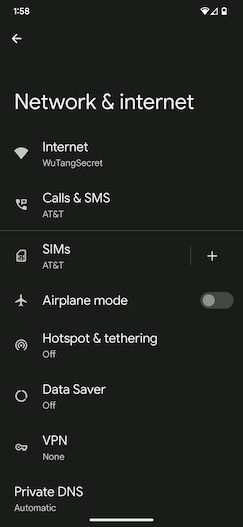
To turn off data roaming on Android devices:
- Go into your phone's settings.
- Find your Connections menu and choose "Network & internet," then tap on your phone carrier.
- Toggle Data Roaming to "Off."

How to check if data roaming is turned on
If you're unsure whether your phone has data roaming is activated on your phone, follow the same steps above to access your phone's cellular data settings. You'll see whether the data roaming option is toggled on or off.
You can also tell if you're currently roaming on another network by checking the top left or right corner of your phone's display, depending on where your LTE/5G network bars are located. You'll see either a symbol or the name of the network you're roaming on.
Cell phone plans for data roaming
If you find your phone often switching between networks, you may want to explore a carrier and plan that has better coverage in your immediate area. And for the travel bugs out there, you may want to consider a cell phone plan that includes broad international roaming benefits, like T-Mobile's Experience More and Experience Beyond plans above.
Either way, WhistleOut can help you pick the perfect plan for your situation. Head over to our comparison engine, select the amount of talk, text and data you're looking for, and enter your home address—and we'll find plans that provide the best cell phone coverage to your area, plus details on all of their included perks like international calling, data, and more.
Here are some of the most popular plans to pick from:
|
#1
|
Visible 
|
|
|
#2
|
Mint Mobile 
|
|
|
#3
|
Verizon 
|
|
|
#4
|
Verizon
|
|
|
#5
|
US Mobile 
|
|
|
#6
|
T-Mobile 
|
|
|
#7
|
T-Mobile
|
|
|
#8
|
Verizon
|
|
|
#9
|
Visible
|
|
|
#10
|
AT&T 
|


What is data roaming: FAQs
Do I get charged for data roaming?
You may or may not get charged for data roaming, depending on which carrier you have and whether you're roaming domestically or internationally. Most carriers don't charge for domestic roaming if you're on one of their standard monthly data plans; some charge roaming fees if you're subscribed to a pay-as-you-go data plan.
Do I want data roaming on or off?
Most people want data roaming turned off. Unless you're traveling outside of your usual commute or living area, you shouldn't need constant access to every network around you. You can always toggle your roaming on when you find yourself in a spot that doesn't have great data coverage with your current network.
If you find that you're consistently dropping your internet signal in your neighborhood or in places that you often visit, you may want to consider switching carriers to a network with stronger coverage in your area.
What happens if data roaming is on?
If data roaming is on, your phone will connect to the next best cellular network if you go outside of your home network's coverage area. For example, if you're an AT&T customer and you enter an area without AT&T coverage but with strong T-Mobile coverage, your phone will connect to T-Mobile until you return to AT&T's network area.
What happens if I turn roaming off on my phone?
If you turn roaming off on your phone, nothing will happen unless you leave your carrier's network coverage area—if you do, you won't have internet access until you return to your network's coverage area.
Can I receive calls if data roaming is off?
You can receive calls if data roaming is off. Phone calls and SMS text messages don't use cellular data.
Lauren Hannula
Managing Editor

Thousands of cell phone plans unpacked. All the facts. No surprises.


.png?w=160&h=160&usm=20&usmrad=0.8&fit=crop "Cell Coverage Near You: Who Has the Best 5G Network?")





.png?w=280&h=280&usm=20&usmrad=0.8&fit=crop "The Best Cheap Phone Plans for 2026: We Tested Them All to Help You Save")