Apple’s Health app includes two mental health questionnaires with clinical naming. Labels like PHQ-9 and GAD-7 don’t offer much immediate context, and without explanation, it’s easy to misread what these tools are actually meant to do.
As part of Apple’s broader mental health features, these tests are more structured than everyday mood logs, but they’re not diagnostic tools either. Instead, they’re simply designed to help you understand if you’re experiencing symptoms of anxiety or depression so you can seek further help.
Understanding what the PHQ-9 and GAD-7 measure—and how Apple positions their results—helps set realistic expectations. We’ll help you understand how these questionnaires work on your iPhone and how to interpret the outcomes without overreacting or dismissing them.
What are Apple’s mental health questionnaires?
The PHQ-9 and GAD-7 are standardized mental health questionnaires that focus on anxiety and depression. They’re modeled after real tests used by medical professionals.
Both appear as guided questionnaires you can complete directly within the Health app, with results saved to your mental health records.
Apple frames these tools as screening questionnaires. They’re intended to highlight potential risk or patterns that may be worth paying attention to, not to provide a diagnosis or definitive conclusion.
What is the PHQ-9?
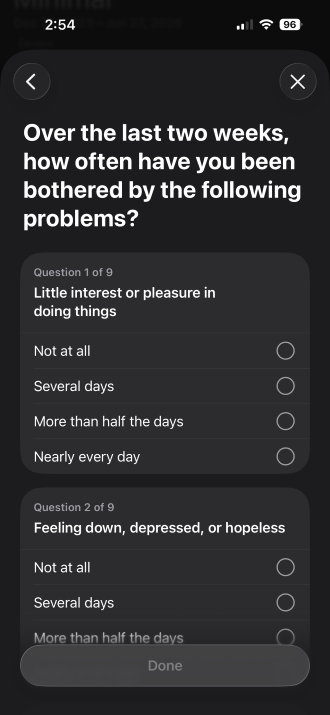
Image: Max McCaskill
The PHQ-9 (Patient Health Questionnaire - 9) is designed to assess depressive symptoms. It asks nine basic questions about your moods and behavior over the previous two weeks. The questions include behaviors like:
- Feeling interest or pleasure in doing things
- Having trouble falling or staying asleep, or sleeping too much
- Having a poor appetite or overeating
After you complete the test, the Health app will give you a scaled score showing your current depression risk.
What is the GAD-7?
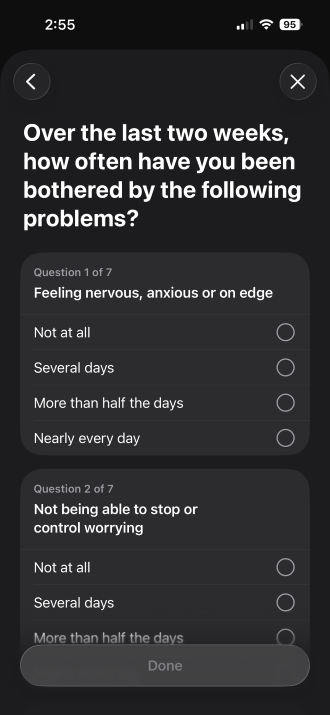
Image: Max McCaskill
The GAD-7 (Generalized Anxiety Disorder - 7) focuses on symptoms associated with anxiety.
It asks seven questions about how you’ve felt during the previous two weeks. The questions are centered around nervousness and anxiety, and ask you to rate aspects like:
- Feeling nervous, anxious, or on edge
- Having trouble relaxing
- Becoming easily annoyed or irritable
Once again, after the test is complete, you’ll receive a scaled score showing your current anxiety risk.
How questionnaire results appear in the Health app
After you complete a questionnaire, the result is stored in the Health app alongside your other mental health data. You can revisit past entries, see when each questionnaire was taken, and review the outcomes over time.
Results aren’t presented as a diagnosis, and they aren’t paired with prescriptive instructions. Instead, it’s up to you as the user to decide when your results warrant speaking with a doctor or therapist.
When are these questionnaires most useful?
The PHQ-9 and GAD-7 tend to be most helpful when they’re used consistently and shared with a doctor. They can support:
- Tracking changes over time in a consistent way
- Preparing for conversations with a doctor or mental health professional
- Reducing reliance on memory when discussing symptoms
Generally, if the questionnaires show you're dealing with a higher risk of anxiety or depression, that's a good sign to make an appointment with a doctor.
Your answers to both questionnaires are also available for exporting as a PDF directly from the Health app to share your results. If you need help, our iPhone mental health data export guide can show you the exact process you need to follow.
Max McCaskill
Sr. Staff Writer

Thousands of cell phone plans unpacked. All the facts. No surprises.





.png?w=280&h=280&usm=20&usmrad=0.8&fit=crop "The Best Cheap Phone Plans for 2026: We Tested Them All to Help You Save")