The Federal Communications Commission has pulled the plug on one of its most consequential internet programs. Over the past two years, the Affordable Connectivity Program (ACP) has helped 23 million households across the United States access low-cost internet service. However, funding expired at the end of May 2024, leaving the future of its users in doubt.
The ACP directed benefits of $30/month to qualifying households for internet service. One in six households in the U.S. was enrolled in the ACP. Most of these households are low-income families, seniors, minorities, and veterans. With the program ending, surveys show that 77% of the people using the ACP are now forced to change their current internet plan or cancel their service entirely.
Here at WhistleOut, we’ve analyzed the ACP and figured out the impact on each state by the program's end. We’ve also outlined potential alternatives to help if you've suddenly found yourself with an internet plan that is now too expensive.
End of the ACP: Overview
- What was the Affordable Connectivity Program?
- How many households in each state have lost internet access?
- What can I do if I’m currently on the ACP?
- The cost to fund the ACP for another year
- Why did the ACP lose funding?
- Who used the ACP?
- Methodology
What was the Affordable Connectivity Program?
The Affordable Connectivity Program was a federal program designed to help offset the cost of wireless internet. Originating as a pandemic-era relief program (the Emergency Broadband Benefit Program), the ACP became a permanent federal subsidy as part of the Infrastructure Investment and Jobs Act passed in 2021. It was targeted at low-income and rural Americans who struggled to pay for high-speed internet.
The ACP provided a $30/month benefit for qualifying households to offset the cost of internet. For tribal households, the benefit increased to $75/month.
There were many ways for households to qualify, including:
- Household income less than 200% of federal poverty guidelines
- Participation in another federal assistance program such as SNAP or Medicaid
- Participation in free or reduced-price school lunch program
- Recipient of federal Pell Grant during current academic year
- Participation in certain Tribal programs
- Meeting eligibility for your current internet provider’s low-income program
For households meeting these guidelines, internet plans can be prohibitively expensive. Recent surveys show that the average cost of a high-speed internet plan in the United States is $81/month or $975 annually.
To put that number into context, the ACP benefit was available to any household earning less than 200% of the federal poverty guidelines. Based on the 2024 guidelines, a one-person household would qualify if it made less than $30,120 annually. Without the ACP, that household would pay a minimum of 3.2% of its yearly income on high-speed internet. That percentage only increases for lower-earning households. For Americans making the average income, the portion of their salary going to internet service is half that at 1.6%.
How many households in each state could lose internet access?
The end of the ACP will impact households in every state.

States with the largest number of ACP households include:
- California: 2,803,599
- New York: 1,701,192
- Florida: 1,685,581
- Texas: 1,666,632
- Ohio: 1,141,482
- North Carolina: 889,073
- Michigan: 887,332
- Pennsylvania: 737,194
- Georgia: 699,446
- Illinois: 676,391
These top states should not be a big surprise. While out of their exact order, these are the 10 largest states in the nation by population as counted by the 2020 Census. It makes sense they would dominate the top slots for the ACP program.
On the other hand, as you leave the top 10, you’ll start finding states punching well above their weight. For example, Louisiana, while ranked #25 in population, sits at #11 for the ACP benefit with 548,192 users. You’ll find similar trends in states like Kentucky and South Carolina with ACP users representing a larger portion of their overall population.
This might be because these states have some of the highest poverty rates in the nation. Because a greater proportion of their population is eligible for the ACP, losing the program could have a larger impact in poorer, less populated states.
Here is how many households are enrolled in the ACP in every state:
Number of ACP enrolled households per state
| State | ACP enrolled households |
|---|---|
| AK | 22,507 |
| AL | 407,236 |
| AR | 210,727 |
| AZ | 519,518 |
| CA | 2,803,599 |
| CO | 242,487 |
| CT | 181,880 |
| DC | 61,244 |
| DE | 50,541 |
| FL | 1,685,581 |
| GA | 699,446 |
| HI | 58,769 |
| IA | 120,238 |
| ID | 51,663 |
| IL | 676,391 |
| IN | 413,741 |
| KS | 133,164 |
| KY | 447,164 |
| LA | 548,192 |
| MA | 358,383 |
| MD | 276,649 |
| ME | 97,299 |
| MI | 887,332 |
| MN | 239,681 |
| MO | 386,739 |
| MS | 239,389 |
| MT | 54,148 |
| NC | 889,073 |
| ND | 16,904 |
| NE | 95,464 |
| NH | 38,039 |
| NJ | 322,997 |
| NM | 178,771 |
| NV | 270,074 |
| NY | 1,701,192 |
| OH | 1,141,428 |
| OK | 347,922 |
| OR | 224,638 |
| PA | 737,194 |
| RI | 83,514 |
| SC | 423,681 |
| SD | 23,176 |
| TN | 421,793 |
| TX | 1,666,632 |
| UT | 71,484 |
| VA | 456,521 |
| VT | 25,040 |
| WA | 339,558 |
| WI | 421,810 |
| WV | 124,831 |
| WY | 21,355 |
What can I do if I’m currently on the ACP?
On March 4, 2024, the FCC formally announced that April would be the final month of the full ACP benefit. Subsequent announcements stated there will be a partial benefit for users in May to exhaust the last of the ACP funds, but it will be far less than $30. Notifications from the FCC and internet service providers should soon go out to affected households outlining the next steps. In most cases, subscribers will be forced to pay an increased rate, switch to a cheaper plan if available, or cancel their service.
If you’re currently enrolled in the ACP, you do have options if the program ends. You may still qualify for free internet from other government programs depending on your income and plan options. For example, other federal programs like Lifeline offer internet discounts, but it has a smaller monetary benefit with more restrictive application terms. Generally, your plan would only be free on the least expensive plan options available.
Unfortunately, many ACP enrollees will simply find themselves needing a cheaper internet plan. Luckily, we can help with that. You can use our internet plan search tool to see some of the plans and providers available in your area. Simply type your address into the tool and see a list of your potential plans sorted by the lowest cost.
Your internet provider may also have a low-income program for specific plans. For example, Xfinity offers the Internet Essentials plan to qualifying customers for $14.95/month. However, the availability of these programs and their requirements are up to the discretion of the providers themselves. It’s generally easier to qualify for discounted plans if you are part of a specific demographic, such as students or seniors.
There are other options for cheap internet plans that don't have low-income requirements. You can see some of the most popular options below. That said, remember that internet service providers (ISPs) are often regional and you may not have access to all these plans. You should also shop around and look at smaller ISPs in your area to see if their pricing is better than the larger companies like Xfinity, Spectrum, or AT&T.
|
#1
|
Astound

50 Mbps Internet + Unlimited
$9.95/mo
Observed speeds may vary | One-time fees extra | Restrictions apply | Not available in all areas | New residential customers only
|
|
#2
|
Viasat

Viasat Essentials
$21.22/mo
with promotion, $69.99/mo. thereafter.
|
|
#3
|
Hughesnet

Select
$64.98/mo
($49.99 plan + $14.99 modem)
for 12 months. Service plan availability varies based on geographic area. All plans are subject to the Hughesnet Subscriber Agreement.
+ $99 Upfront
|
|
#4
|
Wisper

Ready for the Rush
$69.99/mo
Available in select locations
+ $100 Upfront
|
|
#5
|
CenturyLink

Simply Unlimited 60 Mbps
$72/mo
($55 plan + $17 modem)
Available in select locations. Paperless billing required.
+ $25 Upfront
|

Finally, you may find it's cheaper to rely on your mobile plan for internet instead of paying for two separate services. Upgrading your mobile plan to include a large mobile hotspot allotment can be affordable if you pick the right carrier. Mobile hotspot tethering essentially turns your smartphone into a wireless router that can provide access to your carrier's data network.
Two of the best options for this are from Visible and US Mobile. These carriers are mobile virtual network operators (MVNOs). They rent access to the larger carrier networks, meaning they offer the same reliable coverage at lower prices. The Visible Plan operates on the Verizon network. For $25/month, it offers unlimited data and an unlimited mobile hotspot with speeds capped at 5Mbps. That's fast enough for basic browsing and streaming, but not intensive uses like gaming. US Mobile offers the Unlimited Premium plan on the Verizon or T-Mobile networks. It's more expensive at $44/month but offers unlimited premium data and a 50GB high-speed mobile hotspot. If you do more internet-intensive tasks, this plan is a better option.
|
#1
|
US Mobile

Unlimited Premium Plan
$20.00/mo
|
|
#2
|
Visible

$25 Visible Plan
$25.00/mo
Taxes & Fees included
|
The cost to fund the ACP for another year
Based on the number of enrolled households, it would cost $7.8 billion to fund the program again at $30/month for 12 months. The cost for California alone to fund its ACP recipients for a year is over $1 billion. Additionally, this price tag is determined based on current enrollees. When the FCC realized that the ACP would run out of funding, it locked out new applicants from joining the program. If applications are reopened, that figure would only increase.
The top five most expensive states for funding the ACP are:
- California: $1,009,295,640.00
- New York: $612,429,120.00
- Florida: $606,809,160.00
- Texas: $599,987,520.00
- Ohio: $410,914,080.00
These states take up the lion's share of the funding required to keep the ACP going—collectively they use up over 40% of the required funding. If you include the top 10 states on the list, that figure jumps to 59%. Essentially, almost 60% of the ACP funding overall is used by the 10 most populated states in the nation.
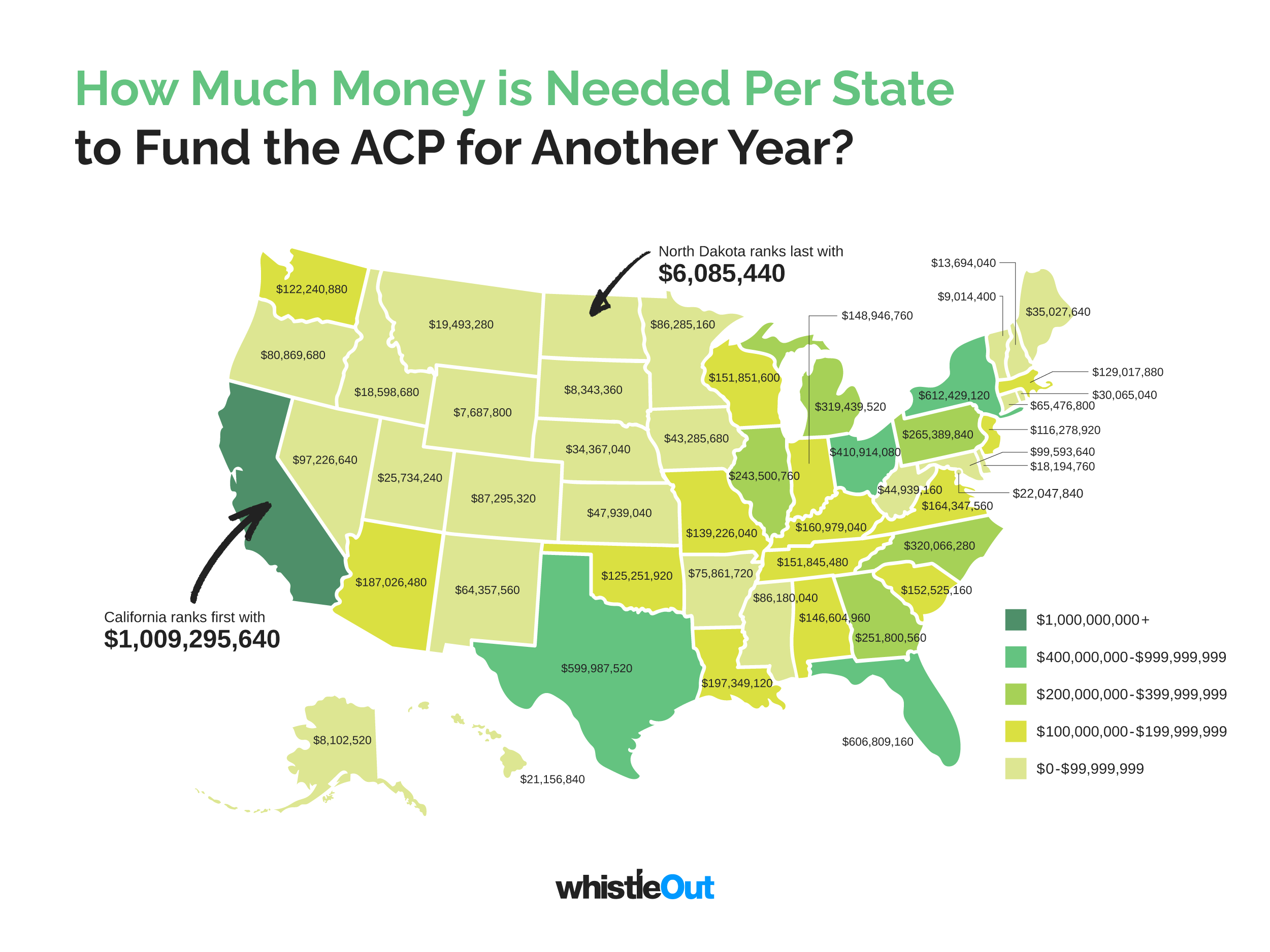
Here is the cost to fund the ACP for another year for every state:
Cost to fund the ACP for one year per state
| State | ACP funding requirements |
|---|---|
| AK | $8,102,520.00 |
| AL | $146,604,960.00 |
| AR | $75,861,720.00 |
| AZ | $187,026,480.00 |
| CA | $1,009,295,640.00 |
| CO | $87,295,320.00 |
| CT | $65,476,800.00 |
| DC | $22,047,840.00 |
| DE | $18,194,760.00 |
| FL | $606,809,160.00 |
| GA | $251,800,560.00 |
| HI | $21,156,840.00 |
| IA | $43,285,680.00 |
| ID | $18,598,680.00 |
| IL | $243,500,760.00 |
| IN | $148,946,760.00 |
| KS | $47,939,040.00 |
| KY | $160,979,040.00 |
| LA | $197,349,120.00 |
| MA | $129,017,880.00 |
| MD | $99,593,640.00 |
| ME | $35,027,640.00 |
| MI | $319,439,520.00 |
| MN | $86,285,160.00 |
| MO | $139,226,040.00 |
| MS | $86,180,040.00 |
| MT | $19,493,280.00 |
| NC | $320,066,280.00 |
| ND | $6,085,440.00 |
| NE | $34,367,040.00 |
| NH | $13,694,040.00 |
| NJ | $116,278,920.00 |
| NM | $64,357,560.00 |
| NV | $97,226,640.00 |
| NY | $612,429,120.00 |
| OH | $410,914,080.00 |
| OK | $125,251,920.00 |
| OR | $80,869,680.00 |
| PA | $265,389,840.00 |
| RI | $30,065,040.00 |
| SC | $152,525,160.00 |
| SD | $8,343,360.00 |
| TN | $151,845,480.00 |
| TX | $599,987,520.00 |
| UT | $25,734,240.00 |
| VA | $164,347,560.00 |
| VT | $9,014,400.00 |
| WA | $122,240,880.00 |
| WI | $151,851,600.00 |
| WV | $44,939,160.00 |
| WY | $7,687,800.00 |
Why is the ACP losing funding?
The ACP was originally allocated $14.2 billion. The program is ending because that money has run out and Congress has not approved new funding. Current estimates show that the ACP fund will be depleted by the end of May 2024.
There’s still hope for the ACP because the program is broadly popular with Americans. There is a bipartisan bill in the U.S. House of Representatives that would allocate another $7 billion in funding to keep the ACP alive for another year. However, it faces an uphill battle and a tight deadline in a deeply divided Congress. Households using the ACP should assume the $30 benefit will—at least temporarily—end in April.
While April will be the final month for full funding, the FCC has announced there will be a limited reimbursement rate for May. This final payment will be made up of whatever remaining ACP funds are available. The FCC estimates the standard rate for May will range between $7 to $16.
Who is using the ACP right now?
There are over 23 million households currently enrolled in the ACP. According to the White House, most recipients of the ACP benefit are rural and low-income Americans.
Other enrollment stats include:
- 1 in 6 households in the United States uses the ACP benefit.
- 1 in 4 households using the ACP are African American and another 1 in 4 are Latino.
- Nearly half of ACP households are military families.
For most of these households, the ACP has allowed them to experience consistent monthly high-speed internet for the first time. An FCC survey showed that 68% of ACP households had inconsistent or no internet service before they were enrolled in the program. Of those respondents, 80% cited affordability as the reason they struggled to maintain their plan or avoided internet service altogether.
The same FCC survey also showed what is at stake if the program ends. Of the total ACP subscribers surveyed:
- 72% used the internet to schedule or attend healthcare appointments
- 48% used the internet to apply for jobs or complete work
- 71% used the internet to stay informed about current events and news
- Of subscribers 18-24 years old, 75% used the internet to complete schoolwork
ACP usage by age
The ACP is used by Americans of all ages. While there is a significant population of seniors in the program, people aged 25–49 rely on ACP more than any other age group.
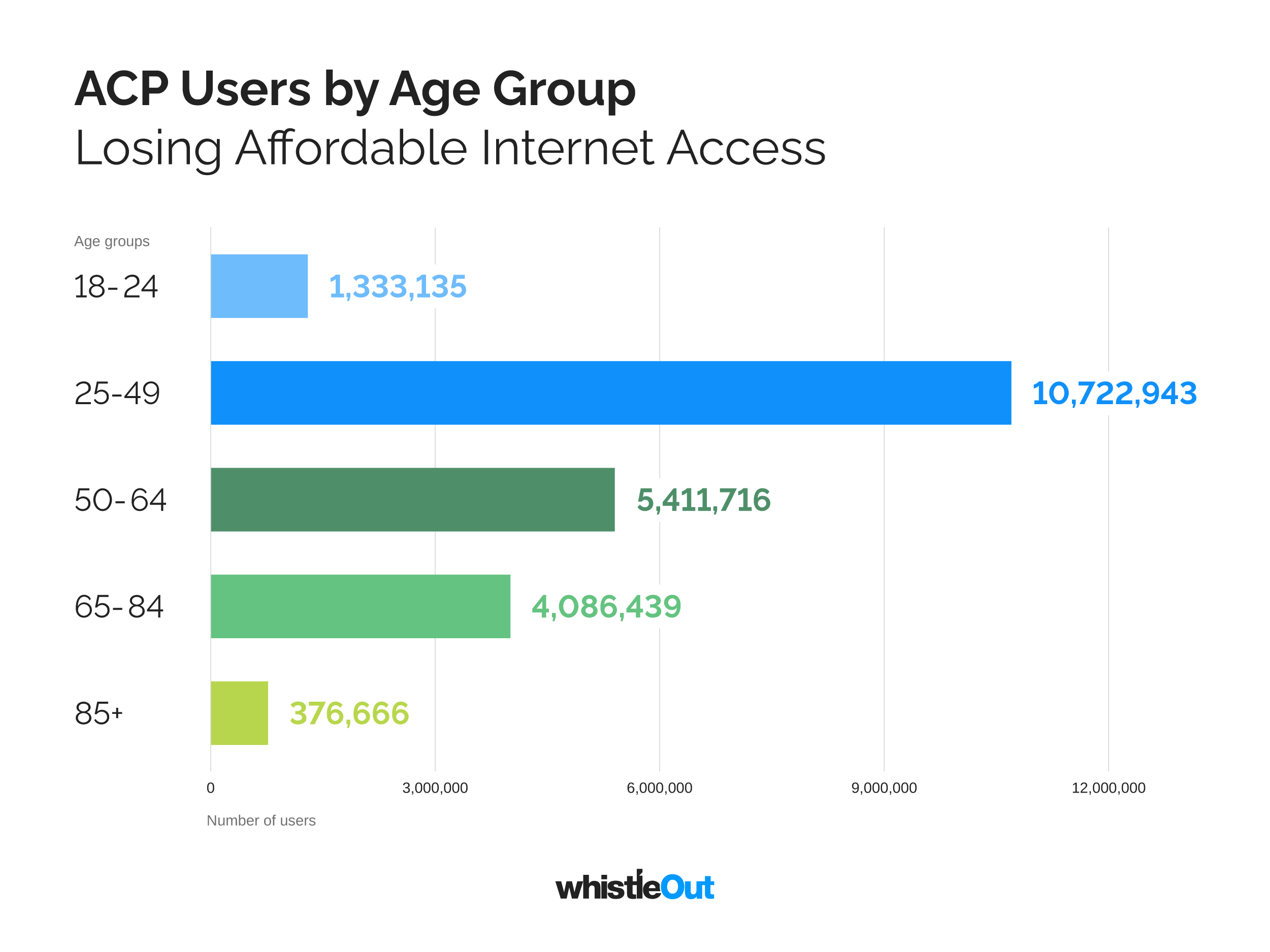
The ACP household age demographics break down like this:
- 18–24 — 1,333,135 users nationwide
- 25–49 — 10,722,943 users nationwide
- 50–64 — 5,411,716 users nationwide
- 65–84 — 4,086,439 users nationwide
- 85+ — 376,666 users nationwide
Most ACP users will quit their current internet plan
What happens if the ACP ends? The FCC has reported that if the ACP benefit ends, 77% of enrolled households would see their service interrupted. In this case, interrupted means they would drop their current plan. These households would be forced to find a cheaper internet plan, rely on mobile data from their phone plan, or drop their internet service altogether.
Unfortunately, finding a cheaper alternative is easier said than done. Internet access is more limited than you might realize. While customers in suburbs and cities often have their pick of internet providers and plans, rural households might only have one option. Customers who can’t afford that option have little recourse.
Methodology
WhistleOut.com analysts looked at data from USAC.org to understand how many people rely on ACP funding by state. Additionally, our team standardized the data per 10,000 people to see which states had the most and least ACP users per capita. We also utilized data from the Federal Communications Commission (FCC) and the White House to show enrollment demographics and statistics.
Max McCaskill
Sr. Staff Writer

Related Articles


Related Topics
Research and ReportsPopular Topics
Internet Spectrum Internet Xfinity Research and Reports AT&T T-Mobile News Verizon MINTernet App ExplainersInternet Providers by State
- Internet in Alabama
- Internet in Alaska
- Internet in Arizona
- Internet in Arkansas
- Internet in California
- Internet in Colorado
- Internet in Connecticut
- Internet in Delaware
- Internet in District of Columbia
- Internet in Florida
- Internet in Georgia
- Internet in Hawaii
- Internet in Idaho
- Internet in Illinois
- Internet in Indiana
- Internet in Iowa
- Internet in Kansas
- Internet in Kentucky
- Internet in Louisiana
- Internet in Maine
- Internet in Maryland
- Internet in Massachusetts
- Internet in Michigan
- Internet in Minnesota
- Internet in Mississippi
- Internet in Missouri
- Internet in Montana
- Internet in Nebraska
- Internet in Nevada
- Internet in New Hampshire
- Internet in New Jersey
- Internet in New Mexico
- Internet in New York
- Internet in North Carolina
- Internet in North Dakota
- Internet in Ohio
- Internet in Oklahoma
- Internet in Oregon
- Internet in Pennsylvania
- Internet in Rhode Island
- Internet in South Carolina
- Internet in South Dakota
- Internet in Tennessee
- Internet in Texas
- Internet in Utah
- Internet in Vermont
- Internet in Virginia
- Internet in Washington
- Internet in West Virginia
- Internet in Wisconsin
- Internet in Wyoming


.jpg?w=280&h=280&usm=20&usmrad=0.8&fit=crop "Verizon Fios Internet vs. Optimum Internet")

.jpg?w=280&h=280&usm=20&usmrad=0.8&fit=crop "Viasat vs Hughesnet Internet Plans Compared")


.jpg?w=280&h=280&usm=20&usmrad=0.8&fit=crop "gFiber vs. AT&T Fiber: Which internet is better for you?")