If you have an Apple Watch, you’re likely already using several features within your iPhone’s native Health app. What you may not realize is that buried deep within the app, you'll also find free clinical-level mental wellness tracking tools. For many people, there’s no need to pay for expensive third-party mental health apps and mood trackers from the App Store. These features are already built into your phone.
The core idea behind Apple’s mental health features is to give you ways to track your mood and screen for anxiety or depression risk, all from the Health app you already carry around every day.
While they’re not a replacement for professional care, they’re worth using to help you take a moment to breathe and be aware of your current mental state.
How does Apple’s Mental Wellbeing feature work?
Apple’s mental health tools are grouped under a Mental Wellbeing category in the Health app. You can find it by using the Search feature in the Health app.
It’s made up of two main features that monitor your mental health:
- State of Mind mood journal: A daily mood tracking log.
- Mental Health questionnaires: Structured screenings for depressive or anxiety symptoms.
The data you enter stays on your device and is only shared if you choose to send it to someone else, like a doctor. Apple emphasizes privacy here, which matters because these are sensitive insights by design.
The State of Mind mood journal
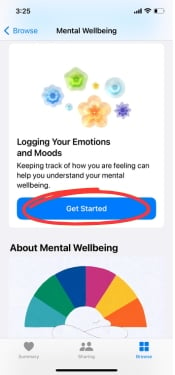
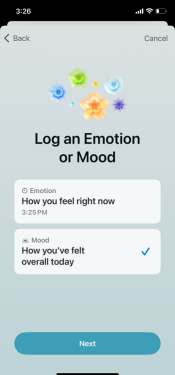
Image: Alissa Bird
The State of Mind mood log lets you track how you feel over the course of a day. You slide a scale between “Very Unpleasant” to “Very Pleasant,” and pick from words that describe the factors influencing your mood. Once you have a handful of entries, you can view them in charts and calendars that show your mental health status over time.
Plus, the Health app can also incorporate your other tracked health data, like exercise time and sleep scores. All of this will give you an overall look at the kinds of things impacting your mental well-being.
Mental Health Questionnaires
The questionnaires are the more clinical-sounding tools. Apple offers versions of clinically validated depression and anxiety assessments like the Patient Health Questionnaire - 9 and Generalized Anxiety Disorder - 7 (PHQ-9 and GAD-7), which are widely used in healthcare settings.
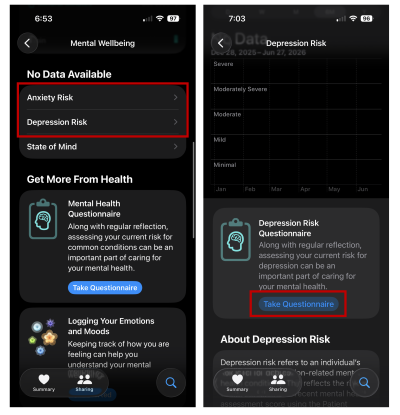
Image: Alissa Bird
These tools are not diagnostic. They won’t tell you you have a disorder, but they can give you a snapshot of where your responses fall on the risk spectrum.
These results are useful if you’re thinking of talking to a doctor or mental health professional. Plus, you can even export your results as a PDF to share ahead of an appointment.
The Health app won’t diagnose you
While these features are useful for tracking your mental state, they are not a diagnostic tool or substitute for therapy. Apple’s implementation is intentionally lean, giving you entry points and data, but not next-step therapy plans or medical advice.
If you’re struggling with severe or complex mental health issues, these tools won’t replace a professional’s guidance. However, they can complement that journey by giving you more context and self-reflection, which is still incredibly useful.
Bottom line: iPhone’s mental health tools can help you
It turns out your iPhone can help improve your mental health. These features are not a cure for anxiety or depression, but they do something practical: Make self-monitoring accessible and private.
The daily mood log is the feature you’re most likely to use frequently, and it has the clearest payoff in helping you notice patterns. The questionnaires, while optional, add a layer of self-screening that’s rarely this convenient on a smartphone’s free native apps.
Max McCaskill
Sr. Staff Writer

Thousands of cell phone plans unpacked. All the facts. No surprises.

Related Articles


Related Topics
iOS FeaturedPopular Topics
Featured App Reviews iOS News Coverage Device Reviews Device Explainers Carrier Explainers App Roundups T-Mobile


Free iPhone 18 Pro, up to $1,200 off, with a trade-in in any condition or a line switch on Experience Beyond





.png?w=280&h=280&usm=20&usmrad=0.8&fit=crop "The Best Cheap Phone Plans for 2026: We Tested Them All to Help You Save")