Verizon stands as a beacon of connectivity across the United States, offering unparalleled mobile service with its extensive 4G LTE network that blankets over 70% of the nation. This coverage not only outstrips rivals such as AT&T and T-Mobile in terms of reliability but also marks Verizon as a leader in the mobile space.
Verizon's network ensures seamless connectivity whether you're navigating the hustle and bustle of urban life, enjoying the peace of rural settings, or somewhere in between. However, it's still important to verify that Verizon delivers strong service in your specific location. Our interactive coverage maps can help you see how Verizon has you covered.
Check out these maps and learn all about Verizon's 4G LTE and 5G networks, including how they compare to the other big networks from AT&T and T-Mobile.
Get Verizon coverage for half the price
Many people don't realize they can get Verizon coverage without paying Verizon prices by switching to an MVNO (mobile virtual network operator). These carriers use the same towers but don't have to pay for the upkeep costs, thereby passing the savings on to you. An MVNO like Visible has plans starting as low as $25/month, which is $35 less than the cheapest prepaid plan from Verizon.
With Visible Wireless, you'll get the nation's best 4G LTE coverage and 5G access, plus unlimited talk, text, and data for a third of the cost of a Verizon unlimited plan. Even Visible's $35/month Visible+ and $45/month Visible+ Pro premium plans, which include unlimited mobile hotspot data and international benefits, are still cheaper than Verizon's cheapest postpaid unlimited data plan at $65/month.
|
#1
|
Visible

$25 Visible Plan
$25.00/mo
Taxes & Fees included
|
|
#2
|
Visible
$30 Visible+ Plan
$30.00/mo
Taxes & Fees included
|
|
#3
|
Visible
$40 Visible+ Pro Plan
$40.00/mo
Taxes & Fees included
|
Verizon coverage map
Verizon 5G coverage
After a quick look at Verizon's 5G coverage map, it's easy to see that the network is not very big. In fact, the Verizon 5G network is the smallest from the three major carriers, covering just 12.77% of the country.
The saving grace for Verizon is that it doesn't take covering much of the land to have most of the nation's population covered—people are gathered in cities rather than spread out. Despite covering a small portion of the country, Verizon's 5G network covers a majority of Americans because it focuses its towers in places like New York and Los Angeles.
But even though Verizon 5G is likely available to you, you're not going to be able to take advantage of it if you don't have the right phone. Most modern smartphones are 5G compatible, but if you haven't upgraded in a few years, your device might not work with the latest network technology. Now that 5G is so prominent, it's a great time to buy a new phone.
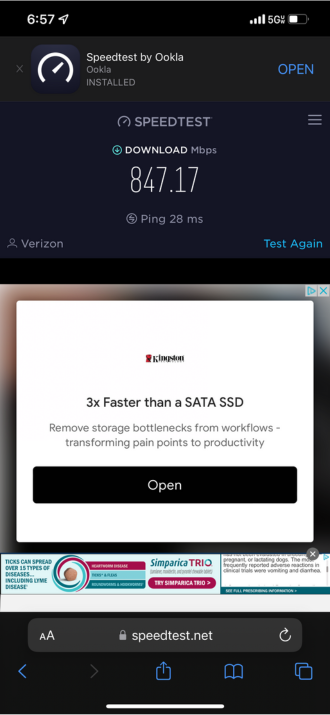
Image: Angelo Ilumba
When you do get on Verizon 5G UW with a compatible phone, the speeds can be wild. I've clocked Verizon 5G UW at over 800Mbps. I have absolutely no idea what I'd be doing on my phone that would require that kind of crazy speed, but it's sure cool to see.
Verizon 4G LTE Coverage
While Verizon's 5G network falls behind the competitors, its 4G LTE coverage zone is the cream of the crop. This wide-spanning 4G has helped keep Verizon the leader in network coverage for years.
Where Verizon's 5G coverage is concentrated mostly in the larger cities and surrounding suburbs across the country, Verizon 4G reaches further out also providing excellent coverage to much of the rural areas.
Does Verizon have good rural coverage?
When it comes to rural coverage, Verizon is still the carrier to beat. Its 4G LTE network reaches roughly 70% of the country, more than any other carrier, and that's the network that matters when you're outside of major metros. Most rural areas don't have 5G from any carrier, so your phone will spend most of its time on 4G LTE anyway.
I've been a Verizon customer for over a decade, and I've been in rural areas with friends where I'm the only one with service. (That also means I'm the one stuck ordering the Uber.) If I don't have a signal from Verizon, I don't have a signal on any other carrier.
A big part of Verizon's rural advantage comes down to years of building out coverage in places competitors skipped, which is why you'll often see Verizon bars in spots where other carriers lose signal.
That said, 70% coverage still leaves real dead zones, and most of them are out West. Idaho, Nevada, and Utah all have huge stretches where Verizon's signal fades once you leave town, and parts of Oregon, Montana, and West Virginia run into the same issue.
Don't expect much from 5G in rural areas. Verizon's 5G coverage is concentrated in cities and suburbs, so you'll spend most of your time on 4G LTE in rural areas. The good news is that it's plenty fast for streaming, video calls, and just about everything else you'd actually use your phone for.
How good is Verizon's coverage?
Broadly speaking, Verizon's network is strong. If you are traveling across the country and want the best chance of being covered most of the way, Verizon is the safe bet. There are some wide open spaces out West in states like Idaho, Nevada, and Utah where coverage can be scarce, but these are areas where there is more nature than civilization. You'll still find plenty of coverage in the bigger cities and towns in these states.
Nationwide numbers are a great way to judge the networks at a high level, but more importantly, you want to know if Verizon's coverage is good where you are.
We'll take a closer look at Verizon's coverage on the state level, but the best way to find out if Verizon has you covered is by taking a close look at the coverage maps above and zooming into your area.
Pros:
- Excellent 4G LTE coverage spanning 70% of the United States
- Great urban and rural service
- Good unlimited and prepaid plans
Cons:
- 5G support only canvasses 12% of the nation
- Pricey plans
Verizon coverage by state
Coverage maps are helpful but might not tell the whole story. Here are the states where Verizon has the best 4G LTE service:
Best Verizon 4G LTE coverage by state
| State | Percentage covered |
|---|---|
| Kansas | 99.69% |
| Arkansas | 99.53% |
| Georgia | 99.07% |
| Indiana | 98.86% |
| South Carolina | 98.73% |
Although Verizon's 5G doesn't exactly blanket the country, it still provides strong service in some areas. Here are the best states for Verizon 5G:
Best Verizon 5G coverage by state
| State | Percentage covered |
|---|---|
| Delaware | 73% |
| New Jersey | 65% |
| Maryland | 53% |
| Connecticut | 46% |
| Ohio | 43% |
Want to see if Verizon has solid coverage in your area? We break down how much of each state is covered by Verizon's network in square mileage.
Percentage of state covered by Verizon
| State | 4G Coverage | 5G Coverage |
|---|---|---|
| Alabama | 95.26% | 39.19% |
| Alaska | 4.67% | 0% |
| Arizona | 71.27% | 29.12% |
| Arkansas | 98.27% | 50.14% |
| California | 74.73% | 42.88% |
| Colorado | 77.82% | 23.37% |
| Connecticut | 96.37% | 81.08% |
| Delaware | 98.78% | 96.95% |
| Florida | 96.27% | 75.67% |
| Georgia | 98.21% | 41.94% |
| Hawaii | 86.54% | 19.51% |
| Idaho | 50.23% | 16.98% |
| Illinois | 99.17% | 71.53% |
| Indiana | 99.77% | 92.68% |
| Iowa | 97.66% | 51.59% |
| Kansas | 99.93% | 33.72% |
| Kentucky | 85.74% | 56.72% |
| Louisiana | 97.02% | 27.98% |
| Maine | 95.17% | 3.33% |
| Maryland | 88.64% | 61.86% |
| Massachusetts | 95.17% | 72.45% |
| Michigan | 88.26% | 46.19% |
| Minnesota | 91.85% | 31.66% |
| Mississippi | 96.76% | 15.69% |
| Missouri | 98.15% | 41.25% |
| Montana | 66.49% | 14.22% |
| Nebraska | 97.23% | 27.99% |
| Nevada | 52.24% | 7.54% |
| New Hampshire | 89.58% | 19.89% |
| New Jersey | 97.09% | 82.33% |
| New Mexico | 78.06% | 16.42% |
| New York | 87.04% | 60.88% |
| North Carolina | 93.15% | 46.42% |
| North Dakota | 97.87% | 46.18% |
| Ohio | 96.34% | 88.08% |
| Oklahoma | 81.21% | 32.07% |
| Oregon | 60.25% | 12.74% |
| Pennsylvania | 91.89% | 66.18% |
| Rhode Island | 89.62% | 84.31% |
| South Carolina | 98.28% | 53.60% |
| South Dakota | 96.38% | 29.46% |
| Tennessee | 91.98% | 41.78% |
| Texas | 91.35% | 38.66% |
| Utah | 58.55% | 18.54% |
| Vermont | 84.95% | 14.85% |
| Virginia | 91.68% | 34.20% |
| Washington | 65.54% | 20.94% |
| West Virginia | 49.71% | 14.93% |
| Wisconsin | 89.15% | 43.71% |
| Wyoming | 73.97% | 11.56% |
Does Verizon have international coverage?
Verizon has international roaming agreements with several network carriers beyond U.S. borders. On all of its 5G Unlimited plans, you'll get unlimited talk, text, and data when traveling in Mexico and Canada, though your data speeds are significantly reduced after using 0.5GB/day—all the way down to 2G speeds.
When traveling abroad, you'll want to look at Verizon's international travel packages. Verizon's Travel Pass lets you use your existing Verizon talk, text, and data plan overseas in over 200 locations for $10/day, and you're only charged for the days you use your phone. If you're outside of Verizon's Travel Pass-supported countries, you'll be charged pay-as-you-go rates instead.
There's also a monthly international talk, text, and data option, which is pricey ($100/month) but might be a great fit for frequent travelers or longer trips.
How does Verizon coverage compare to AT&T and T-Mobile?
| Carrier | 4G nationwide coverage | 5G nationwide coverage | |
|---|---|---|---|
| Verizon | 70% | 12% | See plan options |
| AT&T | 68% | 29% | See plan options |
| T-Mobile | 62% | 53% | See plan options |
On the back of its robust 4G LTE network, Verizon has held the crown for best coverage for some time, but how exactly does its reach compare to those of its big competitors? I've been a Verizon customer for over 10 years and spent a month intentionally testing its service to thoroughly evaluate its performance in everyday scenarios, so the comparisons below come from real-world use, not just spec sheets. Here's a look at how Verizon's network stacks up against AT&T's and T-Mobile's networks.
Verizon vs. AT&T coverage

Image: Angelo Ilumba | WhistleOut
| Verizon | AT&T | |
|---|---|---|
| 4G LTE coverage | 70% | 68% |
| 5G coverage | 12% | 29% |
| Urban coverage | Excellent | Excellent |
| Rural coverage | Good | Good |
| 5G bands | Mid-band High-band |
Mid-band |
Both AT&T and Verizon offer extremely reliable network coverage. Verizon’s 70% nationwide 4G LTE network area is slightly better than AT&T’s 68%. You’ll experience fantastic service in urban environments with good coverage outside of cities.
AT&T's 5G more than doubles than Verizon's in size, but that doesn't necessarily mean it reaches more than double the population. Both carriers claim to reach over 200 million people with their respective 5G networks.
For a full breakdown, see our comparison guide for Verizon vs AT&T.
Verizon vs. T-Mobile coverage

Image: Angelo Ilumba | WhistleOut
| Verizon | T-Mobile | |
|---|---|---|
| 4G LTE coverage | 70% | 62% |
| 5G coverage | 12% | 53% |
| Urban coverage | Excellent | Excellent |
| Rural coverage | Good | Poor |
| 5G bands | Mid-band High-band |
Low-band Mid-band |
Verizon has an impressive 4G LTE network, and T-Mobile falls behind, covering 62% of the country. In cities, T-Mobile and Verizon both perform well. But in rural areas, Verizon dominates. T-Mobile’s service is decidedly spotty outside of cities.
Despite its somewhat lacking 4G coverage, T-Mobile towers over Verizon with a staggering 5G network blanketing 53% of the United States. Still, those in well-populated areas should get very strong Verizon 5G coverage.
For a full breakdown, see our comparison guide for Verizon vs T-Mobile.
Get Verizon coverage for less: Small carriers on Verizon's network
Verizon might have the best overall network, but it also has some of the highest prices. You don't have to pay premium rates to take advantage of the Verizon network. Several MVNOs sell discounted service on the highly-touted network—in fact, we often recommend MVNOs over the major carriers because many of these carriers have seriously upped their game in recent years in terms of plan quality and inclusions, all without sacrificing on service.
Visible: Our top pick for a Verizon MVNO
Our favorite Verizon MVNO is Visible (owned by Verizon). With unlimited plans starting at just $25/month, Visible will have you constantly connected to the Verizon network. Even its more premium plan (with 50GB of premium data that will not be slowed down) is competitively priced at just $45/month.
Our favorite Visible plans

|
Visible Plan
|
View at Visible |
|
|
Visible+ Plan
|
View at Visible |
Red Pocket: A solid runner-up
Red Pocket is another excellent Verizon MVNO choice. Its $40 unlimited plan is a strong option. The plan features unlimited talk, text, and data. After 30GB of use in a month expect slower speeds.
Our favorite Red Pocket plan

|
Red Pocket Elite Monthly Plan
|
View at Red Pocket |
Check out some of the most popular Verizon MVNO plans:
Other popular Verizon MVNO plans

|
US Mobile Unlimited Premium Plan
|
View at US Mobile |

|
Pay As You Gig Plan
|
View at Cox Mobile |

|
Spectrum Mobile Unlimited Data
|
View at Spectrum Mobile |

|
Xfinity Mobile Unlimited Plan
|
View at Xfinity Mobile |
Verizon coverage FAQ
Does Verizon have the best coverage in the U.S.?
Verizon has the largest 4G LTE network in the country, reaching about 70% of the United States. That's a slim lead over AT&T at 68% and a wider gap over T-Mobile at 62%. Verizon's coverage is especially strong in rural areas, where its network outperforms both competitors. The one place Verizon trails is 5G, where T-Mobile's 53% nationwide reach far outpaces Verizon's 12%.
How do I check if Verizon covers my address?
The fastest way to check Verizon coverage at your address is to use the interactive coverage maps above. Type your address or zip code into the search bar, then toggle between 4G LTE and 5G to see what's available at your specific location. Coverage can vary block by block, so it's worth checking your home, your workplace, and any spots you regularly drive through before you sign up. If you're already a Verizon customer, you can also report dead zones directly through the My Verizon app.
Does Verizon cover rural areas?
Verizon offers the strongest rural coverage of the three major carriers. Its 4G LTE network reaches places where AT&T and T-Mobile signals fade, which is why long-distance travelers and people in small towns tend to stick with Verizon. That said, real dead zones still exist, mostly in the West. Idaho, Nevada, Utah, and parts of Oregon, Montana, and West Virginia all have wide stretches where Verizon's signal disappears once you leave town. If you live in or regularly travel through those areas, check the coverage map closely before committing.
Is Verizon 5G available near me?
Verizon 5G is most likely available if you live in or near a major city. Verizon's 5G network only covers about 12% of the country by land area, but it's concentrated in densely populated areas, so it still reaches a majority of Americans. The fastest version, 5G Ultra Wideband, is available in major metros like New York, Los Angeles, and Chicago. To check 5G availability at your address, use the coverage map above and toggle the 5G filter. You'll also need a 5G-compatible phone to actually connect to the network.
Angelo Ilumba
Senior Writer

Thousands of cell phone plans unpacked. All the facts. No surprises.





.png?w=280&h=280&usm=20&usmrad=0.8&fit=crop "The Best Cheap Phone Plans for 2026: We Tested Them All to Help You Save")