Consumers have long complained about the confusing process of shopping for broadband internet plans. After several years of deliberation, the FCC is finally rolling out its solution to the problem: nutrition labels. Reminiscent of the black-and-white tables you find on your favorite food’s packaging, the broadband nutrition labels aim to provide the contents of every internet plan sold in the United States.
Although the deadline for internet service providers to release these labels has arrived, consumers still have questions about the labels and how they’ll simplify purchasing a new internet plan. In this guide, we’ll break down everything you need to know about the new broadband nutrition labels so you’ll be prepared when you see them in the wild.
Background and release
The broadband nutrition labels were initially proposed in the FCC’s 2015 Open Internet Order as a straightforward and standardized way for consumers to distinguish the many internet plans offered by various ISPs. In 2016, the Commission drafted some preliminary labels, though the requirement was not mandated until President Biden’s 2021 Infrastructure Investment and Jobs Act. The Infrastructure Act required the FCC to adopt regulations within the following year and hold public hearings to inform consumers and seek commentary.
The subsequent FCC regulations require that internet service providers create and include the nutritional labels at every point-of-sale, including online, in-person, and third-party retailers. Major ISPs (those with over 100,000 subscribers) were required to provide labels by April 10, 2024. Smaller ISPs (those with under 100,000 subscribers) have until October 10, 2024.
Contents

Source: FCC
The “Broadband Facts” include a number of plan details, including the monthly price, additional charges, and typical speeds, along with links to network management and privacy policies. For the most part, these things are already readily available from ISPs, but the FCC’s intent is to organize them in one place in a form that’s already recognized and trusted by consumers.
Beyond the design, there’s one crucial distinction with the nutrition label requirements and the plan details ISPs usually provide: the word “typical.” Most ISPs advertise their top download and upload speeds, even if those speeds aren’t the norm for most customers. But the “Broadband Facts” label asks every ISP to provide typical download speed, upload speed, and latency. That means customers will get a more accurate picture of a user experience rather than a picture of the plan’s potential.
While the label also includes a section about the Affordable Connectivity Program, you won’t find much useful information there. The program is no longer accepting new applicants and expired in April 2024. Whether or not that section will be removed from the nutrition labels is unclear.
So, what's it all mean?
Good question. One of the downsides of the nutrition labels is that they’re heavy on the jargon. They’re intended to aid consumers looking to purchase broadband access, but some folks might feel like they’re just placing the same confusing information in a spiffy new graphic. Maybe we can help.
Translating the nutrition labels
We assembled a glossary of terms to help you navigate the undefined language on the new broadband nutrition labels. Feel free to consult it any time you’re shopping for a new internet plan.
Monthly price: Maybe this term seems self-explanatory, but it’s important to note that the nutrition labels are only required to list the plan’s base price—that means the number could change depending on where you live because ISPs often offer different prices to different parts of the country.
Download speed: This measures how quickly data travels from an ISP to your home. This is the best indicator of what you’ll experience as an internet user, because most online activity (like streaming video, gaming, or refreshing a feed) involves downloading. As of March 2024, the FCC has deemed anything above 100Mbps as “broadband” or “high speed.”
Upload speed: This measures how fast data travels from your computer to your ISP or another device. Upload speeds are often much slower than download speeds on home internet plans. The FCC considers 20Mbps and faster to be “broadband” upload speeds.
Latency: This is the delay between your computer sending a signal and receiving a response. Most people call this “lag,” which is a delay in service (like an online game or videoconference briefly freezing) caused by high latency.
Data: This is any information you download or upload from the internet. Plans with data caps (as opposed to those offering unlimited data) limit the amount of information you can download or upload in a given month.
Want to get a sense of your current internet plan in action? Try out our speed test.
Are those numbers accurate?
We hope so, but we’re skeptical. The FCC asks ISPs to determine their own “typical” speeds by using “internal testing, consumer speed test data, or other data regarding network performance, including reliable, relevant data from third party sources.” Whether or not those self-reported speeds will be routinely audited is unclear.
In theory, the FCC could require all ISPs operating in the US to enroll in its Measuring Broadband America (MBA) initiative, which independently tests the performance of ISPs. For now, though, the FCC is not mandating ISPs to enroll in the program. Instead, the Commission has said they’ll only be investigating an ISP’s self-reported numbers if they receive customer complaints.
An early preview from gFiber (formally known as Google Fiber)

Source: Google
Google released labels for their Fiber internet plans in October 2023, far in advance of the April 2024 deadline. The results were illuminating.
For one thing, Google’s reported typical speeds are faster than advertised, numbers we’re inclined to believe based on the kind of performance we’ve previously seen from gFiber. So far, we haven't seen the same from other ISPs; in most cases, their typical speeds (if they’re being honest in their reporting) are the same as or, in some cases, slower than their advertised speeds.
We also noticed that much of the language on Google’s labels are written in the sales-centric style of the provider’s ad copy, with phrases like “everyday low pricing” and “no tricks or gimmicks” included in the “Ingredients Summary.” While that kind of language might be expected from any company trying to sell a service, we believe this is an essential problem the FCC needs to address: if these labels are permitted to indulge in subjective qualifications and vague platitudes, are they really the standardized and objective consumer aids the Commission wants them to be?
TV and mobile nutrition labels
For now, the FCC has not announced any plans to require TV or mobile providers to include nutrition labels with their services. That hasn't stopped some mobile carriers—including Visible, Cricket, Metro, and Mint—from releasing their own nutrition labels. Visible's label for the Visible Plan is similar to most of the internet labels we've seen, providing prices, fees, and typical speeds, along with links to network management and privacy policies. Unfortunately, the label doesn't pin down specific speeds you can anticipate, instead opting for wide ranges that promise the potential for a high-speed connection while also leaving room for the possibility that your service will be sluggish.
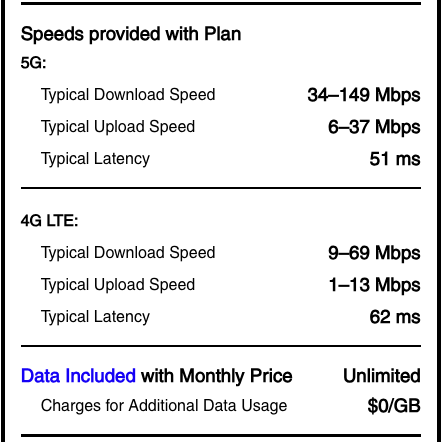
Source: Visible
So, are mandated mobile nutrition labels next? The FCC has already voted to require more transparency from cable and satellite TV providers so customers will no longer be straddled with what Biden has called “junk fees.” It would only make sense to bring the same scrutiny to the mobile industry, especially considering Americans waste $600 on cell phone services they don’t use.
Kevin Kearney
Sr. Staff Writer

Enter your address to find the best internet providers available in your area.

Related Articles


.jpg?w=160&h=160&usm=20&usmrad=0.8&fit=crop "Viasat vs Hughesnet Internet Plans Compared")
Related Topics
InternetPopular Topics
Internet Spectrum Internet Xfinity Research and Reports AT&T T-Mobile News Verizon MINTernet App ExplainersInternet Providers by State
- Internet in Alabama
- Internet in Alaska
- Internet in Arizona
- Internet in Arkansas
- Internet in California
- Internet in Colorado
- Internet in Connecticut
- Internet in Delaware
- Internet in District of Columbia
- Internet in Florida
- Internet in Georgia
- Internet in Hawaii
- Internet in Idaho
- Internet in Illinois
- Internet in Indiana
- Internet in Iowa
- Internet in Kansas
- Internet in Kentucky
- Internet in Louisiana
- Internet in Maine
- Internet in Maryland
- Internet in Massachusetts
- Internet in Michigan
- Internet in Minnesota
- Internet in Mississippi
- Internet in Missouri
- Internet in Montana
- Internet in Nebraska
- Internet in Nevada
- Internet in New Hampshire
- Internet in New Jersey
- Internet in New Mexico
- Internet in New York
- Internet in North Carolina
- Internet in North Dakota
- Internet in Ohio
- Internet in Oklahoma
- Internet in Oregon
- Internet in Pennsylvania
- Internet in Rhode Island
- Internet in South Carolina
- Internet in South Dakota
- Internet in Tennessee
- Internet in Texas
- Internet in Utah
- Internet in Vermont
- Internet in Virginia
- Internet in Washington
- Internet in West Virginia
- Internet in Wisconsin
- Internet in Wyoming


.jpg?w=280&h=280&usm=20&usmrad=0.8&fit=crop "Verizon Fios Internet vs. Optimum Internet")

.jpg?w=280&h=280&usm=20&usmrad=0.8&fit=crop "Viasat vs Hughesnet Internet Plans Compared")


.jpg?w=280&h=280&usm=20&usmrad=0.8&fit=crop "gFiber vs. AT&T Fiber: Which internet is better for you?")