After years of drafting and deliberation, the FCC broadband nutrition labels have finally arrived. Major internet service providers (those with over 100,000 subscribers) were required to publish their labels at the point of sale by April 10, 2024, and smaller ISPs will have to do the same by October 10, 2024.
The arrival of the labels, however, doesn’t guarantee their clarity. While we’re thrilled that the FCC took steps to provide consumers with transparency, we know that many people shopping for an internet plan will still be confused by the new labels.
In this guide, we’ll explain how to read the new broadband nutrition labels, highlighting the most important details, decoding internet industry jargon, and explaining how to keep your local ISP honest.
1. Look for hidden fees (so you can avoid them)
In 2022, a Consumer Reports study found internet shoppers often struggle to distinguish between legitimate and illegitimate fees. It’s not hard to see why: internet plans often bury vague fees for installations and price hikes in the fine print, hoping customers won’t find them.
The broadband nutrition labels, meanwhile, emphasize them. When you inspect a plan’s label, you’ll likely focus on the monthly price. But we suggest looking just below that number at a few essential aspects of the plan. In the fine print under “Monthly Price,” the label explains whether or not this is an introductory rate (i.e., a starting price that will jump during the contract) and whether the plan requires a contract.
If it is an introductory rate, you should investigate further to find the eventual price: some monthly payments can double throughout the course of a contract, blindsiding customers who’d only budgeted for the introductory rate.

Go down a bit further and you’ll see a list of “Additional Charges & Terms.” These are the charges that are often tacked on at activation and installation. Some of the charges are conditional. In the label above, for example, you won’t be charged a late payment or non-return equipment fee so long as you pay on time and return the hardware at the end of the contract. But beware of vague language like “enhancement fee” or “deregulation fee”: these are the kinds of junk fees the FCC is hoping to eliminate through the standardized label requirement.
Feel free to call an ISP if you’re confused about a potential fee. If they can’t give you a straightforward answer, we suggest shopping elsewhere.
2. Err on the side of caution
Rather than simply listing the fastest possible upload and download speeds for a plan, the broadband nutrition labels require ISPs to list the “typical” speeds users can expect. In theory, that means ISPs will provide honest information. In reality, we’re seeing a mixed bag.
While some ISPs include highly specific speeds, most of the nutrition labels we’ve seen include ranges, including some that are so wide that they’re unhelpful. In those cases, we suggest erring on the side of pessimism; don’t assume you’ll receive the top end of the reported range, even though it’s possible. It’s better to buy a plan with a firm understanding of its limitations rather than hoping for its absolute peak.

Keep in mind, too, that the fastest plan is not always the best plan. You’ll want to choose a plan that suits your household’s internet use. Casual browsers and streamers should be fine with 100Mbps and less, while gamers and work-from-home professionals will need faster-than-average upload speeds.
We recommend reimagining the FCC’s nutrition labels as something closer to the FDA’s. Think about how those food labels are organized: each item is measured by how much it fills your daily value. (That Snickers bar, for example, is 15% of your suggested daily fats.) If you’re an average internet user, consider 100Mbps downloads, 20Mbps downloads, and unlimited data to be your “Daily Value.” How much of that suggested amount does the plan you’re looking at provide you?
What’s in an internet speed?
- Download speed: his measures how quickly data travels from an ISP to your home. This is the best indicator of what you’ll experience as an internet user, because most online activity (like streaming video, gaming, or refreshing a feed) involves downloading. As of March 2024, the FCC has deemed anything above 100Mbps as “broadband” or “high speed.”
- Upload speed: his measures how fast data travels from your computer to your ISP or another device. Upload speeds are often much slower than download speeds on home internet plans. The FCC considers 20Mbps and faster to be “broadband” upload speeds.
- Latency: This is the delay between your computer sending a signal and receiving a response. Most people call this “lag,” which is a delay in service (like an online game or videoconference briefly freezing) caused by high latency.
- Data: This is any information you download or upload from the internet. Plans with data caps (as opposed to those offering unlimited data) limit the amount of information you can download or upload in a given month.
3. Compare ISP nutrition labels
would “ensure consumers can make side-by-side comparisons of various service offerings from an individual provider or from alternative providers—something essential for making informed decisions.” Unfortunately, the FCC has yet to make good on that promise and create a central database with every ISP’s labels. That’s where we come in.
The WhistleOut internet plan search was already a dynamic tool, allowing customers to find and compare plans available in their area. But since April 10, we’ve also been adding the data from every ISP’s nutrition labels so you can make the side-by-side comparisons the FCC wrote about back in 2022.
4. Read with a healthy dose of skepticism
he nutrition labels are a step in the right direction, but they’re still, unfortunately, a work in progress. Nearly half of the current labels do not adhere to the FCC’s requirements, according to Sascha Meinrath, a Penn State University professor who studies the telecom industry and worked on the labels' earliest iteration through his work with the Open Technology Institute. To date, some ISPs haven’t even released labels, a decision Meinrath calls “wanton non-compliance.”
Meinrath argues that part of the problem is the FCC itself, comparing the Commission to a “lackadaisical babysitter” who threatens punishment but never follows through. One of the biggest issues he sees with the current labels is that the “typical speeds” are reported by the ISPs themselves. “That is systemically problematic,” he said. “You have to trust but verify what these claims are.”
With that in mind, we suggest you use the labels as a guide rather than empirical evidence. We hope the FCC will eventually verify the ISP-reported data and punish those who defy the requirements or deceive consumers, but we’re not there yet.
5. Report non-compliant ISPs and suspicious speeds
If an ISP hasn’t posted broadband nutrition labels on their website, they’re in violation of the mandate. If your ISP reports faster speeds for your address than you’ve ever recorded with a speed test, they’re misleading consumers. As it stands, the only method for keeping ISPs honest is reporting non-compliant, deceptive, or suspicious behavior through the FCC website.
Are cell phone plan labels next?
For now, there are no concrete plans to require cell phone carriers to create anything like broadband nutrition labels. It does seem likely, though, that that will change in the near future. In March, the FCC voted to require cable and satellite providers to provide more transparent “all in” pricing, a move the White House praised as a step towards eliminating “junk fees.” Considering the amount of money Americans annually waste on cell phone services, we assume the wireless industry is next.
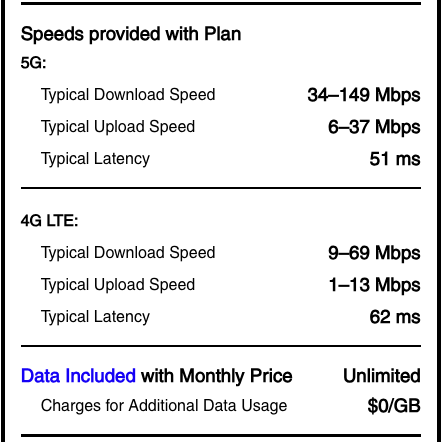
Some wireless carriers seem to agree. Visible, Cricket, Metro, and Mint have already released nutrition labels for their cell phone plans in anticipation, apparently trying to get ahead of the pack like Google Fi did back in October 2023.
Kevin Kearney
Sr. Staff Writer

Enter your address to find the best internet providers available in your area.

Related Articles


.jpg?w=160&h=160&usm=20&usmrad=0.8&fit=crop "Viasat vs Hughesnet Internet Plans Compared")
Related Topics
InternetPopular Topics
Internet Spectrum Internet Xfinity Research and Reports AT&T T-Mobile News Verizon MINTernet App ExplainersInternet Providers by State
- Internet in Alabama
- Internet in Alaska
- Internet in Arizona
- Internet in Arkansas
- Internet in California
- Internet in Colorado
- Internet in Connecticut
- Internet in Delaware
- Internet in District of Columbia
- Internet in Florida
- Internet in Georgia
- Internet in Hawaii
- Internet in Idaho
- Internet in Illinois
- Internet in Indiana
- Internet in Iowa
- Internet in Kansas
- Internet in Kentucky
- Internet in Louisiana
- Internet in Maine
- Internet in Maryland
- Internet in Massachusetts
- Internet in Michigan
- Internet in Minnesota
- Internet in Mississippi
- Internet in Missouri
- Internet in Montana
- Internet in Nebraska
- Internet in Nevada
- Internet in New Hampshire
- Internet in New Jersey
- Internet in New Mexico
- Internet in New York
- Internet in North Carolina
- Internet in North Dakota
- Internet in Ohio
- Internet in Oklahoma
- Internet in Oregon
- Internet in Pennsylvania
- Internet in Rhode Island
- Internet in South Carolina
- Internet in South Dakota
- Internet in Tennessee
- Internet in Texas
- Internet in Utah
- Internet in Vermont
- Internet in Virginia
- Internet in Washington
- Internet in West Virginia
- Internet in Wisconsin
- Internet in Wyoming


.jpg?w=280&h=280&usm=20&usmrad=0.8&fit=crop "Verizon Fios Internet vs. Optimum Internet")

.jpg?w=280&h=280&usm=20&usmrad=0.8&fit=crop "Viasat vs Hughesnet Internet Plans Compared")


.jpg?w=280&h=280&usm=20&usmrad=0.8&fit=crop "gFiber vs. AT&T Fiber: Which internet is better for you?")