
Unlimited 5G internet for as low as $50/month
- Fiber, 5G, and DSL plans
- Discounts for Verizon mobile customers
- Up to 940Mbps download speed
Verizon is one of the largest internet service providers in the nation, offering wireless, fiber, and DSL plans. With download speeds reaching 940Mbps, it’s a good option for those who need fast service. While Verizon's fast speeds, unlimited data, and discounts for existing customers are impressive, its coverage footprint and prices could be improved.
Is Verizon Home Internet right for you? Let’s explore its plans, features, and coverage stack up against competitors like Xfinity and T-Mobile Home Internet to find out.
Is Verizon home internet right for you?
If you’re looking for fast speeds or are already a Verizon customer, Verizon Home Internet may be exactly what you’re looking for.
What we like
- Fast speeds
- Bundling discounts
- Unlimited data
80/100
Verizon home internet plans
Verizon Home Internet offers a variety of plans and prices via wireless (5G/4G LTE), fiber optic, and DSL connections.
Verizon’s 5G plans are offered in major metropolitan areas across the nation and consist of three offerings: Verizon 5G Home starting at $50/month, 5G Home Plus starting at $60/month. 5G Home Plus, and 5G Home Ultimate starting at $75/month. 5G Home Plus and Ultimate offer more perks than 5G Home, but both plans have download speeds averaging around 300Mbps.
|
Verizon

5G Home Ultimate
$75/mo
with AutoPay
|
|
Verizon
5G Home
$50/mo
with AutoPay
|
|
Verizon
5G Home Plus
$60/mo
with AutoPay
|
Verizon Fios (fiber optic) plans provide the highest download speeds of any Verizon Home Internet option, maxing out at 940Mbps. Starting at $50/month, some fiber plans are also cheaper than comparable 5G options. However, they are only available in certain metro areas of New England and the Mid-Atlantic.
|
Verizon Fios

300 Mbps
$30/mo
with AutoPay
+ $99 Upfront
|
|
Verizon Fios
myPlan + 300 Mbps
$30/mo
with AutoPay and any Verizon mobile phone plan
+ $99 Upfront
|
|
Verizon Fios
500 Mbps
$65/mo
with AutoPay
+ $99 Upfront
|
Most internet companies are moving away from DSL in favor of fiber, cable, and wireless connections. While Verizon still offers DSL to select areas, it’s an ever-shrinking footprint with slow speeds. Verizon's main DSL plan costs $75 for a year of service, but download speeds max out at 15Mbps.
What we like: Fast speeds
Verizon Home Internet offers fast speeds on many of its plans. This is especially true of its fiber options, which are 940Mbps. As for 5G, its options blow the competition out of the water, averaging 300Mbps on both plans.
What internet speed do I need?
We recommend most households have an internet download speed of at least 100Mbps. This provides most people with the speeds they need to do online tasks like work from home, play competitive video games, and stream in HD or 4K. Luckily, all of Verizon’s Home Internet plans exceed the 100Mbps benchmark.
Most households will be fine with the 300Mbps of Verizon’s 5G and lower-tier fiber plans. However, heavy internet users who do a lot of downloading or need instant connections should consider the 940Mbps of Verizon’s top fiber plan.
What we like: Verizon mobile discounts
In addition to offering internet, Verizon is also, of course, one of the largest cell phone carriers in the nation. Verizon’s mobile customers can qualify for major discounts on internet through the company. For example, Verizon’s basic 5G internet plan drops from $50/month to $35/month when combined with an eligible mobile plan and autopay.
|
Verizon Fios
300 Mbps
$30/mo
with AutoPay
+ $99 Upfront
|
|
Verizon Fios
myPlan + 300 Mbps
$30/mo
with AutoPay and any Verizon mobile phone plan
+ $99 Upfront
|
Visible (owned by Verizon) customers can also save on Verizon Home Internet. Those on the Visible+ and Visible+Pro plans get a $10/month discount, while those on the basic Visible plan will get $5/month off.
|
Visible

$25 Visible Plan
$25.00/mo
Taxes & Fees included
|
|
Visible
$30 Visible+ Plan
$30.00/mo
Taxes & Fees included
|
What we like: Unlimited data
All Verizon Home Internet plans come with truly unlimited data. There are no caps, and your speeds won’t slow down due to exceeding a certain amount of data.
What could be improved: Limited coverage
One of the biggest issues with Verizon Home Internet is that it is not widely available. Only major metropolitan areas and certain regions have the option to hook up. It’s not an option for rural internet customers. For more details, check out our availability section below.
What could be improved: Pricey plans
Verizon Home Internet can be a costly option. It's a great deal for Verizon mobile customers scoring a discount on their plan, but customers not already with Verizon may want to look elsewhere.
T-Mobile’s 5G plan is cheaper than both of Verizon’s 5G options. Customers interested in less expensive fiber alternatives can look into providers like Xfinity, Cox, and Google Fiber. However, remember that fiber coverage varies regionally. You may not have access to every provider and prices may vary depending on your location.
What could be improved: Wireless speed variations
You’ll notice that Verizon’s 5G home internet speeds average around 300Mbps. This is because the download speeds vary widely across plans.
Verizon’s 5G home internet runs on Verizon’s 5G cellular network, which makes it subject to the same temporary slowdowns that impact phone data speeds, such as network congestion. Since Verizon prioritizes mobile users over home internet users, your speeds may slow down if there are a lot of mobile users on your network.
Verizon also utilizes both its 5G and 5G Ultra Wideband towers for home internet coverage. The type of coverage you use impacts your speed. Depending on location and connection type, customers have reported download speeds as low as 80Mbps to as high as 1,000Mbps.
Luckily, this is only a problem with 5G internet connections. Verizon Fios (fiber) is a wired connection, so it doesn’t suffer from lagging speeds.
Verizon home internet availability
Verizon Home Internet has different coverage options depending on the type of internet service you want to use.
Verizon Fios
Fios (fiber optic) has the smallest coverage footprint of Verizon’s internet options. It is currently only available in the largest metro areas of eight eastern states (Delaware, Maryland, Massachusetts, New Jersey, New York, Pennsylvania, Rhode Island, Virginia) and Washington DC.
Verizon 5G Home Internet
Verizon’s 5G Home Internet is available across the nation, but like Verizon Fios, it is limited to metro areas. This is because it runs off Verizon’s 5G network, which is currently strongest in cities. While there is 5G mobile coverage in rural areas, it’s not yet strong enough to offer the stability a home internet connection requires. The sections of the map below that are saturated in purple are where Verizon 5G is available.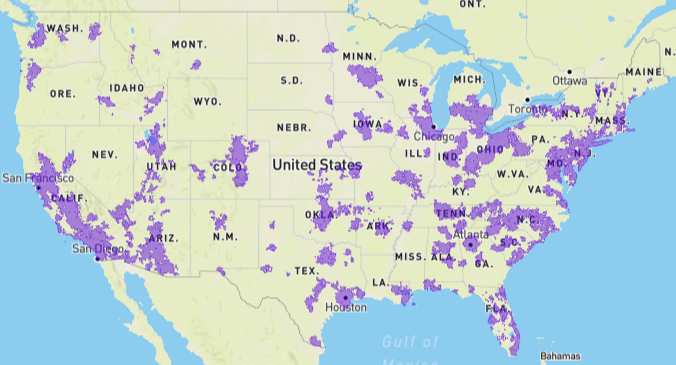
Verizon internet vs. competitors
We’ve looked into Verizon Home Internet; now let’s see how it compares with other 5G internet and fiber providers.
Verizon 5G Home Internet vs. T-Mobile Home Internet
Verizon and T-Mobile both offer 5G home internet service. Verizon offers the 5G Home and 5G Home Plus plans, while T-Mobile offers the T-Mobile 5G Home Internet plan.
- $50/month
- 100Mbps
- Limited coverage

- $50/month
- 200Mbps
- Larger coverage footprint
Verizon’s basic 5G Home plan and T-Mobile’s 5G Home Internet are two similar offerings. The Verizon 5G Home Plan is $50/month and offers an average of 100Mbps download speed. However, it’s limited to select cities across the nation because it needs Verizon’s 5G network infrastructure.
|
Verizon
5G Home
$50/mo
with AutoPay
|
T-Mobile’s 5G Home Internet plan is a serious competitor. Costing $50/month, it offers a larger coverage footprint than Verizon, so more people can hook onto its network. This is because T-Mobile also uses its 4G LTE network to fill in coverage gaps in its 5G service.
Using 4G LTE expands the map for customers, but it also limits speed. T-Mobile states the average speed for its 5G home internet is between 33–182 Mbps. That’s a pretty wide gap. You don’t want to spend $50/month on a slow speed, so check our map below to see the regions in the country where T-Mobile’s 5G network is strongest.
Verizon Fios Home Internet vs. Xfinity
Both Verizon and Xfinity offer fiber internet service. Two comparable plans are Verizon’s 1 Gig plan and Gigabit Extra plan.
- $89.99/month
- 940Mbps download speed
- Limited footprint

- $75/month
- 1,000Mbps download speed
- Larger coverage footprint
Verizon’s 1 Gig fiber plan is $89/month and offers top download speeds of 940/Mbps. That’s an incredibly fast speed at a decent price for fiber internet. However, Verizon has limited fiber infrastructure. It’s only available in select states in New England and the Mid-Atlantic.
|
Verizon Fios
myPlan + 2 Gig
$90/mo
with AutoPay and any Verizon mobile phone plan
+ $99 Upfront
|
Xfinity offers a slightly faster download speed at a lower price. Where Xfinity sets itself apart is its larger footprint. Xfinity is one of the largest internet providers and covers over 30% of the country. While most of its footprint is cable, it still has a large fiber network.
|
Xfinity

1 Gig + Unlimited
$90/mo
Internet price guaranteed for 5 years. Price includes $10/mo autopay and paperless discount.
|
Check out how Verizon stacks up to other home internet providers:
Verizon home internet bundles
Verizon offers discounts on cell phone and internet bundles. Customers can bundle their 5G home internet with Verizon's 5G Unlimited mobile plans to save on their monthly bill.
|
Verizon Fios
300 Mbps
$30/mo
with AutoPay
+ $99 Upfront
|
|
Verizon
myPlan + 5G Home
$35/mo
with AutoPay and any Verizon mobile phone plan
|
|
Verizon Fios
myPlan + 300 Mbps
$30/mo
with AutoPay and any Verizon mobile phone plan
+ $99 Upfront
|
|
Verizon Fios
myPlan + 500 Mbps
$65/mo
with AutoPay and any Verizon mobile phone plan
+ $99 Upfront
|
|
Verizon
5G Home Ultimate
$75/mo
with AutoPay
|
Should you switch to a Verizon internet plan?
If you want fast internet speeds, need a variety of connection types, and live in an area Verizon covers, Verizon Home Internet might be a great option for you. This is especially true if you’re a Verizon mobile customer and qualify for steep discounts on your internet service.
However, Verizon’s plans are also more expensive than some comparable plans. If you’re on a budget, you might consider shopping around for a plan that better serves your needs.
Methodology
When analyzing Verizon Home Internet, we compared it to similar providers. We looked at options and prices to determine which services offered the most value. We also dove into the features included with each product, including prices, speeds, and coverage. We will update our findings as necessary.
Max McCaskill
Sr. Staff Writer

Enter your address to find the best internet providers available in your area.

Related Articles


.jpg?w=160&h=160&usm=20&usmrad=0.8&fit=crop "Viasat vs Hughesnet Internet Plans Compared")
Related Topics
Internet VerizonPopular Topics
Internet Spectrum Internet Xfinity Research and Reports AT&T T-Mobile News Verizon MINTernet App ExplainersInternet Providers by State
- Internet in Alabama
- Internet in Alaska
- Internet in Arizona
- Internet in Arkansas
- Internet in California
- Internet in Colorado
- Internet in Connecticut
- Internet in Delaware
- Internet in District of Columbia
- Internet in Florida
- Internet in Georgia
- Internet in Hawaii
- Internet in Idaho
- Internet in Illinois
- Internet in Indiana
- Internet in Iowa
- Internet in Kansas
- Internet in Kentucky
- Internet in Louisiana
- Internet in Maine
- Internet in Maryland
- Internet in Massachusetts
- Internet in Michigan
- Internet in Minnesota
- Internet in Mississippi
- Internet in Missouri
- Internet in Montana
- Internet in Nebraska
- Internet in Nevada
- Internet in New Hampshire
- Internet in New Jersey
- Internet in New Mexico
- Internet in New York
- Internet in North Carolina
- Internet in North Dakota
- Internet in Ohio
- Internet in Oklahoma
- Internet in Oregon
- Internet in Pennsylvania
- Internet in Rhode Island
- Internet in South Carolina
- Internet in South Dakota
- Internet in Tennessee
- Internet in Texas
- Internet in Utah
- Internet in Vermont
- Internet in Virginia
- Internet in Washington
- Internet in West Virginia
- Internet in Wisconsin
- Internet in Wyoming


.jpg?w=280&h=280&usm=20&usmrad=0.8&fit=crop "Verizon Fios Internet vs. Optimum Internet")

.jpg?w=280&h=280&usm=20&usmrad=0.8&fit=crop "Viasat vs Hughesnet Internet Plans Compared")


.jpg?w=280&h=280&usm=20&usmrad=0.8&fit=crop "gFiber vs. AT&T Fiber: Which internet is better for you?")